





The Spanish entrepreneur visa costs €60 on paper. But if you get it wrong, you could end up losing over €15,000 on legal fees, waste six months waiting, and still get rejected with a generic form letter.
We’ve seen applicants submit polished pitch decks, glowing recommendation letters, and impressive resumes, only to realize those don’t move the needle.
What matters to ENISA reviewers is clarity, real viability, and whether your business genuinely brings something new to the market, not just another recycled SaaS idea.
If you want to avoid the usual traps, here’s how to apply smartly for the entrepreneur visa in Spain.
Spain entrepreneur visa: Explained
The Spain entrepreneur visa is a special residence permit aimed at non-EU citizens who want to launch and grow a business in Spain.
To qualify, your business idea must be considered innovative and add economic or social value. Spain’s government evaluates your proposal, mainly through Empresa Nacional de Innovación (ENISA), the entrepreneurship body, before approving it. This visa gives you the legal right to live and work in Spain while building your company.
It’s a good fit for:
- Founders planning to start a high-growth or tech-focused company
- Non-EU citizens without access to other EU visa options
- Entrepreneurs who want to base their operations in a European market
- Startup builders with enough funds to support themselves in Spain
- Business owners who need a visa pathway without needing a local job offer
Now that you know what the visa offers, the next question is: Why pursue it at all?
Why do you need an entrepreneur visa in Spain?
This is the line between being seen as a founder building in Spain and just another visitor with a laptop and a dream that stops at immigration.
Here’s what the Spanish entrepreneur visa actually lets you do:
- Live and work legally in Spain while building your startup
- Run a company as a solo foreign founder without needing a local partner.
- Apply through a fast-track process with shorter wait times and clearer steps
- Bring your spouse and children under one application
- Count your time toward permanent residency
- Access Spain’s startup networks, grants, and investor support
- Apply from within Spain if you’re already there on another visa
- Qualify by presenting an original, innovative business
If you’re serious about building something in Spain, this is your most practical starting point. Everything else adds more steps or more stress. But before you start packing, make sure you’re the kind of founder Spain is betting on.
Who is eligible for the Spain entrepreneur visa?
The entrepreneur visa comes with a bar to meet. If you’re applying, you’ll need to show that your business idea is viable, original, and backed by proper documentation.
Here’s what the eligibility checklist looks like:
You must be a non-EU/EEA citizen. The visa is designed for third-country nationals, and if you’re from the EU, you’ll need to take a different route since this visa doesn’t apply to you.
Your business idea must be truly innovative. ENISA expects ideas that bring something new to the table, such as tech-enabled, high-growth, or impact-driven models, not traditional brick-and-mortar businesses.
You need substantial financial resources. You must show at least €31,752 in savings for yourself, €11,907 for a spouse, and €3,969 per child, all with supporting bank documentation.
You need comprehensive private health insurance. Your policy should match Spain’s public system, with zero deductibles or co-payments, and be active from the day you arrive.
Your criminal record must be spotless. You’ll need a background check proving no offenses over the last five years in any country you’ve lived in; serious violations can result in rejection.
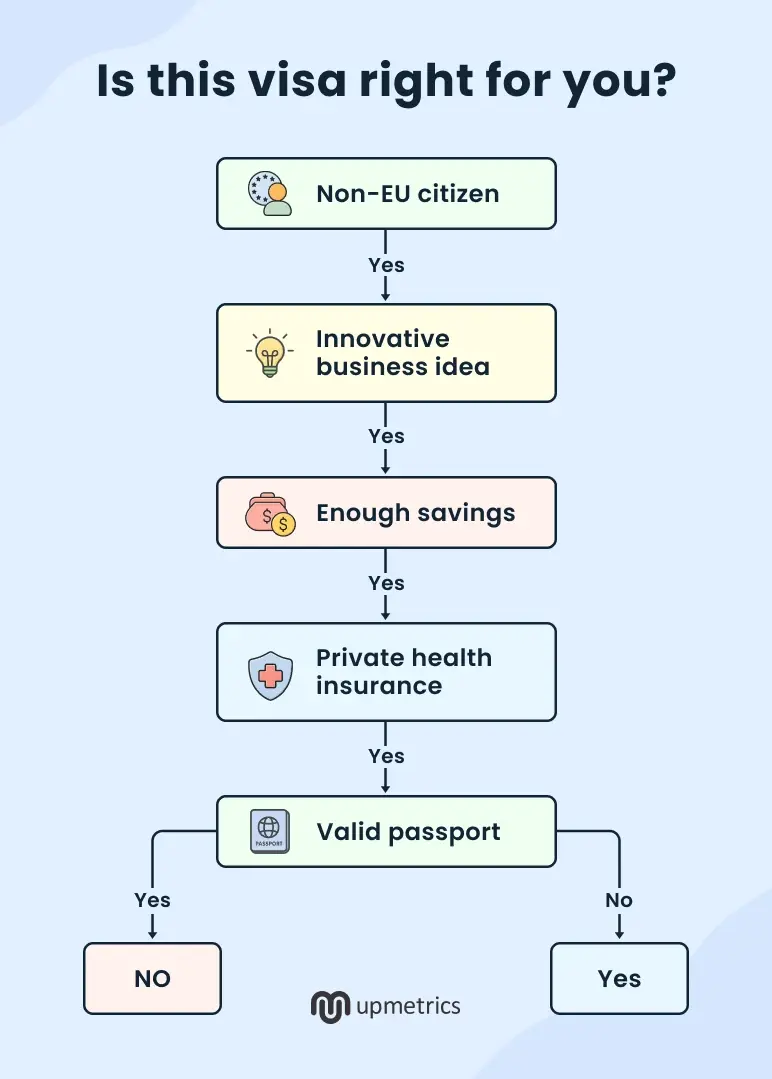
You’ve got the green light to apply. What happens next depends entirely on what you submit and how airtight it is.
Spain entrepreneur visa: Requirements
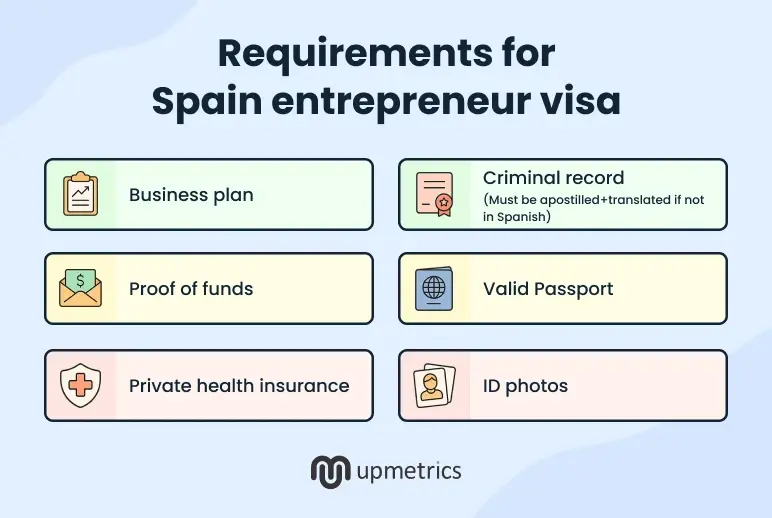
Your pitch deck might wow investors, but it won’t get you through immigration if the basics fall apart. A brilliant concept means little if you can’t show you have the funds, the paperwork, and a plan that doesn’t fall apart in a real-world scenario. They’re non-negotiables.
Let’s break down exactly what you’ll need to get approved.
1. Detailed business plan
Your business plan isn’t just part of the application—it is the application. Reviewers will use it to decide if your idea is serious, feasible, and worth backing with a visa.
Here’s what your plan needs to clearly show:
- What problem are you solving, and how?
- Is there real demand in Spain or the European Union?
- Can this business actually make money and grow?
- Do you have the skills and experience to pull it off?
And yes, it has to match what ENISA cares about: Innovation, the potential to boost Spain’s economy, and some job creation.
If you’re not sure where to start, Upmetrics offers business plan writing built for this exact purpose. It keeps things structured, aligned, and actually readable.
Spain’s visa reviewers expect a real business plan
We write plans that pass and actually mean business

2. Proof of financial resources
To get a residency permit, you’ll need to prove you’re financially ready to survive the startup grind without relying on public support. Here’s what you’ll need to show:
- €31,752 for yourself as the main applicant
- €11,907 if you’re bringing a spouse
- €3,969 per child
This is a one-time proof of funds requirement, not a monthly income. The amount should be clearly documented in a bank statement or official financial certificate.
3. Private health insurance
You need a private health insurance policy that gives you full coverage from day one in the country. It must cover everything that Spain’s public healthcare system does, such as general care, hospital stays, emergencies, etc., without any deductibles or co-pays. If you have to pay out of pocket for any covered service, that plan won’t qualify.
The insurance provider also has to be officially recognized to operate in Spain. If you’re applying from abroad, double-check that your policy is accepted locally.
Your coverage must begin the moment you enter Spain, not after a few weeks or once your visa is approved. The immigration authorities want to see that you’re protected from the start and won’t be a burden on the public system.
Spain’s Ministry of Health (for recognized insurers): https://www.mscbs.gob.es
So yes, get the paperwork right, but make sure the policy itself actually fits the requirements.
4. No criminal record
For the entrepreneur visa in Spain, you’ll need to show a clean criminal record covering the past five years from every country you’ve lived in, not just your home country.
Most consulates only accept background checks issued within the last 90 days, so time it right. You’ll also need to get it apostilled or legalized, depending on where it’s from. And in many cases, you’ll need to get a sworn translation into Spanish before submitting it.
Apostille info: https://www.hcch.net/en/instruments/conventions/full-text/?cid=41
Some consulates may even ask for fingerprint-based checks, so check their specific checklist before you start. Even a minor charge could raise flags and slow down your application.
5. Valid passport & ID photos
Your passport must be valid for at least 12 months from the time you apply. If it’s going to expire soon, renew it first.
You’ll also need two recent passport-size photos. They must follow Spain’s biometric standards: White background, neutral expression, no headgear or glasses, and a full face visible. These photos go on your residence card, so if they don’t meet the specs, your file may get flagged or rejected.
Most consulates post their exact photo guidelines, so check before you walk into an appointment with the wrong ones.
With the basics in place, let’s get into the process of the application.
Spain entrepreneur visa: Application process
It’s not the hardest visa on earth, but it’s detailed enough to trip you up if you’re not careful. If you get even one step wrong, your approval chances become thin.
So here’s how to get it done right.
Step 1: Prep every single document
As we covered earlier, the documentation is the backbone of your application. Start by collecting everything you’ll need in one go:
- A business plan that aligns with ENISA’s evaluation standards
- Proof of funds (bank statements or official financial documents showing the required minimum)
- Full private health insurance with no deductibles or co-pays
- Clean criminal record certificates from every country you’ve lived in over the last five years
- A valid passport with at least one year of validity remaining
- Two recent passport-sized photos on a white background
Also, check your local consulate’s checklist carefully, as many require sworn translations or apostilled documents.
Step 2: Choose your route: Inside or outside Spain
There are two ways to apply:
- If you’re already in Spain legally (on a tourist visa or any other legal stay), you can apply from within the country through Spain’s Large Business Unit (UGE) online portal.
- If you’re applying from abroad, submit your application through the nearest Spanish consulate in your country. Each consulate may have a slightly different process, so double-check their checklist.
Step 3: ENISA reviews your idea
ENISA (Empresa Nacional de Innovación S.A.) is going to pick apart your business plan, so it better be good. They want innovation, economic value, and proof you’ll create jobs. Generic ideas get rejected fast.
Make sure this is airtight, as your entire visa depends on convincing them your business is worth the reviewer’s time.
Step 4: Wait for the verdict
Once ENISA approves your plan and the government reviews your documents, you’ll usually get a decision in 20 to 30 working days.
Once your application is submitted and complete, Spain’s immigration law grants approval by default if there’s no official response within 20 working days under Spain’s positive administrative silence rule. (Yes, really.) But this rule only applies if all your documents are in order and the application is considered valid.
Step 5: If approved, get your residence card
Once your application is approved, there’s still one final step to make it official. What happens next depends on where you submitted your application:
- If you applied from abroad: Visit the nearest Spanish consulate, collect your stamped visa, and enter Spain using that document.
- If you applied from within Spain: You’ll receive confirmation of your residence authorization, and within 30 days, you must visit your local immigration office in Spain to apply for the Tarjeta de Identidad de Extranjero (Foreigner Identity Card).
Make sure you book your appointment early. These slots fill up fast, especially in cities like Madrid or Barcelona.
How much does the Spain entrepreneur visa cost?
The visa application fee is small, around €80, but the full process isn’t exactly cheap. Here’s what you might spend to get everything in order:
Estimated costs
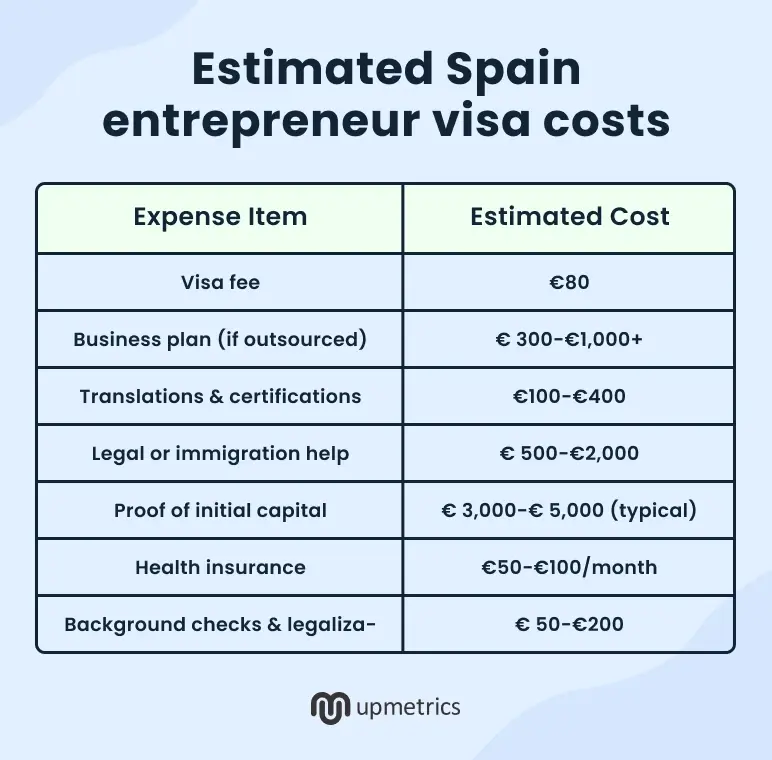
These numbers vary depending on where you’re applying from, how many documents you’re submitting, and whether you get professional help. Budget at least €1,500–€3,000 in extra costs, more if you’re not doing it all yourself. The application fee is the smallest part of the bill.
How long does it take to get the visa approved?
Officially, the Spain entrepreneur visa takes about 20–30 working days for review once your application is submitted. But in practice, the entire process, from document prep to approval, can take 3 to 5 months.
That includes delays from consulate backlogs, missing paperwork, or follow-up requests. As mentioned earlier, if you don’t hear back within the review window, the positive administrative silence rule may apply.
Quick tip: Don’t quit your job or make big plans until the visa’s officially approved.
How long does the entrepreneur visa last? Can it be renewed?
The Spanish entrepreneur visa is initially valid for 3 years. After that, you can renew it for another 2 years as long as your business is active, compliant, and financially stable.
Renewal requires proof that:
- Your business is still running and aligned with the original plan
- You’ve met the job creation or economic contribution goals
- You continue to meet income, insurance, and legal requirements
Once you hit 5 years of legal residence, you may become eligible for long-term residency.
Mistakes to avoid when applying for a startup visa
Applying for a startup visa in Spain involves several moving parts, and small errors can lead to long delays or outright rejection. Here are some common mistakes people make (and how to avoid them):
1. Submitting a vague or weak business plan
Generic ideas or overestimated projections won’t hold up. Your plan must show market potential, financial feasibility, and alignment with what ENISA looks for, i.e., innovation, job creation, and economic contribution.
2. Skipping document formalities
Every consulate has slightly different requirements, so don’t assume the basics will be enough. Some documents must be translated into Spanish, apostilled, or legally certified. So, even if you skip one step, your application could be flagged as incomplete.
3. Not proving you can support yourself financially
Undocumented funds or vague financial letters won’t be enough to show you have the funds to live in Spain without relying on public support. You must have bank statements or official proof of income that match the required amounts.
4. Misunderstanding the “administrative silence” rule
While it’s true that Spain sometimes grants approvals by default if there’s no reply within 20 working days, this only applies to complete and valid applications. If anything is missing, the timeline resets or leads to rejection.
5. Delaying paperwork or appointments
Some consulates have long wait times for appointments, and official documents can take weeks to prepare. Don’t wait until the last minute to start gathering what you need. Work backwards from your target date and give yourself buffer time.
6. Not following the consulate’s exact checklist
Using a generic list from another source is a risky move, as each Spanish consulate may ask for slightly different documents or formats. Always check their specific requirements before submitting.
This process rewards preparation. Take the time to double-check everything before submission. Missing details don’t just slow you down; they can shut the door to getting a Spanish startup visa completely.
Need help with your business plan?
You’ve got the idea and the drive. But writing a plan that passes Spanish scrutiny while showing you’ve thought everything through is a different skill.
Upmetrics helps you write a business plan that’s sharp, structured, and ready to submit. Use our platform to build it yourself, or work directly with our experts to handle the heavy lifting. Either way, you’ll end up with a business plan that supports your Spain visa application instead of slowing it down.
Spain’s visa reviewers expect a real business plan
We write plans that pass and actually mean business