




Starting a business sounds exciting.
But if you’re honest with yourself, it also feels a little overwhelming, especially in the U.S., where rules, tariffs, and requirements seem to change every other week. One day, it’s a new license, the next, it’s paperwork you didn’t even know existed.
I’ve seen business owners get stuck here. Some even gave up halfway because the process felt too complicated. And that’s exactly why I wrote this guide: To save you from that confusion.
I’m a business consultant who has worked with hundreds of entrepreneurs trying to set up in the U.S., including right here in Florida. I know the hurdles, I know the shortcuts, and I know what actually works.
So if you’ve been asking yourself, “How do I start a business in Florida?” This blog is for you.
Let’s break it down together, step by step.
Why I call Florida one of the best places to build a business in 2026
Florida is called the Sunshine State, but what matters for business is how its geography shapes the economy. Being a peninsula with ports on both coasts makes it a hub for trade and logistics.
Add millions of tourists visiting each year, and you’ve got steady demand for hotels, restaurants, entertainment, and real estate. That’s why Florida keeps creating openings for smart entrepreneurs.
I’ve worked with many entrepreneurs here, and the pattern is clear: Visitors need places to eat and stay, ports need workers and services, and new neighborhoods need shops and solutions.
Thus, if you’re looking to get started in a business in Florida, knowing these numbers and trends before you start gives an edge. Here’s a quick snapshot of Florida’s business landscape:
| Metric | Value (Approx.) |
|---|---|
| Population (Total) | 24 million |
| Male/Female Split | 49.13% Male 50.87% Female |
| GDP Contribution | 5.8% |
| Per Capita Personal Income | $57,317 |
| Tax Structure: Personal Income Tax | None—Florida does not impose a state personal income tax. |
| Contribution to national tax | 6.38% |
| Unemployment Rate | 3.6% |
| Best Business Sectors | Tourism & Hospitality; Trade, Transportation & Utilities; Professional & Business Services; Real Estate; International Banking; Life Sciences; Aerospace & Defense. |
My step-by-step guide to starting a business in Florida
These are the same steps I’ve seen real entrepreneurs use to launch and grow successfully. Follow them, and you’ll have a clear path to building your business:
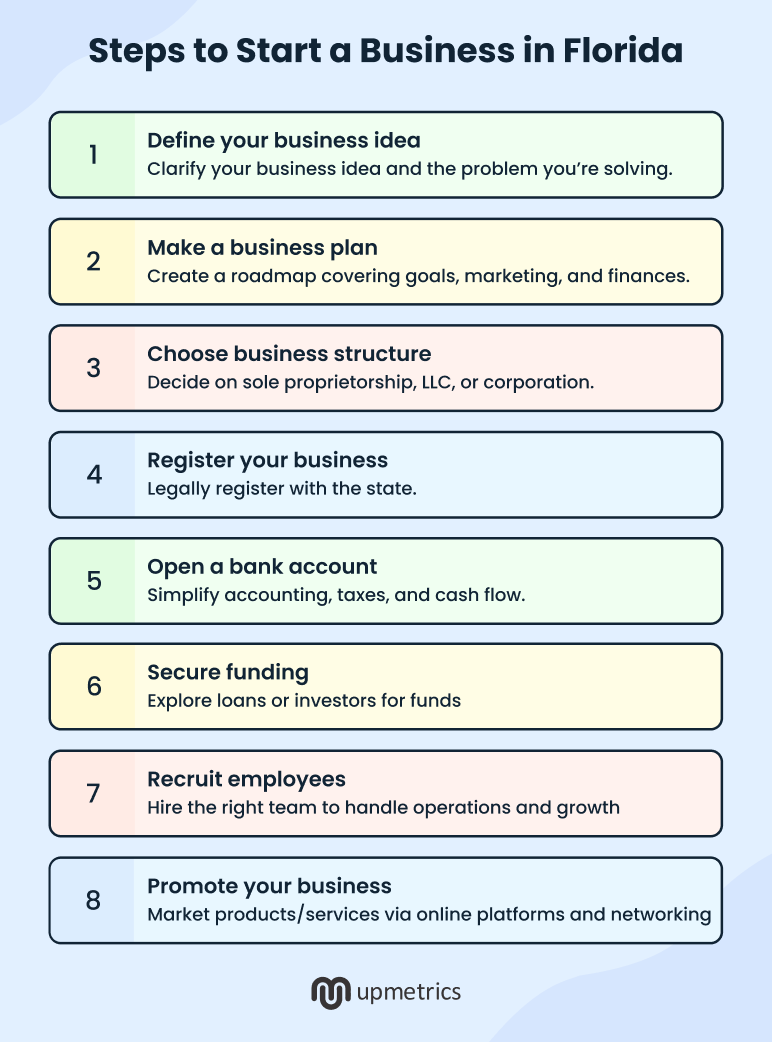
Step 1: Define your business idea
So, what does “define your business idea” really mean? It’s about clearly defining the purpose of your business, like:
- What problem are you solving?
- Who exactly are you solving it for?
- Why will anybody need it?
When you’re clear on your destination, every other path becomes easier. Your setup, planning, marketing, and growth will flow much more smoothly.
However, sometimes your idea might feel commonplace, such as selling clothes. Lots of people do that, right? So you might wonder, “Does that mean my purpose is the same as everyone else’s?” Not at all.
In businesses like this, what you define is how you’re different. Maybe you’re selling only sustainable products, or your designs have a unique story, or you serve a market others overlook.
That difference becomes the base of your business. From there, you’ll shape everything else, your products, marketing, and even how you grow.
Step 2: Make a business plan
I know what you might be thinking: “Do I really need to get into all this planning stuff?” Honestly, this is the step most people want to skip because it sounds boring. Who wants to sit and write research notes or map out a plan?
But here’s the thing: A solid business plan keeps both your present and your future on track. It doesn’t have to be complicated or fancy, and you’re not reinventing the wheel.
It’s really a simple process that shows you where you’re going and how to get there. Especially when you’re starting a business in Florida, a solid business plan can keep you grounded in the wind.
Remember, Florida’s market leans on tourism, so challenges, like a pandemic or sudden shifts in travel, can flip things fast. Having a clear plan helps you steady the ship and keep moving forward.

Now, you might be thinking, “Okay, I’ll draft a plan and do some research… but where do I even start?” Don’t worry—I’ve got a shortcut.
Upmetrics’ founder, Vinay, has put together a clear, step-by-step guide to writing a business plan that walks you through the whole thing. Follow that method, and you’ll have everything you need on paper; no fancy reinvention is required.
Further, if you still find it tricky to get started or you just don’t have the time, you can use ready-made business plan templates. It will make your life easier and help you craft business plans quickly.
Say goodbye to boring templates
Build your business plan faster and easier with AI
Plans starting from $14/month

Step 3: Choose the right business structure
I feel like this is one of those steps many business owners take lightly, but it’s actually really important. Let me explain with an example: A friend of mine started a small café in Tampa and registered it as a sole proprietorship.
Everything went smoothly—until a customer slipped and got hurt. Because the business wasn’t registered as an LLC, my friend was personally liable and had to cover the medical costs from his own pocket.
The takeaway? Make sure to choose the right business structure from the start; it can save you time, money, and stress later. Here are the main types of business structures you’ll likely consider:
- Sole Proprietorship
- Partnership
- Limited Liability Company (LLC)
- Corporation (C-Corp or S-Corp)
- Cooperative
If you want to dive deeper and figure out which structure is best for your business, feel free to check out the comprehensive article on types of business structures prepared by my team.
Nevertheless, in Florida, I usually recommend LLCs for small businesses. They’re simple to set up, flexible, and provide liability protection without the complicated paperwork of a corporation. Here’s the process to choose an LLC for your business structure:
| What to Do | Documents Required | Where to Go/Apply | Fees |
|---|---|---|---|
| Choose a Business Name | None (just check availability) | SunBiz.org—Name Search | Free |
| Appoint a Registered Agent | Registered Agent consent form | Can act as your own or hire a service | Varies ($50–$200 if using a service) |
| File Articles of Organization | Articles of Organization | Submit online via SunBiz.org | $125 |
| Create Operating Agreement | Draft Operating Agreement | Keep with your records | Free (if DIY) |
| Obtain EIN | Form SS-4 | IRS website | Free |
| Apply for Business Licenses / Permits | Varies by business type | Local county office or DBPR | Varies by industry |
| Maintain Compliance | Annual report | SunBiz.org | $138 annually |
Whether you’re opening a boutique, freelancing, or running an online store, an LLC gives you a solid foundation to grow safely.
Step 4: Register your business with the State of Florida
Alright, you’ve got your idea and a solid plan, now it’s time to make it official. Remember, it’s not just paperwork in Florida; it’s an important step that provides you permission to do legal business.
Thus, to get started, legally begin with licensing and permits. Every type of business has its own set of licenses or permits. Miss one, and you could end up with fines or even get shut down.
I’ve seen new owners rush to open their doors, only to find out later they weren’t cleared to sell food, cut hair, or build a deck. Save yourself that stress.
Common Florida Businesses & Their Permits:
| Business | Licenses/Permits You’ll Likely Need |
|---|---|
| Restaurant or Café | Food service license from the Florida Health Dept, local business tax receipt, and maybe a zoning or building inspection. |
| Salon or Barber Shop | A cosmetology or barber license from DBPR, plus your county or city tax receipt. |
| Contractor (Plumbing, Electric, etc.) | A contractor’s license from DBPR and building permits for each job. |
| Retail Store | A seller’s permit for sales tax, a local business tax receipt, and a certificate of use if you’re renting space. |
| Home-Based Business | Usually, a simple business tax receipt — just check your city’s zoning rules first. |
If you need deeper insights into the licensing and permitting process, my team has created a comprehensive guide for small businesses. Check out, I’m sure it will make your licensing process easy and smooth.
Let’s take a quick overview to register your business in Florida:
- Choose name
- Appoint a registered agent
- File documents
- Create an operating agreement
- Get Employee Identification Number (EIN)
- File BOI report
- Apply for a tax receipt
- Stay compliant
Step 5: Open a business bank account
Okay, here’s where a lot of new owners get lazy; they start mixing business money with their personal account. Don’t do that.
A separate business bank account is a must; it keeps your books clean, makes taxes way easier, and protects you if something ever goes wrong legally.
So, what kind of account should you open?
Start simple with a business checking account; that’s the workhorse. If you expect to hold money for a while or build savings, you can add a business savings account later.
As for banks, Florida has plenty of good options. If you want big names with lots of branches, try Bank of America, Wells Fargo, or Chase; they all have small-business packages. Here’s the document you may need to open a business bank account:
- Business formation papers
- EIN confirmation from the IRS
- Operating agreement or bylaws
- Business license or tax receipt from the State
- Personal ID
- Partnership agreement (if you have partners)
Step 6: Secure funding for your Florida business
Alright, let’s talk money. You’ve got your idea, a plan, and even a bank account—now you need cash to actually get this thing off the ground. I’ve seen so many business owners say, “I’ve got enough capital, I’m good.”
But when they finally start running the business, they realize their money isn’t stretching as far as they thought. Because funds aren’t just for buying materials, they touch almost every part of your business, like:
- Hiring
- Day-to-day expenses
- Stationery
- Salaries
- Rents
- Bills
That’s why planning your funding early is important; it saves you from scrambling later and keeps your business moving without stress. Here are some smart ways people I’ve worked with in Florida pull funds together:
| Type of Funding | What It Is (Short) | Time to Access | Typical Amount |
|---|---|---|---|
| Personal savings | Use your own money; the fastest way to start. | Immediate | Whatever you’ve set aside |
| Friends & family | Loans or investments from people you know; set clear terms. | A few days to weeks | A few hundred to tens of thousands |
| Small business loans | Bank or credit union loans for start-ups. | 2–6 weeks (depends on paperwork) | $5,000–$250,000+ |
| SBA loans | Government-backed loans through banks; good rates. | 4–8 weeks | $30,000–$5M |
| Microloans & grants | Small loans or free grants from Florida SBDC or community programs. | 2–8 weeks | $500–$50,000 |
| Investors / Angels | Equity investment in scalable businesses. | 1–3 months (pitch & due diligence) | $25,000–$500,000+ |
Remember, if you’re aiming for SBA loans or investors, make sure you have a solid business plan, keep your finances tidy, and prepare a pitch deck that really stands out.
Need help to get funded?
Create a leader-ready business plan using Upmetrics
Step 7: Recruit and onboard employees
Think you can run your Florida business solo? Sure, you can start that way, but real growth depends on the right team.
Hiring the right people helps your business:
- Grow efficiently
- Improves productivity
- Ensures your team can handle new challenges as you scale
To get started, you need to register yourself as an employer first and get your EIN. The next step when hiring your first employee in Florida ensure you fill out a W-4 form, also called the Withholding Exemption Certificate.
This form determines how much federal income tax should be withheld from the employee’s paycheck.
Once that’s done, you can start posting your job openings on local job boards and community college career centers. online platforms, like Indeed or LinkedIn, to find the right talent.
Remember, if you’re hiring your first employee in Florida, make sure you report every new hire to the Florida Department of Revenue using the Florida New Hire Reporting Form.
Step 8: Promote and market your Florida business
You can build the best product, but if nobody knows it exists, what’s the point? Promoting your business in Florida is crucial because the competition is always sharp. If you don’t get yourself seen, someone else will.
Hence, here are the types of promotions that really work in Florida:
1) Build a website
Your website serves as your online storefront, and many people will check it out before visiting your establishment. Make it simple to use, unambiguous, and highlight your unique selling points. Provide visitors with your location, services, hours, and excellent photos so they can quickly determine your professionalism and dependability.
Moreover, add professional photos, maps, and keywords like “Orlando catering service” or “Tampa fitness studio” so customers nearby can find you fast.
2) SEO
Ensure your business shows up when someone Googles “restaurant near Miami Beach” or “best salon in Tampa”. Additionally, keep your info updated, like hours, address, and photos, so people instantly trust what they see.
3) Event marketing & local partnerships
Pop-up booths, fairs, markets, and regional celebrations allow you to meet people face-to-face and quickly establish trust. Don’t be bashful; take a booth, shake hands, and introduce yourself as the brand’s face.
Social media is now the next important element that will assist you in marketing and promoting your goods and services in Florida. Here are some pointers to get you going:
Now, the next big factor that will help you promote and market your product and service in Florida is social media. Here are a few tips to get you started:
- Join Florida-based Facebook groups and community pages, tag your city in posts, and use local hashtags like #MiamiSmallBusiness or #MadeInTampa.
- Use LinkedIn to position yourself as an authority in your field and engage with other Florida professionals.
- Answer valuable questions on Reddit to showcase your expertise and build trust.
- Create an account on X (formerly Twitter) to share updates, insights, and local events.
- Set up WhatsApp communities or channels to promote your products directly to interested customers.
The bottom line
I get it, looking at all these steps at once might feel like a lot. But it’s really not. Once you take it one step at a time, the whole process flows, and before you know it, you’ll be running your business in Florida with confidence. In this blog, I’ve shared deep insights into Florida’s business environment and shared proven steps to start a business in Florida.
Thus, getting started shouldn’t be a challenge for you anymore; however, what I suggest is: Before you dive into your business, take time to map out a clear plan. Yes, it may be time-consuming, but tools like Upmetrics can make things easy for you using AI.
Apart from business planning, we can also help through financial forecasting, strategic planning, and pitch deck designing. Make sure to take advantage of all these features to make your start easy and smooth in Florida.
Wishing you the best for your future endeavors!
The Quickest Way to turn a Business Idea into a Business Plan
Fill-in-the-blanks, AI-assistance, and automatic financials make it easy.
