




I’ve lost count of how many people have told me they want to “start a digital marketing agency.” Honestly, I get it—low upfront costs, flexible work, and the chance to help brands grow online. But here’s the funny thing: Most of them freeze the moment they move past the idea.
I’ve asked a bunch of would-be agency owners the same question: What’s stopping you? And the answers are always familiar:
- “I don’t know how to get clients.”
- “Everyone’s already doing it—how will I stand out?”
- “Do I need to hire a team right away?”
- “What if I don’t get results for clients?”
But here’s the part no one tells you—it’s not as complicated as it looks. Sure, there are moving parts (services, pricing, outreach, delivery), but when you break it down step by step, starting an agency feels a lot less overwhelming.
That’s exactly what I’ll do in this guide. I’ll walk you through everything—from choosing your niche and setting up your business legally to finding your first clients and scaling smart.
By the end, you won’t just “think about” starting an agency. You’ll actually know how to start a digital marketing agency, launch it confidently, without second-guessing every step.
Let’s begin!
Key Takeaways
- Choose one niche to stay focused and attract the right clients.
- Make a simple plan, including your service offerings, prices, and goals.
- Set up basic systems to manage your projects and finances.
- Do great work and keep your clients happy to grow your agency.
11 Easy steps to start a digital marketing agency
Starting a marketing agency can feel overwhelming, but it doesn’t have to be. From what I’ve seen, it’s much easier when you break things into clear, doable steps instead of trying to do everything at once.
In this guide, I’ll walk you through the process, starting with your first idea and going all the way to signing clients and building a business that actually lasts.
Step 1: Choose a type of marketing agency
Before you get into the details of setting up your agency, the first step is to decide what kind of digital marketing agency you want to run. This choice will shape everything—what services you offer, the clients you go after, and even how you promote yourself.
One thing I often see is: Beginners try to do it all at once—SEO, ads, social media, design, email, and more. It might sound good, but in reality, it just makes things messy and harder for clients to believe you.
Here are some common agency types you can start with:
- SEO agency
- Content marketing agency
- PPC/ads agency
- Social media agency
- Email marketing agency
- Influencer marketing agency
- General marketing agency
That’s why, early on, it’s way better to start with one or two main services that you’re most confident in. This makes it easier for you to explain what you do, get the right kind of clients, and build trust faster.
Later, once you’ve got solid results and happy clients, you can always add more services.
Step 2: Pick a specific niche
One of the fastest ways to stand out as a new agency is by choosing a niche. I’ve seen many beginners try to pitch themselves as “we do SEO, social media, and ads for all kinds of businesses.”
The problem? It sounds generic, and suddenly you’re competing with every other agency out there.
A real estate agent, an e-commerce store owner, and a local gym don’t have the same problems. Their goals are completely different, and if you try to serve them all at once, your message gets lost.
So, I think the better approach is to focus on one type of business where you already have an edge. Ask yourself:
- Have I worked in a specific industry before?
- Do I already know how marketing works in that space?
- Is there a rapidly expanding market in which I could focus?
For example, if you’ve worked in property management, real estate agencies could be a natural fit. If you’ve run e-commerce ads before, then online stores make sense.
And even if you don’t have deep experience yet, you can still pick a niche that interests you and commit to learning as you go.
The key is specialization. It makes your message clearer, your services more relevant, and your pitch easier for clients to believe.
Step 3: Analyze your market
Once you’ve chosen a niche, understand the market you’re stepping into. I’ve noticed many new agency owners skip this part and rush straight into building a website or designing a logo.
But the problem is: If you don’t know what other agencies are offering, how they’re pricing, and where they’re weak, you risk blending in or underpricing yourself.
The good news is, market research doesn’t need to be complicated. You don’t need a 50-page report. A few hours of focused work is enough to get insights that give you an edge. Here’s a process I’ve found works well:
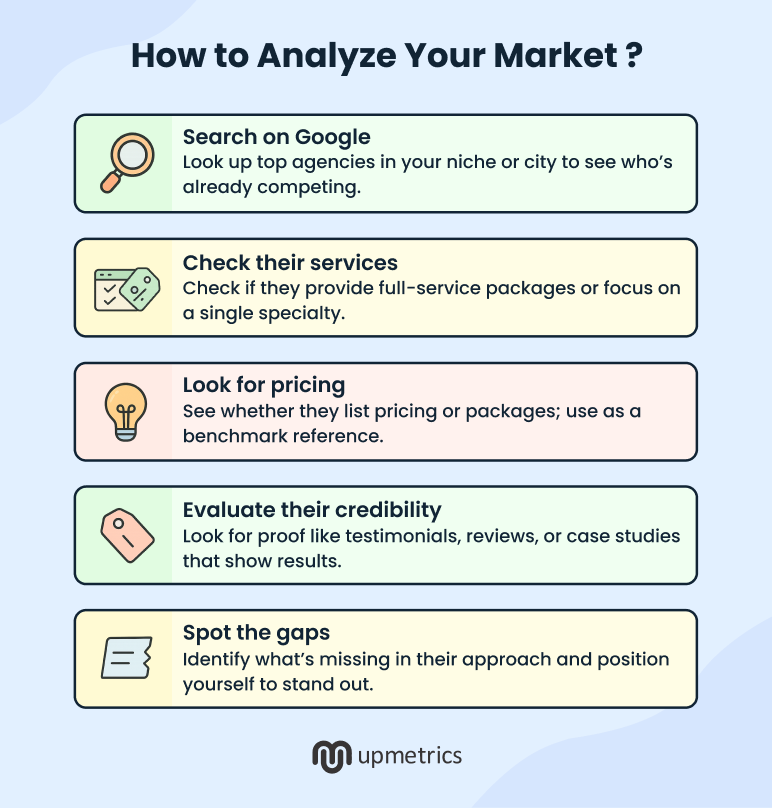
One thing I’ve noticed is that many agencies focus on designing sleek websites but forget to show real results. That gap creates an opportunity. Even two or three strong testimonials or a small case study can instantly make a new agency more appealing.
To keep this research structured, I usually suggest setting up a simple spreadsheet with three columns: Competitor strengths, weaknesses, and opportunities for us. For instance:
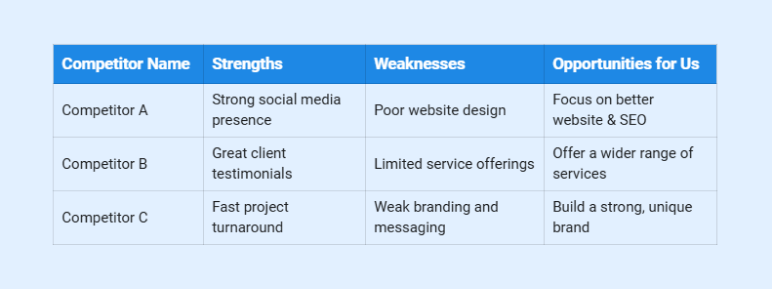
This exercise doesn’t take long, but it makes the gaps in the market obvious and shows where you can stand out.
Step 4: Write a simple business plan
Before you start developing a website or attracting your first client, it’s worth writing a business plan. I don’t mean a formal 40-page document for investors. Just a basic blueprint that keeps you focused and helps you avoid guesswork later.
Here are the basics I’d suggest including:
| Key elements | Description |
|---|---|
| Goals | Be specific. Set measurable targets, e.g., “sign 6 clients in 6 months” or “reach $6,000 monthly revenue.” |
| Target market | Define who you’ll serve, such as local service businesses or Shopify e-commerce stores. |
| Service focus | Decide which services solve urgent client problems. Start with 1–2 high-demand services, like SEO or paid ads. |
| Startup budget | Plan for basics: website setup, marketing tools, and legal registration. Expect around $200–$500 to start. |
| Financial projections | Outline expected revenue and expenses to see when the agency becomes profitable. |
Writing this down doesn’t take long, but it gives you a direction that makes every next step easier. This will even help you avoid overcomplicating things and keep you focused on building a profitable agency instead of just looking busy.
In fact, I’ve found that a one-page business plan is more than enough in the early stages. It gives you clarity, helps make informed decisions, and stops you from wasting time on things that don’t really move the needle.
Unsure how to draft your plan? Need a little extra help?
Write a solid plan faster with our AI Business Plan Generator
Plans starting from $14/mo

Step 5: Register your business and handle the legal basics
This is the part that many new agency owners procrastinate on because it feels intimidating. I’ve been there myself—paperwork and legal setup don’t sound nearly as exciting as landing that first client.
But the truth is: Registering your business is a lot simpler than most people expect. And once it’s done, it instantly makes you look more professional and credible in front of clients.
Here’s how you can get it done in the U.S.:
Choose a business structure
When starting your agency, choosing the right business legal structure is an important step. Many new agencies go with a Limited Liability Company (LLC) because it’s simple to set up, protects your personal assets, and makes taxes easier to manage.
Get an Employer Identification Number (EIN)
Apply online through the Internal Revenue Service (IRS). It’s free, takes only a few minutes, and serves as your official business ID for taxes and banking. I remember being surprised at how quick this step actually was.
Open a business bank account
Keeping personal and business money separate isn’t just good practice; it’s a lifesaver during tax season. I learned the hard way that mixing accounts only creates headaches later—clients also take you more seriously when payments go to a business account.
Set up accounting
You don’t need to hire an accountant right away. At first, tools like QuickBooks, Xero, or free options like Wave are more than enough in the beginning.
Although the entire process often takes less than a week, the results are substantial. Clients are far more likely to sign contracts and send payments to a registered business than to an individual’s personal account.
It’s one of those small steps that boost your confidence and prepare you for smoother growth in the future.
Step 6: Start solo or build a small team
Most digital marketing agencies start solo—and that’s often the smartest way to learn the ropes, handle your first clients, and understand how your business runs.
But as you grow, doing everything yourself becomes unsustainable. That’s when freelancers become key. Use platforms like Upwork, Fiverr Pro, or your network to find experts who can take on:
- Design – For graphics, creatives, and ad visuals
- Copywriting – For websites, ads, and emails
- SEO – For audits, strategy, and optimization
- Paid Ads – For running Google and social campaigns
Outsourcing helps you maintain quality without burnout.
Once you hit 5+ steady clients, consider hiring full-time help. Most agencies start with an account manager to handle client communication, then gradually bring on specialists based on demand.
Step 7: Get the essential tools
Without the right tools, running a digital marketing agency quickly turns into chaos. I’ve seen too many new agencies rely on spreadsheets and messy email threads—only to end up missing deadlines and confusing clients.
Choosing the right tools helps you stay organized, collaborate better, and clearly show results.
In the beginning, don’t overspend on fancy platforms. Instead, focus on a few essentials that cover the basics.
Here are the categories worth setting up from day one:
| Category | Recommended Tools | Purpose |
|---|---|---|
| Project Management | ClickUp, Asana, Trello | Keep track of tasks, deadlines, and projects |
| Communication | Google Meet, Slack, Zoom | Easily communicate with clients or team members. |
| Analytics & SEO | Google Analytics, Ahrefs, SEMrush | See how your website is doing and find ways to improve it. |
| CRM & Proposals | HubSpot CRM, PandaDoc | Manage clients, leads, and send proposals or contracts. |
| Accounting & Invoicing | QuickBooks, Xero, Wave | Send invoices, track spending, and manage finances. |
When launching your agency, basic tools like a project management app and free invoicing software are more than enough to get started. You don’t need expensive tools to look professional. What matters is staying organized and getting good results.
Start with the basics. Add more advanced platforms only when you really need them.
Step 8: Create a compelling portfolio
This is where many new agency founders feel stuck: “I don’t have a portfolio… Why would anyone hire me?” I get it; I’ve been there too.
But here’s the truth: You don’t need a massive portfolio to start. You just need a few solid examples that show you can get results.
Here are a few practical ways to build early credibility:
- Do a free audit. Offer a website or ad account review to a business in your niche.
- Take on a discounted project. Run a campaign for a small fee to prove results.
- Leverage past work. Even if it was freelance or in-house, package those results as agency case studies.
Once you’ve completed even 2–3 projects, package them into simple mini case studies. Each should answer:
What was the client’s problem? What did you do? What results did you achieve?
Clients trust results more than fancy presentations. I’ve seen agencies win great clients just by showing one simple project, like increasing traffic or doubling leads, which can land you paying clients.
For instance, Julian Everly Shervington, founder of Julian Everly Creative Ventures Inc., shared in Forbes how he landed his dream client through LinkedIn—without a big portfolio or polished setup. By keeping his outreach simple and personal, he turned one connection into a major win
Step 9: Set your prices and service offerings
One of the most common mistakes I see new agency owners make (and I’ve been guilty of it too) is trying to offer everything at once—SEO, ads, email, social media, design, web development. It feels like you’re being flexible, but in reality, it makes you harder to trust.
Businesses don’t want “a little bit of everything.” They want specialists who can solve their specific problems.
A gym owner struggling with Facebook ads isn’t looking for someone who also offers SEO, TikTok management, and graphic design. They just want results from Facebook ads.
That’s why it’s smarter to start by focusing on one or two services you can confidently deliver. For example:
- SEO + content marketing
- Google Ads + landing pages
- Facebook/Instagram ads + funnel setup
Once you’ve proven results in one area and built trust, you can expand your services. But keep it focused at the beginning.
Now let’s talk about pricing strategy. Another big challenge for beginners!
I’ve seen far too many agencies underprice themselves just to win clients. It might feel like a win at first, but it quickly leads to burnout and resentment, especially when you’re delivering $1,000 worth of work for just $200.
Remember, always price for value, not for desperation. If you help a client generate $5,000/month in extra sales, charging $1,000/month is more than fair.
Pricing yourself with confidence not only helps your bottom line, but it also makes clients respect you more.
Even real marketing agencies prove it works.
Agencies that switch to value-based pricing set fees based on client outcomes—not just hours or cost. For example:
Rocketlane explains that the value-based pricing model lets you “bill according to the revenue or leads generated from a campaign,” which ties your pay directly to the results you deliver.
Step 10: Build a solid marketing plan to find your first clients
Getting your initial clientele can often be the most difficult aspect. I remember constantly checking my email in the hopes of finding prospects that never arrived and feeling pretty discouraged when they didn’t.
Here’s what I’ve learned: When you’re just starting out, things like your brand or website aren’t as important as simply showing up and putting yourself out there.
You can’t just wait around hoping clients will come to you. You’ve got to start conversations, connect with people, and make things happen. Focus on simple digital marketing strategies, like cold outreach, networking, and sharing helpful content online.
For example, Coca-Cola’s marketing is a good real-life example of this idea. They didn’t just sell a drink—they built emotional connections through campaigns like “Share a Coke” and “Holidays Are Coming.” By focusing on feelings of joy, friendship, and togetherness, they turned their brand into something people remember and care about.
It’s all about getting your name in front of the right people. That’s how you build momentum.
Here are some proven approaches that work for new agencies:
- Send personalized cold emails
- Reach out through friends or colleagues
- Provide free audits to spark client conversations
- Join groups or forums where clients are active
The goal here isn’t to try every marketing channel at once, but to double down on one or two that fit your niche best.
Step 11: Deliver great work and grow
Getting clients is only half the battle. The other half is keeping them happy—because retention is where agencies grow. It costs far less to keep a client than to find a new one. And happy clients become your best source of referrals.
Here’s what I’ve found really helps in building strong client relationships:
- Onboard properly. Set clear goals, KPIs, and timelines from day one.
- Communicate regularly. Weekly updates, monthly reports, quick check-ins. Clients hate silence.
- Show results, not just activity. Instead of saying “We posted 20 times on social,” show “Traffic increased 40%” or “Generated 50 new leads.”
- Upsell naturally. If you start with ads, suggest SEO. If you start with SEO, offer content marketing.
Once delivery feels smooth and clients trust you, that’s when scaling becomes possible. Document your processes (SOPs), hire specialists, and use inbound marketing to attract clients without constantly chasing them.
One thing I’ve learned: Growth isn’t about adding clients fast. It’s about proving value, keeping clients happy, and building systems that make your work scalable. Do that, and referrals flow in, your team grows smoothly, and you can focus on long-term strategy.”
4 Mistakes to avoid
After working with and talking to many new agency founders, I’ve noticed a few mistakes that show up again and again. They sound small, but they can make or break your early progress:
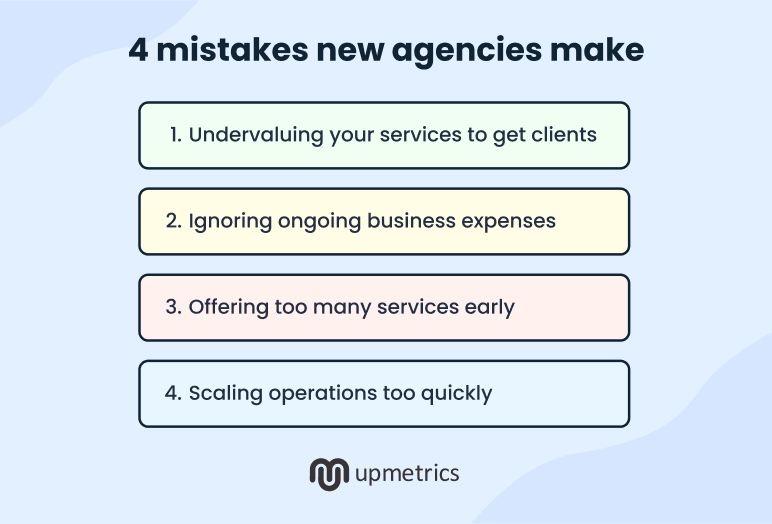
1. Underpricing your services
When you’re new, it can feel safer to lower your prices to attract clients. But the problem is, budget clients usually expect the most, show less respect, and leave as soon as they find a better offer. Instead, set your prices based on the value you provide, not on the pressure to close a quick deal.
2. Forgetting about hidden costs
Most beginners think running lean means no overhead. The truth is, even a small agency has monthly costs. Tools like social media management software, freelancers, ad spend, and other subscriptions can easily add up to $200–$500 per month. I’ve seen too many people blindsided because they didn’t plan for it.
3. Trying to do everything at once
SEO, ads, design, content—offering it all sounds impressive, but it spreads you too thin. I’ve watched new agencies burn out fast this way. It’s smarter to start with one or two services you can really deliver well, then expand as you gain experience and resources.
4. Scaling too fast
Hiring staff or renting office space feels like progress, but if your revenue isn’t steady, it just adds pressure. I’ve noticed founders overextend and struggle to keep the lights on. A safer path is to grow in phases—start solo, bring in freelancers, then hire permanently when your income supports it.
In the end, avoiding these mistakes keeps you focused on what really matters: landing the right clients, doing great work, and building an agency that grows without burning you out.
Conclusion
Summing up! We’ve covered the 10 key steps to starting a digital marketing agency, like picking your niche, making a plan, registering your business, setting your prices, building a team, and landing your first clients.
We also talked about using the right tools, creating a solid portfolio, and keeping your clients happy so they stick around.
But keeping a well-written business plan helps a lot. Tools like Upmetrics can make the process much easier by helping you set goals, manage your budget, and grow your business without wasting time or money.
It’s all about results, trust, and showing up. That’s how you grow.
The Quickest Way to turn a Business Idea into a Business Plan
Fill-in-the-blanks, AI-assistance, and automatic financials make it easy.
