




I once watched a pitch deck presentation: Strong market size, slick design, all that. But when they reached the team slide, they said, “We’ve got a great team,” and moved on without a single detail.
No photos, no roles, no backstory.
Later, the lead investor walked away. His feedback? “If I don’t know who’s driving, I’m not getting in the car.”
That moment stuck with me. It was a reminder: Investors don’t just buy ideas—they buy the people behind them.
In this guide, I’ll break down what makes a great team slide pitch deck, how to decide what to include, and what to avoid (like cramming in your entire LinkedIn list).
If done right, this one slide can boost investor confidence (sometimes, it’s the dealmaker). Let’s get into how to actually make that happen. But first…
Why should you add a team slide to your pitch deck?
YouTube’s original pitch deck is an excellent example of how a strong team slide can elevate your entire pitch. I analyzed it recently, a basic-looking 10-slide pitch deck, no fancy slides, nothing.
But they had a team slide that gave instant trust and credibility (something that is of utmost value for a pre-revenue startup). It’s much easier to trust a startup built by ex. PayPal engineers compared to a few college students.
A strong founding team or management is one of the most influential aspects when it comes to gaining investor trust. It doesn’t mean you need to be an ex. employee of a tech giant, but relevant experience and a working background are needed.
If you ask me, your team slide is crucial for investors for a few simple reasons.
They care about your team slide because it reveals the real people behind the idea: who’s building, executing, and steering the company.
It builds immediate trust, demonstrates founder–market fit through relevant experience, clarifies each member’s role, and signals that the team has the capability to run the show and drive results. Even if the product is early, a strong, credible team makes the entire pitch feel grounded and investable.
How to create a “great” pitch deck team slide?
Let’s be honest, most of us throw together the team slide at the end, thinking it’s just a formality. I’ve done that too at some point.
But here’s what I’ve learned (the hard way): Investors don’t just scan this slide, they study it. They want to know who’s behind the idea and why they’re worth betting on.
Here’s how I build team slides now and what I’d suggest if you want yours to land:
1) Choose the right team members to feature
Only include your core founding team and key executives, the people who actually drive the company forward.
Early on, I made the mistake of putting every hire on the slide just to “look bigger.” It had the opposite effect. Investors got confused, asked who was really leading, and I had to explain my way out of it. (Time-consuming and not a pretty look.)
Focus on:
- Founders & Co-founders
- C-level executives (CEO, CTO, COO, CMO, etc.)
- One or two domain experts, if they’re truly essential.
Try to avoid:
- Every single hire
- Advisors who have minimal involvement (unless they’re genuinely high-profile and active)
2) Add professional headshots, full names, and roles
Your team slide is part of your first impression. Investors do notice the little things, like how professional the team looks.
So if you’re planning to crop your face from a wedding photo, please don’t 🙂
Instead, always ensure your headshot checks these boxes:
- Taken in a well-lit setting (natural light works great)
- Shows at least 60% of your face
- You’re in professional (or clean casual) attire, not a party outfit
For instance:
🟥 On the left: A photo that technically works, but screams “last-minute.”
🟩 On the right: A clean, intentional, professional look that builds trust.

Also, keep your team headshots consistent; same style, same framing, and ideally the same background (if that’s possible). Uniformity signals attention to detail.
And, when adding the names and roles, keep it specific like “CTO & Product Lead” instead of vague titles like “Technology Enthusiast or Tech Wizard”
3) Write one punchy credibility line per team member
One of the biggest lessons I’ve learned while helping to build decks is: Less text = more impact.
When someone’s skimming your pitch, especially a busy investor, they don’t want a 5-line bio. They want a reason to bet.
So, under each name, include just one line that screams credibility. Something that makes them go, “Okay, this person knows how to handle this business.”
Here are a few examples:
- “Scaled a fintech app from 0 to 1M users”
- “Ex-Google engineer led Maps team for 5 years”
- “Built ops at 3 YC-backed startups”
- “Former VP at Netflix, 15 years in content strategy”
It’s short, scannable, and instantly shows why they matter to your startup’s success.
Prepare Your Pitch Deck in Less than an Hour with Our
AI Pitch Deck Generator
Plans starting from $14/month

4) Use brand logos or social proof strategically
If someone on your team has worked at a well-known company or scored a big win, show it.
Brand logos are quick credibility markers; they instantly tell investors, “This person has done great work in respected places.”
Use them for each relevant team member under a “Previously at:” or “Ex-” row. Keep them small, clean, and easy to scan. But don’t go overboard. One or two strong logos per person (if applicable) is enough. Otherwise, it starts to look messy, like you’re trying too hard.
Look at this example for a quick reference:

5) Keep the layout clean and team-focused
Fancy designs? I’ve tried them—they usually end up looking messy. So, I keep it simple:
- 3–4 people max for early-stage teams (Series A+ can go larger)
- Consistent fonts, spacing, and alignment
- Either a horizontal row or a neat 2-column grid
Always remember, don’t let design get in the way of clarity.
6) Add a team summary caption (totally optional)
When I’m helping founders build their deck, in some cases, I notice the team has one big thing in common that instantly makes them stand out.
Maybe they’ve built and sold a product together before. Maybe they worked at the same top company. Or maybe their skills fit together so well that it’s obvious they can pull this off.
When that’s the case, I like to sum it up in one short line above the team section. It gives investors the “big picture” of who the team is before they even start reading bios.
Something like:
- “Built and sold 2 SaaS startups together”
- “Ex-Tesla and MIT founders with 20+ years in AI infrastructure”
- “Team behind 3 successful YC-backed ventures”
- “Product, tech, and growth leaders who scaled a fintech app from 0 to 1M users”
If your team has a story like that, highlight it. A single caption can set the stage and make the rest of the slide powerful.
If you do just these six steps well, your team slide will already stand out. The best part? You’ll spend less time explaining “why us” during the pitch, because the slide will do it for you.
Best pitch deck team slide examples (f/ real startups)
I’ve looked at hundreds of startup pitch decks, both from my own work, clients that I help, and from publicly available collections. Some team slides stand out instantly.
Here are real examples that nailed it, and what you can learn from them:
1. Airbnb
The original Airbnb pitch deck is famous for how simple yet effective it is. And the team slide is no exception. Look:
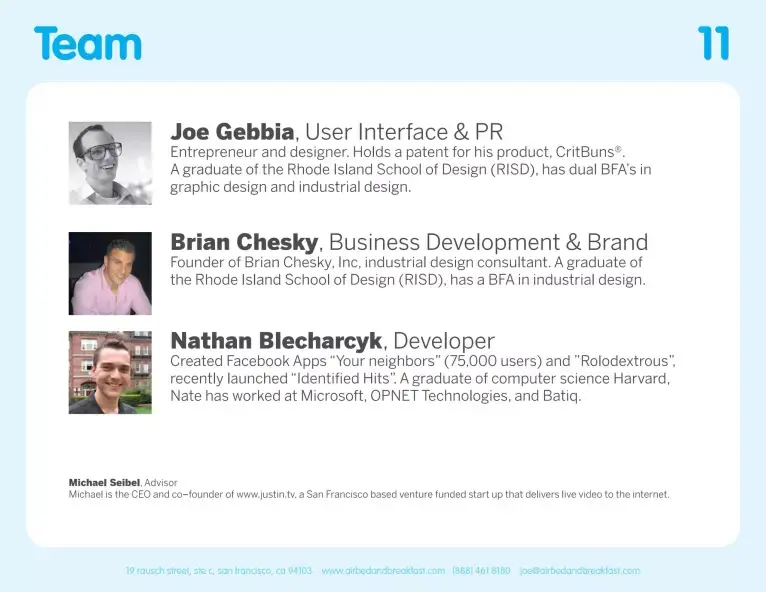
Notice how the team slide has:
- Three co-founders (not every early hire)
- Headshots + names + roles (Joe: UI/PR, Brian: Biz Dev & Brand, Nathan: Developer)
- A quick credibility line under each person
It’s tight, clear, and shows complementary skills. You’ve got someone for tech, someone for design, and someone for the business side.
Also worth noting: They included Michael Seibel as an advisor, which adds instant attention.
2. Buffer
The team slide of the Buffer pitch deck does a few things differently, and it works surprisingly well. Let’s see how:
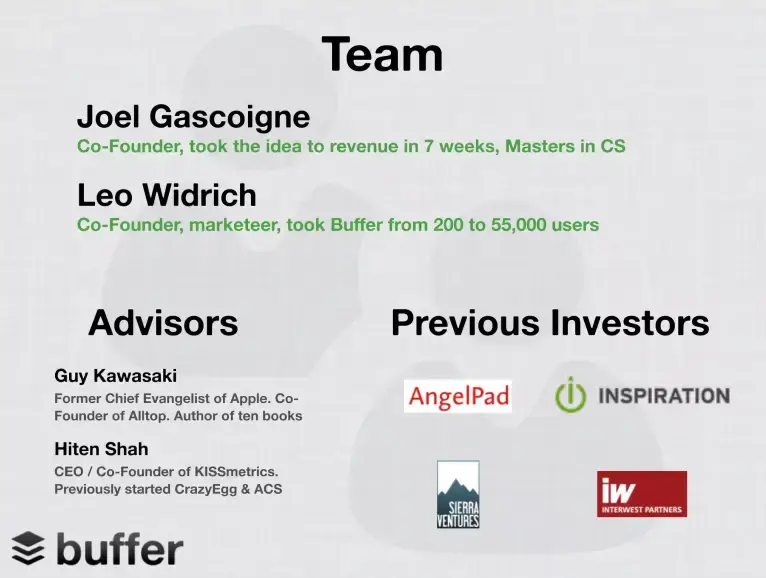
Instead of long bios or job titles, they use short, impact-focused statements under each founder’s name:
- Joel Gascoigne: “Took the idea to revenue in 7 weeks”
- Leo Widrich: “Grew Buffer from 200 to 55,000 users”
That’s powerful. In just a few words, you know exactly what each founder contributed, with real traction to back it up. They also mention Joel’s Master’s in CS, which adds technical credibility.
The slide also includes two smart add-ons:
- Advisors: Industry-recognized names (Guy Kawasaki & Hiten Shah) with just enough detail to prove their relevance.
- Previous investors: Well-known logos (AngelPad, Inspiration, Sierra Ventures, etc.)
It’s a clean layout, no headshots, but still manages to feel credible, focused, and backed by traction and support.
3. Front
This team slide from Front works because it signals experience without overload. As a mid-sized SaaS company, their early slide already showed a strong, capable founding team.

The slide includes:
- Two co-founders with clear roles (CEO and CTO)
- Logos of top schools (HEC Paris, École Polytechnique) and Y Combinator for instant credibility
- Team hires featured strong sales and success credentials from companies like Box and Dropbox
- A playful but powerful line: “Unfair access to pool of excellent French engineers”, backed by mini headshots of the broader team
It’s a great balance of founder credibility, early execution team strength, and subtle signaling about their technical talent advantage. Short, visual, and effective.
Prepare Your Pitch Deck in Less than an Hour with Our
AI Pitch Deck Generator
Plans starting from $14/month
Preparing a solid pitch deck team slide ( w/ 4 Basic mistakes to avoid)
I’ve seen hundreds of pitch decks over the last few years. And, I’m amused to see how most of them make similar mistakes when it comes to presenting a team slide. These are the 4 most common team slide mistakes entrepreneurs make:
1) Using random or inconsistent photos
If your headshots look like a mix of LinkedIn portraits, blurry selfies, and a cropped image from a group photo, it shows you are unprepared. Take an hour, get clean, consistent shots for everyone.
It’s worth it + reusable for different professional purposes.
2) No team slide at all
Some early-stage founders tell me, “We’re too early to show a team.” But that’s exactly why you should show it. At this stage, investors are betting more on you than the product.
Skipping it feels like something’s missing, or worse…, like you don’t have the right people yet.
3) Overloading with irrelevant history
Just because someone worked at 10 companies doesn’t mean you need to list them all. Stick to the one or two recent roles or wins that actually strengthen your case for this current startup.
4) Using outdated information
It happens more often than you’d think: a deck shows someone as CTO, but they left three months ago. Or the roles haven’t been updated since the first version of the slide.
It might seem like a small detail, but it sticks out. It’s a simple fix that shows you’re updated with the current information.
Prepare a compelling pitch deck using Upmetrics
A great team slide needs the right people, clear roles, and clean formatting, all working together. Doing that manually in PowerPoint or Google Slides can get messy fast. That’s where Upmetrics can help.
With our AI-powered pitch deck builder, you can create your entire deck in minutes, not hours. It auto-formats your slide for a clean, consistent look, with space for headshots and logos, no external design tools required.
And because everything stays connected to your business plan, there’s no need to juggle multiple files or tools. Just one smart, investor-ready presentation from start to finish.
Turn Your Pitch Into an Investor-Ready Deck
Create a simple, structured pitch that investors can understand and trust
