


Lately, I’ve been seeing more and more founders using AI tools to write their business plans—and honestly, it’s a smart move. The drafts look clean and structured, and they get the job done fast.
But when we start going through the details together, that’s when the gaps show up. The plan explains what you want to do, but not why it’ll work. The numbers appear neat, but they don’t always hold up under scrutiny.
That’s usually the point when founders think of hiring a consultant. And choosing that person isn’t easy. Everyone sounds capable, and on paper, most look like they can deliver.
So the question is: How do you tell the difference?
That’s exactly what we’re covering here—tips for choosing the right business plan consultant so you don’t waste time (or money) on the wrong one.
8 Tips for choosing the right business plan consultant
I know how tricky it can be to choose a business plan consultant. Everyone promises “investor-ready plans,” “funding success,” and “custom strategies,” and after a few conversations, they all start to sound the same. I know there’s no shortage of talent, but it’s just hard to tell who’s genuinely good at their job.
To make it easier, I’ve put together a few practical tips to help you narrow down your options. We’ll talk about what questions to ask, how to gauge real expertise, what red flags to look for, and how to find someone who fits your business.
1. Ask: Which of your past clients secured SBA loans, VC funding, or bank credit using your plans?
Most founders ask consultants about “years of experience.” That’s the wrong question. Longevity doesn’t prove effectiveness. The sharper question is: Did their plans actually secure funding for clients?
In my opinion, you’ll learn more by asking specifics:
- Have your clients secured SBA loans or bank financing with your plans?
- Did any raise angel or VC rounds?
- Can you share anonymized examples of those outcomes?
Why, you ask?
The real benchmark of a consultant’s value is funding success. A glossy plan that fails to convince a banker or investor is wasted effort. And each type of funder looks for different things:
- Banks focus on repayment capacity,
- VCs on scalability and market size
- Angels on founder credibility
That’s why you need a consultant who can adapt the plan accordingly. When you have the proof of past success, it tells you they can flex to those different audiences.
When I used to work with founders, we started every project by mapping the plan to its end use. For a bank, cash flow coverage comes first. For a VC, the growth story and unit economics take center stage.
That outcome-first approach means you’re getting a “business plan” as well as a tool specifically designed to win over the decision-maker you need to persuade.
A founder we helped was applying for a $200k SBA loan. Their first plan (done by another consultant) looked great, but missed what lenders actually care about. So we rebuilt it around repayment capacity, tightened assumptions, and added a sensitivity table. The loan was approved in two weeks. Same business, different framing.
That’s what happens when a consultant understands funding outcomes, not just formatting.
2. Test: Give them a five-minute industry scenario and watch if they outline key metrics correctly
I believe one of the quickest ways to see if a consultant really understands your world is to hand them a simple scenario and watch how they respond.
For example,
- If you’re building a SaaS product, ask how they’d track churn, CAC, and lifetime value.
- If you’re opening a restaurant, ask what margins to expect (most operate on 8–12% net) and which costs founders overlook.
- If you’re in manufacturing, ask how supply chain risks or equipment costs should be modeled.
You won’t get a full analysis in five minutes, but that’s not the point. What you’re testing is whether the consultant instinctively focuses on the right levers.
Also consider whether you need someone deeply specialized in your industry or a consultant with broader exposure. Specialists spot details others miss, while generalists often bring new angles from other markets. The right fit depends on whether your funding story relies on narrow benchmarks or big-picture strategy.
A consultant who gives vague or generic replies will lean on clichés later, and investors spot that instantly. A sharp one ties every answer to real trade-offs, like CAC vs. payback in SaaS or seasonality in retail.
One founder we advised was opening a farm-to-table restaurant. During our initial discussion, we pointed out that food costs should stay under 30% and that winter dips could push margins down to 8–10%.
The founder later told us that a simple observation like that was missing in every other consultant call they’d had, and that’s what made them realize how much real context matters over polished language.
I call this an “assumption audit.” Ideally, within the first meeting, the consultant should be mapping your metrics against industry data so they can see where you’re optimistic, conservative, or way off-base
Unsure if your plan will impress investors?
Get expert help building an investor-ready business plan

3. Review: Request a sample financial model with editable assumptions, not static one-page forecast tables
Many consultants will proudly show you their forecast tables—three years of revenue growth, a profit line, maybe even a chart. But investors don’t care about the final numbers as much as they care about the assumptions underneath.
That’s why you should always demand a sample financial model. It shows you if the consultant builds with investors in mind, or just fills cells in Excel.
Here’s what you must look out for:
- Flexibility: Can you change core inputs (like pricing, churn, or salaries) and watch those changes ripple through revenue, cash flow, and profitability?
- Scenarios: Does the model already include best, worst, and base cases? Because no serious lender or VC will trust a straight-line forecast.
- Industry sense: Do the assumptions feel grounded in your market? A SaaS plan without CAC payback or a restaurant plan ignoring food cost % is a dead giveaway of generic work.
Investors will go straight for assumptions. “What if your margins fall 5%?” “What if churn rises by 2 points?” If your consultant’s model can’t answer those questions, it’s not for you.
It’s for these exact reasons that I always recommend providing a living, editable model tied to real benchmarks. That way, when those questions come, you can answer them confidently.
Here’s what a weak vs. strong output looks like:
- Weak plan table (generic):
Revenue 2025: $1M → 2026: $2M → 2027: $3M (no assumptions shown). - Strong model (editable):
Revenue = (Avg. Price × # Customers). Inputs are clearly editable. Includes CAC, churn, and margin drivers. Shows base, best, and worst scenarios.
This “before vs after” contrast makes it obvious if a consultant is giving you a vanity forecast or a real financial tool.
4. Confirm: Explain your funding goal and see if they adapt the plan structure to that audience
The easiest way to spot a cookie-cutter consultant is to tell them your funding goal and watch what happens. If their approach looks the same whether you’re pitching a VC, applying for an SBA loan, or talking to an angel, you’re in trouble (not kidding).
That’s because each audience reads your plan through a completely different lens:
- Banks want repayment capacity, collateral, and conservative assumptions.
- VCs push for scalability, market size, and bold growth stories.
- Angels often focus on founder credibility and early product-market fit.
This is why I believe the first step is clarifying the funding target. A plan designed for a bank looks nothing like one designed for a VC round. The structure, emphasis, and even the language shift depending on the reader.
Here’s a quick test you can do to determine if the consultant can adapt the plan structure based on the audience it’s being presented to:
Tell them your exact funding goal, then ask: “How would that change the way you build my plan?”
A good consultant will immediately call out which sections need more weight, which assumptions to stress-test, and how the story should be framed for that audience. If they can’t do that on the spot, chances are the plan they deliver will miss its mark.
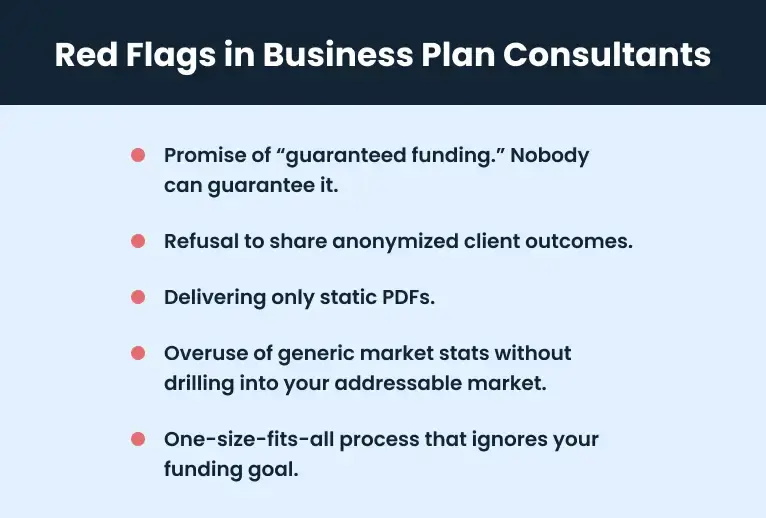
5. Check: Ask for their end-to-end workflow from kickoff interview through research, drafts, and revisions
A strong business plan is built through discovery, testing, and refinement. If they can’t break that down for you, it’s because the process doesn’t exist.
When you ask for their workflow, you’ll be testing for:
- Depth of discovery: Do they probe your business model, customer economics, and funding goals in detail, or just hand you a questionnaire?
- Integration of research: Can they show where industry benchmarks, competitor data, and financial norms enter the process?
- Iterative drafting: Do they share partial drafts so assumptions can be corrected early, or do they “surprise” you with a final plan?
- Revision structure: Is there a clear limit and rhythm to revisions?
- Ownership at the end: Will you have editable models and documents?
I believe in treating the workflow as collaborative and transparent: Structured kickoff calls, draft reviews at key milestones, and two built-in revision rounds.
And importantly, you should get editable files so that you can update them as your strategy evolves. That way, you know the structure is solid from the start.
6. Verify: Ask what data sources they use for market benchmarks—reject answers limited to Google search
A common weakness in business plans is market research that sounds impressive but doesn’t stand up to questioning.
You’ve probably seen it: “The global software industry will be worth $500B by 2030.” That’s a Google headline, not a benchmark. It says nothing about your addressable market or the assumptions behind your forecasts.
What you want to see instead is data that connects directly to your model. For example:
- Customer acquisition cost benchmarks in your sector.
- Operating margin ranges from similar companies.
- Industry growth rates segmented by geography or niche.
- Loan default ratios for your business type if you’re applying to banks.
When I used to help build plans, this step sat right after discovery. Once I understood the assumptions, I ran them against published data (IBISWorld for market size, BLS for labor costs, PitchBook for fundraising benchmarks).
So, if you say your SaaS churn is 3%, I’d immediately compare it with the industry range (say 5–7%) and make changes accordingly.
How to test a consultant quickly?
Don’t just ask “what sources do you use?” Instead, give them a sample assumption (like your pricing strategy or customer acquisition cost) and ask, “What benchmarks would you compare this against?” Their answer will tell you if they think in data or not.
Once you have clarity on these aspects, when you’re in front of a lender or VC, you won’t be scrambling to defend numbers. Every assumption ties back to an external reality, which makes your plan resilient under scrutiny.
7. Probe: How do they handle confidentiality and IP?
When you hand over your business plan details, you’re also handing over your financials, pricing, customer insights, and sometimes even your investor list. That’s sensitive information.
And not every consultant treats confidentiality the same way. Some store drafts in shared folders that anyone on their team can open. Others recycle frameworks or language across clients, which means your plan could end up looking uncomfortably similar to someone else’s in your industry.
If an investor spots that overlap, the credibility hit is on you, not the consultant. So push them a little with these questions:
- Will they sign an NDA before you share details?
- Where do they store your files?
- Who besides them will see your numbers?
- Do they ever reuse models or investor lists between clients?
Experienced consultants should answer these questions without hesitation. In my opinion, NDAs should be signed up front, files should be stored in restricted, encrypted platforms, and all frameworks should be custom-built.
Confidentiality isn’t only about keeping your data safe; it’s also about showing investors and banks that your business handles sensitive information responsibly.
Remember: If you can’t show that you take your own IP seriously, it raises doubts about how you’ll manage theirs in the future (like customer data or proprietary technology).
8. Ensure: Require delivery of fully editable Word and Excel files, not locked or static PDFs
What good is a business plan if you can’t edit when your assumptions change next quarter? A static PDF may look professional, but it won’t help when an investor asks for new scenarios or a lender wants updated numbers.
And they will ask. I mean, rarely does a plan get approved without at least one round of “show me the downside” or “update this for higher costs.”
That’s why I always insist my clients walk away with editable files. They let you adjust narrative sections, test new inputs, run sensitivities, and see the impact flow through cash flow, P&L, and balance sheet instantly.
Anything less keeps you dependent on the consultant for even minor updates. If all you get is a locked PDF, you’ll be paying again every time you tweak a revenue line, add a new market, or change a funding ask. Worse, you’ll lose momentum with investors who expect you to respond quickly.
And don’t stop at editable files. Investors often want a two-page summary or a pitch deck before they’ll even glance at the full plan. A consultant who can adapt your business plan into those formats saves you the hassle of starting from scratch later.
So, before you hire, ask them a few questions like:
- Will the Excel models include working formulas I can adjust myself?
- If I change a cost assumption, will charts and tables update automatically?
- Do I receive full source files or just static PDFs for presentation?
- Can the plan also be adapted into a pitch deck or one-pager for investors?
- How easy will it be for me to reuse this plan for a new funding round?
I believe editable delivery is the default. Clients should always walk away with full ownership. I expect them to revisit and adapt their plan, whether that’s for a new investor conversation, a pivot in pricing, or a revised funding ask. It saves weeks of back-and-forth later.
Spending weeks rewriting your business plan?
Let an expert build a clear, data-driven funding story
Conclusion
Finding the right consultant doesn’t have to feel like a lot of work. If you keep the above questions in mind—about outcomes, process, data, and ownership—you’ll know exactly what to look for and what to avoid.
You don’t want to just hire someone who can “write a plan.” They should be a partner who makes your ideas stronger and your numbers credible.
Of course, you might decide you’d rather build it yourself. If hiring isn’t the path you want to take, Upmetrics is a solid alternative. The software gives you financial models, strategy frameworks, and guided planning tools so you can create and update your plan on your own terms.
So, why not write your business plan on your own? Start planning today.