




You’ve probably seen it happen on Shark Tank.
A founder steps in with confidence (and background music), rehearsed lines, and perfect slides — only to be interrupted two minutes in.
“Wait, how big is this market again?” Mark Cuban asks.
“Who’s actually paying for this?” Mr. Wonderful interrupts again.
And suddenly, the pitch spirals.
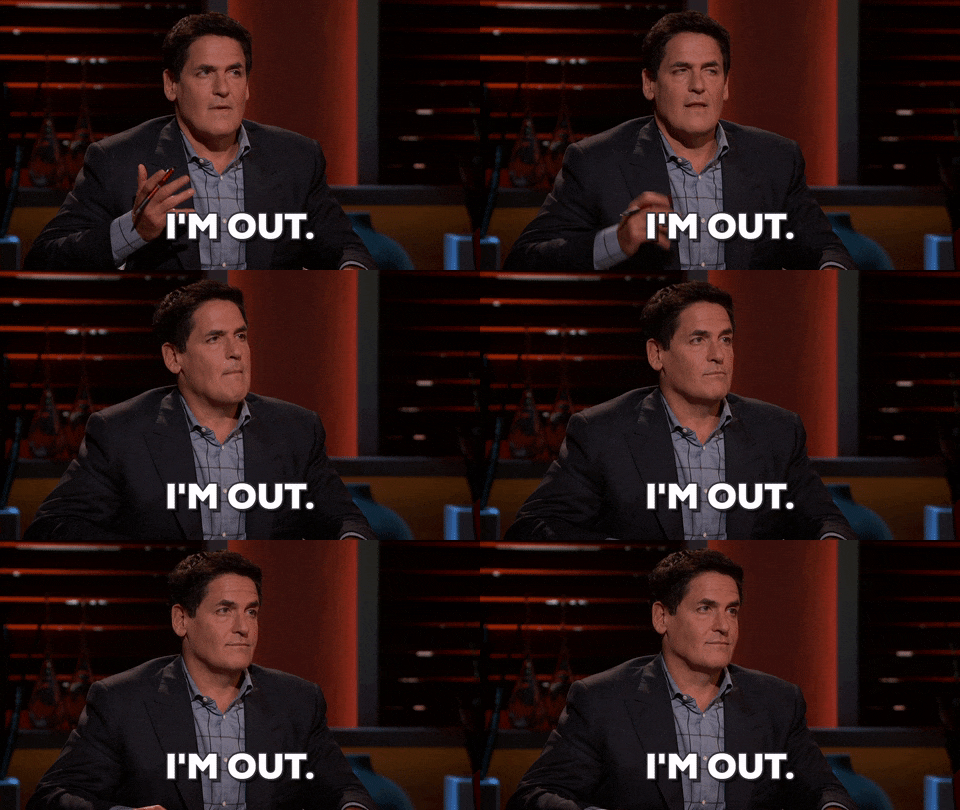
That’s the real investor room. It’s not a monologue; it’s a live negotiation disguised as a conversation.
Great ideas die in long explanations.
Investors don’t just buy potential, they buy clarity.
If your story takes 20 minutes to make sense, you’re asking someone else to organize your thoughts for you.
Yes, numbers are important, and market size matters. But you still need a story that connects logic with emotion.
That’s where the 7-Minute Investor Test comes in. It’s not just about brevity; it’s about creating a story they can’t stop listening to.
Why seven minutes?
Because that’s roughly how long investors stay fully engaged before deciding if they care.
Seven minutes is long enough to tell your story, show traction, and make your ask — but short enough to demand focus and clarity.
Think of it like interval training for your pitch. Every minute has a goal.
The Countdown Framework
Each minute equals one talking goal. Start at 7 and end at 1.
Minute 7: The Hook (Why now)
Start strong. Show the problem and why it matters right now.
Example: “Remote teams doubled in three years, yet most still manage projects like it’s 2015.”
Minute 6: The Solution (Why you)
Show how your product hits that pain point differently. One sentence and one visual are stronger than five slides.
Minute 5: Market & Timing
Prove there’s demand and show the scale.
Investors back inevitability more than innovation.
Minute 4: Traction
This is where most investors tune in first.
Show what’s working — users, revenue, retention, partnerships.
Minute 3: Business Model
Explain the numbers like you would to a friend.
Simple math wins: “We earn $X per customer at Y cost, giving Z margin.”
Minute 2: Team & Moat
Who’s behind this, and why can’t others copy it fast?
One line per strength. No resumes.
Minute 1: Ask & Vision
Share what you’re raising, how you’ll use it, and your end-state vision.
End with a one-liner they’ll remember after the meeting.
Run the Test
Before your next pitch, record yourself.
Talk for seven minutes. No slides. Just you and your story.
If you can’t finish cleanly, you’re not pitch-ready yet.
The goal isn’t perfection. It’s compression.
The tighter your story, the easier it is for investors to see the scale behind it.
Why it works
This simple test trains three founder skills:
- Clarity: You focus on what matters most
- Sequence: You learn to tell a story that flows logically
- Confidence: You sound like someone who understands their business deeply
Each of these seven parts isn’t meant to stand alone.
They work best when they connect — one idea flowing into the next, forming a single, coherent story investors can follow from start to finish.
Seven minutes, one story.
Hit record and see how your pitch really sounds.
