




Perplexity is now one of the fastest-growing AI search engines, helping millions get clear, sourced answers without sifting through endless links.
But in 2022, it was just an early product from a small team with deep AI roots—former researchers and engineers from OpenAI, Google, Meta, and Databricks—chasing a big question: What if search could give you direct answers you can trust?
They built it, shipped demos, and pitched it. The story was product-first, showing how their answer engine worked, why it was different, and how it could scale.
That pitch landed $25M in Series A funding led by NEA, with backing from Elad Gil, Nat Friedman, Jeff Dean, Andrej Karpathy, and Susan Wojcicki.
I’m reviewing this deck because it’s a rare example of an AI startup winning serious funding with a clear, demo-driven pitch—not just hype.
Let’s take a look at the actual slides from Perplexity’s pitch deck.
About Perplexity (then vs. now)
In 2022, Perplexity was a small AI startup with a big goal: to become the world’s most knowledge‑centric company.
Its product was an AI‑powered answer engine that combined large language models with real‑time web search—giving users direct, cited answers instead of endless lists of links.
The founding team came from top AI and tech backgrounds, including OpenAI, Google Brain, DeepMind, Meta, Microsoft Bing, and Databricks. Their pitch centered on four things: product clarity, technical edge, user trust, and speed.
They proved it with live demos showing how Perplexity could handle complex questions, cite reliable sources, and refine answers through follow‑up queries.
At the time, the product was free and already gaining attention from tech leaders like Jack Dorsey, along with coverage in Fortune and The New York Times. That momentum helped secure a $25M Series A led by NEA (New Enterprise Associates), with backing from Elad Gil, Nat Friedman, Jeff Dean, Andrej Karpathy, and Susan Wojcicki.
Today, Perplexity has millions of users worldwide and offers Perplexity Pro at $20/month or $200/year, giving access to GPT‑4, higher Copilot limits, and premium features.
It now competes directly with Google, Microsoft, and other AI‑first search tools—a big leap from its early days as a lean startup pitching a better way to search.
Detailed Perplexity pitch deck analysis
Going through the deck, these were the slides I kept coming back to. They weren’t just pretty visuals—they actually pushed the pitch forward. If I had to pick my favorites, these six are the ones worth showing you.
Slide: 1 Intro – “Ask Anything”

This opening slide is clean and direct—just the Perplexity name and the tagline “Ask Anything.” It sets a confident tone and makes a clear first impression. I like that it avoids clutter and gets straight to the point.
For someone new to Perplexity, it may feel too open‑ended. A short line mentioning “AI‑powered search” could make the value clearer right away. Still, as an opener, it works well by keeping things simple and drawing attention to the core idea.
Takeaway: A clean opener works, but a small hint of what makes you different can make it stronger.
Slide: 2-3 Cofounders, Mission & Product Vision
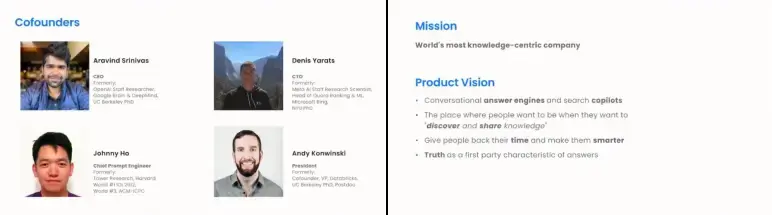
These slides introduce Perplexity’s founding team and the vision driving the company. The team combines deep AI expertise and strong academic backgrounds, with experience from OpenAI, Google Brain, DeepMind, Meta AI, and Databricks.
This credibility anchors their mission: To be the world’s most knowledge‑centric company. Their vision is to build conversational answer engines and AI copilots that save people time, make them smarter, and deliver truth‑first answers.
Takeaway: Lead with a strong team and a clear mission—it builds early trust and shows the problem is in capable hands.
Slides 4–5: Investors
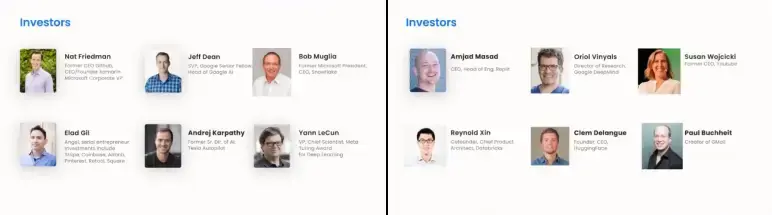
Perplexity highlights its investors, featuring former leaders from Google, Meta, Microsoft, YouTube, Tesla, and the founders of Hugging Face and Replit. It’s an impressive lineup that instantly adds credibility.
I like how it blends technical expertise with real startup experience — it signals that capable people believe in the company’s vision. It might have been even stronger with a brief note on how each investor supports the business, helping the audience connect the names to real strategic value.
Takeaway: Well‑known investors stand out more when their specific value to the business is clear.
Ditch your old-school pitch deck creation methods
Make compelling pitch decks in minutes with AI
Plans starting from $14/month

Slide 6: Theory of Relativity example
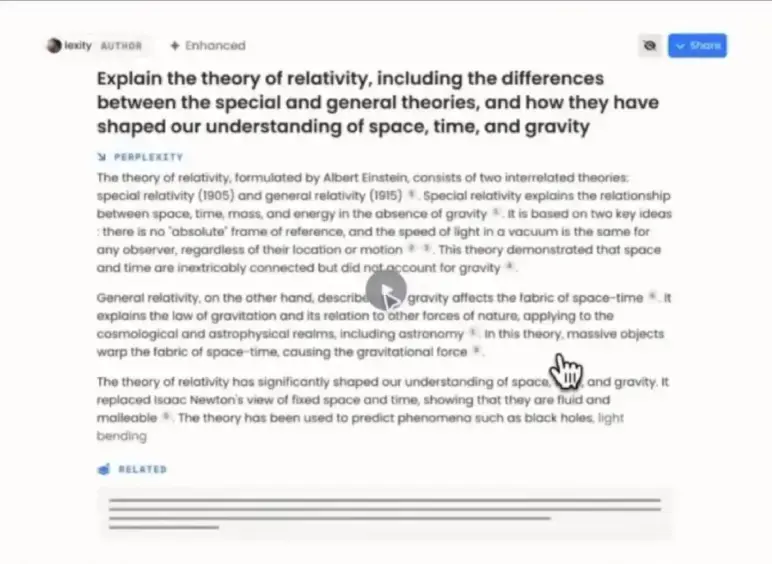
This 6th slide shows perplexity, explaining the theory of relativity in plain language. It’s a strong example of how the product handles complex topics—breaking them down into structured sections that are easy to follow.
The answer here doesn’t just give a short summary; it dives into the differences between special and general relativity and links them back to how we understand space, time, and gravity. For an investor, this helps illustrate the product’s depth and versatility.
Takeaway: Showing your product in action on a tough topic proves its real‑world value better than abstract claims.
Slides 7–8: Quick vs Enhanced (GPT‑4) Search
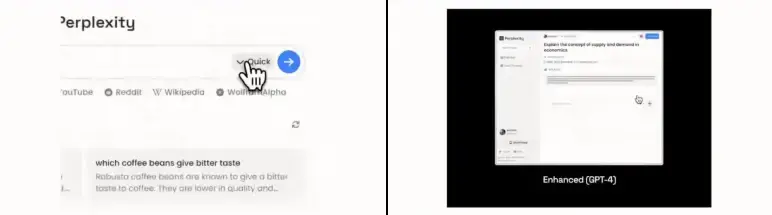
Perplexity compares Quick search with Enhanced (GPT‑4) search. Quick is fast and straightforward, while Enhanced gives deeper, more detailed results. The side‑by‑side format works well here.
I like how it makes the difference easy to understand without extra words. It’s clear when you’d choose one over the other, and it doesn’t need heavy explanation.
Takeaway: Let visuals show the difference so people get it instantly.
Slides 9–12: Lifestyle/learning/content creation examples

These slides showcase how Perplexity can fit into everyday life—helping with entertainment choices, learning complex topics, boosting professional skills, and creating well‑researched content.
It’s a smart move to use relatable examples: Binge‑watch lists appeal to casual users, mastering concepts attracts learners, and AI‑driven content creation speaks to professionals.
I like that it blends lifestyle and productivity use cases without feeling too technical, which makes the product approachable for a wide audience.
Takeaway: Show real‑world, relatable examples to make your product feel useful to everyone.
Slide 13–14: “Available now for free”/Branding

Here, the closing slides keep things short and clean. “Available now for free” is as straightforward as it gets, and the Perplexity branding locks in the final impression. I like that it doesn’t overcomplicate the ending—no unnecessary jargon or long calls to action.
It’s a confident close that tells the audience exactly how to try the product. If anything, I’d say adding a subtle hint of urgency could make it even stronger.
Takeaway: End with clarity and confidence. Make it easy for the audience to know the next step.
Slides 15–19: Copilots (Human agency premium) examples
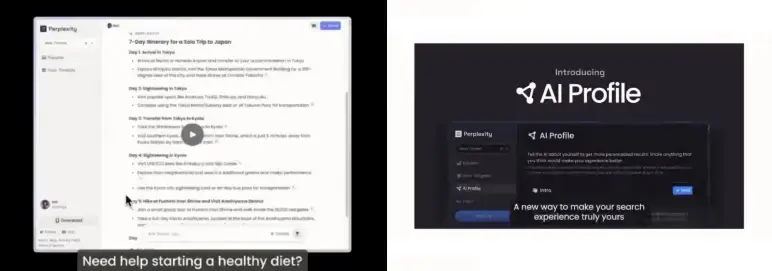
These slides explain the “Copilot” idea — an AI that works with human guidance instead of running fully on its own. It asks follow-up questions, clears up vague requests, and makes answers more accurate. Framing human involvement as a strength works well here.
The everyday examples — trip planning, buying headphones, starting a healthy diet — make the concept easy to understand. They show how Copilot turns search into a guided, tailored experience rather than a one-off query.
Takeaway: Real-life examples help make “human agency” easy to grasp and see value in.
Ditch your old-school pitch deck creation methods
Make compelling pitch decks in minutes with AI
Plans starting from $14/month
Slides 20–23: Personalization via AI Profile
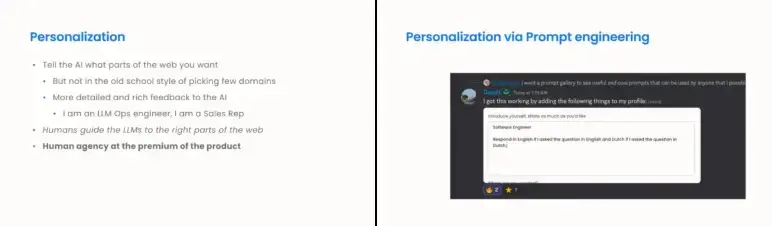
These slides explain how Perplexity takes personalization beyond just basic settings. Instead of picking a few preferred sources, users can give rich, detailed context to guide the AI—such as their profession, expertise, or interests. This enables the AI to deliver answers shaped to their specific needs.
I like that the examples feel practical, showing how a software engineer, for instance, could tailor the AI for coding help, or how prompts could be refined for different contexts and languages.
Takeaway: Real examples of tailored prompts make personalization feel clear, useful, and easy to apply.
Slides 24–27: Tool Use
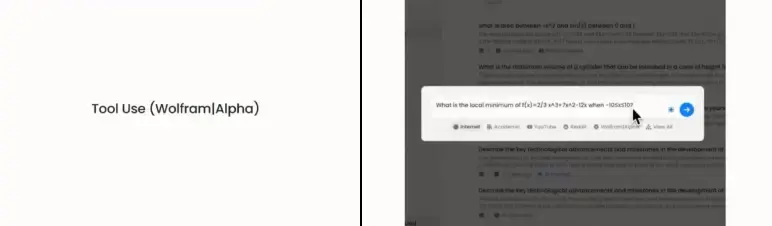
In these slides show how Perplexity becomes more powerful by connecting to tools like Wolfram|Alpha. This isn’t replacing AI reasoning—it’s boosting it. The AI can solve tough math problems, run calculations, pull verified facts, and handle scientific queries with ease.
I like that the examples make it clear: With the right tools, AI goes from a helpful assistant to a reliable expert.
Takeaway: Combining AI with trusted tools delivers faster, more accurate answers.
Slides 28–30: Why Use Tools?
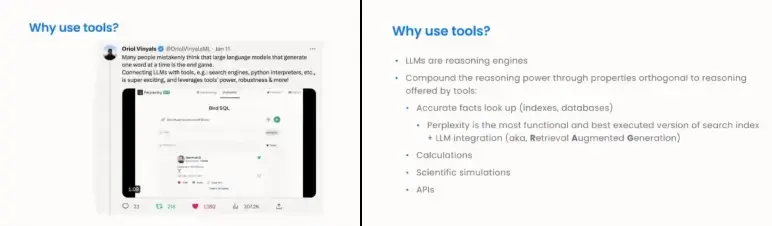
Here, this slide explains why tools are essential for LLMs (Large Language Models). The examples from Oriol Vinyals and Sundar Pichai show that connecting AI to tools like search engines, interpreters, and APIs makes it far more capable.
It’s not just producing text—it can calculate, find accurate facts, and run simulations. I like how they use credible voices in AI to back this up, making the point stronger.
Takeaway: Tools turn AI into a true problem-solver, not just a text generator.
Slides 31–35: Orchestration
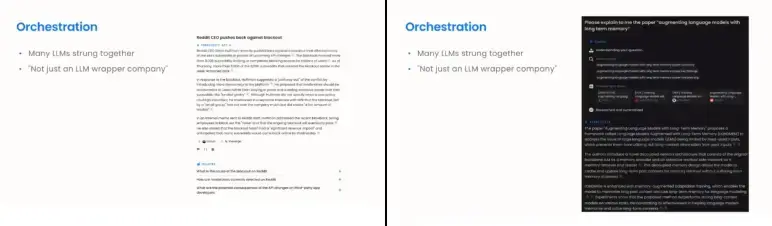
The perplexity slides show how orchestration connects multiple Large Language Models (LLMs), tools, and systems to work as one. It’s framed as more than a single model in an interface—it’s a coordinated system designed to boost accuracy, cut latency, and handle complex queries.
I like that it addresses early issues like slow responses and hallucinations, explaining how these were improved with better prompts, human feedback, and stronger models. Still, the section focuses heavily on the tech. For a pitch, it would be stronger if it clearly linked orchestration to user benefits and market traction.
Takeaway: Strong technology works best when it’s tied to real user benefits and market growth.
Ditch your old-school pitch deck creation methods
Make compelling pitch decks in minutes with AI
Plans starting from $14/month
Slides 36–40: Organic traction
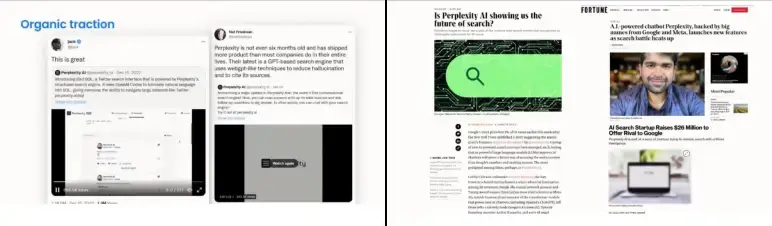
The “Organic Traction” slides show how perplexity was noticed early, without spending much on ads. Big names like Jack Dorsey and Nat Friedman spoke about it, and it was featured in major outlets like The New York Times and Fortune. This helped build trust and made people pay attention.
The attention is great, but it would be even stronger if it also showed numbers on users or activity.
Takeaway: Positive mentions and media coverage are valuable, but investors also want to see proof that it’s leading to real, steady growth.
Slides 41–44: More product demo + voice input
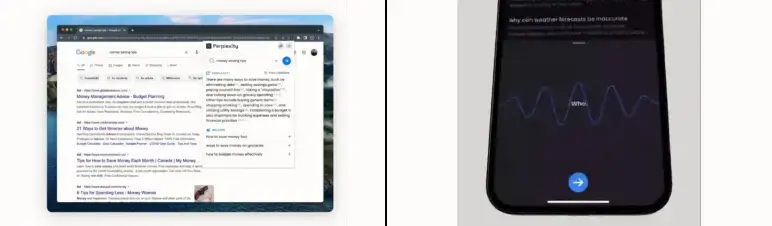
These 41 to 44th slides highlight more product capabilities, including voice input.
On the left, Perplexity answers a complex investment question with clear, source-backed results. On the right, it takes voice commands, making it quick and hands-free to ask questions.
The demo also shows threaded follow-up questions, side-by-side comparisons with Google, and deeper research options. User posts praise Perplexity for helping them find new insights and making research faster.
Takeaway: Shows the product is both powerful and easy to use. Voice input and follow-ups make it convenient, and real user feedback backs its value.
Slides 45–46: Team/Hiring
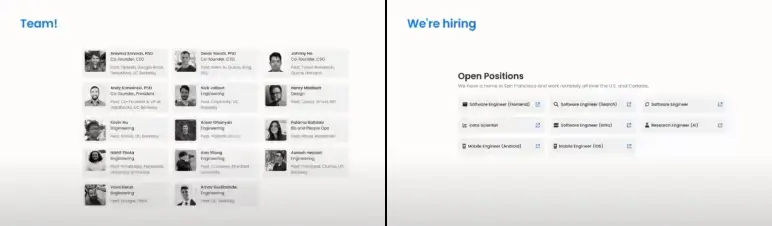
The team slide shows a group with experience at top companies like OpenAI, DeepMind, Meta AI, Google, and Databricks. It’s a mix of AI experts, engineers, designers, and business roles. I like that it’s not just tech—they have people for business and operations too.
The hiring slide is clear—they’re growing quickly and looking for people in engineering, AI research, mobile, and data science.
Takeaway: Strong team and active hiring show they have the skills and are ready to grow fast.
Ditch your old-school pitch deck creation methods
Make compelling pitch decks in minutes with AI
Plans starting from $14/month
Slide 47: Pricing
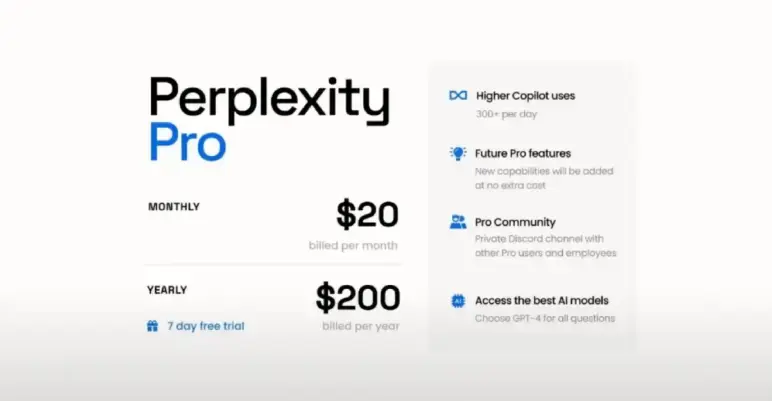
The final slide breaks down Perplexity Pro’s paid plan: $20/month or $200/year with a 7‑day free trial. It includes higher daily Copilot usage, access to future features at no extra cost, a private Pro community, and the option to use top AI models like GPT‑4.
What I like here is that the pricing is simple and the value is clear—investors can quickly see how the product plans to monetize.
Takeaway: Keep pricing easy to understand and tie it to clear benefits. A straightforward offer helps both users and investors see the value immediately.
Things I liked?
Perplexity’s pitch deck had several strong points that made it stand out, even with 40+ slides. Here are the highlights:
- Showed the product in action with real demos instead of just talking about features.
- Highlighted a strong team with backgrounds from OpenAI, Google, Meta, and Databricks.
- Included real traction through tweets from well-known names and coverage in top media.
- Shared a clear $20/month Pro plan that made the revenue path easy to follow.
- Framed the big opportunity for better search in a way investors could quickly understand.
- Flowed logically from problem to solution, making the story simple to follow.
Overall, I think the deck did a great job showing the product, team strength, and early signs of demand—all things I would want to see early on as an investor.
Perfect your deck and pitch using Upmetrics
After reviewing Perplexity’s pitch deck, one thing is clear—you don’t need flashy slides or a 50‑page deck to win over investors. What matters is a clear product story, proof it works, and why it matters now.
Perplexity’s deck nailed it. It focused on an AI‑powered answer engine, a strong founding team, and early traction—no fluff, just clarity and evidence.
Working on your own pitch deck? Upmetrics can help. Use our AI pitch deck creator to build a clean, investor‑ready deck fast. Prefer expert input? Try our pitch deck design services for sharper slides, a stronger story, and a pitch you’ll feel confident presenting.