




You might have a clear vision for your inn. You’ve found the historic Vermont farmhouse, sourced local maple syrup for breakfast, and identified your ideal guest.
But turning a hospitality dream into a bank-ready document is a different challenge. Lenders don’t fund visions; they fund proof of market demand, verifiable occupancy targets, and an operational structure built to scale.
Creating a plan with the right data and professional layout is difficult for most first-time innkeepers and hospitality entrepreneurs planning to open a bed & breakfast. This sample plan for Havenwood Inn solves that problem.
It provides a complete, practical example you can study and adapt to build your own successful lodging business from the ground up, particularly for those seeking SBA loans or bank financing.
Executive Summary
Vermont’s tourism industry drew 16 million visitors in 2024, putting immense pressure on local lodging. Large hotel chains only target high-volume highway exits. Independent Airbnbs often lack professional management.
There is no dedicated boutique-scale lodging option designed for mid-sized groups in the Cedarville corridor. Havenwood Inn will fill this specific void.
Havenwood Inn is a 6-room bed and breakfast opening in June 2026 at 742 Maple Ridge Road, Cedarville, Vermont, positioned at the gateway to the Green Mountain National Forest.
The inn serves a hot breakfast made entirely from local Vermont ingredients and hosts micro-events for groups up to 30 guests, including elopements, small weddings, and corporate retreats.
Ownership
Rachel Nguyen and David Nguyen bring 23 years of combined industry experience to the business. Rachel spent 8 years in boutique hotel operations at the Burlington.
David managed 12 rental properties across northern New England for 15 years. He identified the Cedarville farmhouse as an undervalued asset and knows what it takes to keep a property running. Between operations and property management, the execution risk here is well covered.
Target Customer
Havenwood Inn targets couples and small groups aged 35 to 60 traveling from Boston, New York City, and Hartford. These guests prioritize local authenticity over branded consistency. They want outdoor recreation, a real breakfast, and a professionally managed property.
Revenue & Funding
- Capital Needs: $475,000 total, covering property acquisition, renovation, furnishings, equipment, and working capital.
- Loan Structure: $350,000 SBA 7(a) loan plus $125,000 in owner equity.
Financial Outlook
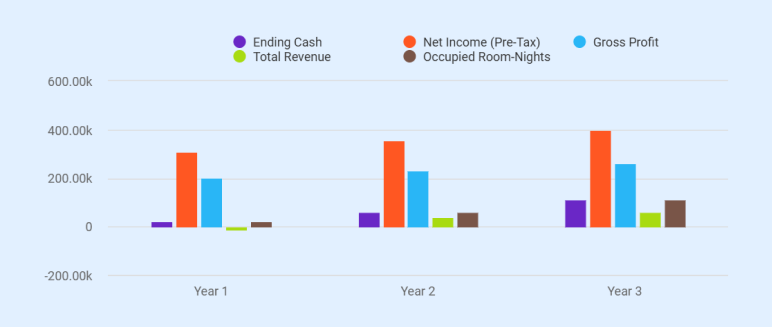
Year 1 targets $309,600 in revenue at 55% occupancy. Break-even lands in Year 2 as occupancy reaches 63% and repeat guests stabilize demand.
The business prioritizes direct bookings over third-party platforms to protect margins and ensure reliable debt service. This approach is reflected across all three years in the projections.
| Year 1 ($) | Year 2 ($) | Year 3 ($) | |
| Occupied Room-Nights | 1,200 | 1,380 | 1,546 |
| Total Revenue | $309,600 | $356,040 | $398,765 |
| Gross Profit | $202,788 | $233,206 | $261,190 |
| Net Income (Pre-Tax) | ($10,381) | $38,633 | $58,861 |
| Ending Cash | $23,020 | $59,273 | $113,726 |
Business Overview
Havenwood Inn is structured as a Vermont limited liability company. Co-founders Rachel Nguyen and David Nguyen plan to open in June 2026. This structure is chosen specifically to protect personal assets from business liabilities.
An LLC also provides a “pass-through” tax benefit. This helps manage high depreciation and renovation costs during the early stages.
Location & Property
The property sits at 742 Maple Ridge Road, Cedarville, VT 05736. It is a 19th-century farmhouse on two private acres right at the edge of town.
We have six guest rooms and a classic wraparound porch. Since we are at the gateway to the Green Mountain National Forest, guests can reach hiking trails, ski resorts, and breweries in under 15 minutes.
We picked this spot because the outdoor appeal doesn’t stop when the seasons change. It keeps visitor traffic steady year-round.
The Founders
Rachel Nguyen holds 55% ownership and acts as the lead operator for the property. She previously managed vendor contracts and guest services across three Burlington properties simultaneously.
Rachel understands exactly where small lodging operations tend to fail and how to get ahead of those issues. Her B.S. in Hospitality Management is backed by eight years of direct, on-the-floor experience.
David Nguyen holds the remaining 45% stake and is responsible for the physical asset. He used his regional network to find and secure the Cedarville farmhouse as an undervalued acquisition.
With 15 years of experience managing a dozen rental units in New England, David handles all maintenance and contractor oversight. He personally led the renovation crew through the May 2026 finish line.
The pair covers the two most expensive roles that new innkeepers usually have to outsource. Rachel focuses on the guest experience while David handles the building and infrastructure.
This partnership keeps overhead exceptionally low during the critical first year. It also significantly lowers the execution risk that lenders usually flag with new hospitality ventures.
Business Model
Havenwood Inn generates revenue through three streams. Room revenue is the primary driver. Event hosting and ancillary sales provide year-round support during low-occupancy periods.
Room revenue anchors the model. The six rooms operate year-round across Vermont’s four travel seasons, with rates adjusted to capture peak foliage and ski demand. Event bookings require a full-house buyout, meaning all six rooms are reserved simultaneously. This protects room revenue while adding a high-margin site fee. Ancillary sales average $33 per occupied room night and require no additional staffing.
Business Goals
The goals below define what success looks like across the first three years.
- Reach financial self-sufficiency by Year 2 with 63% occupancy and net income of $38,633
- Build a direct booking base that reduces OTA (Online Travel Agency) dependency from 60% to 40% of total bookings by Year 3
- Generate $59,000 in net income by Year 3 with $113,726 in ending cash
- Develop a 20% repeat guest rate by Year 2 through email retention and loyalty incentives
- Launch a full event hosting program after Year 3
Market Analysis
Industry Overview
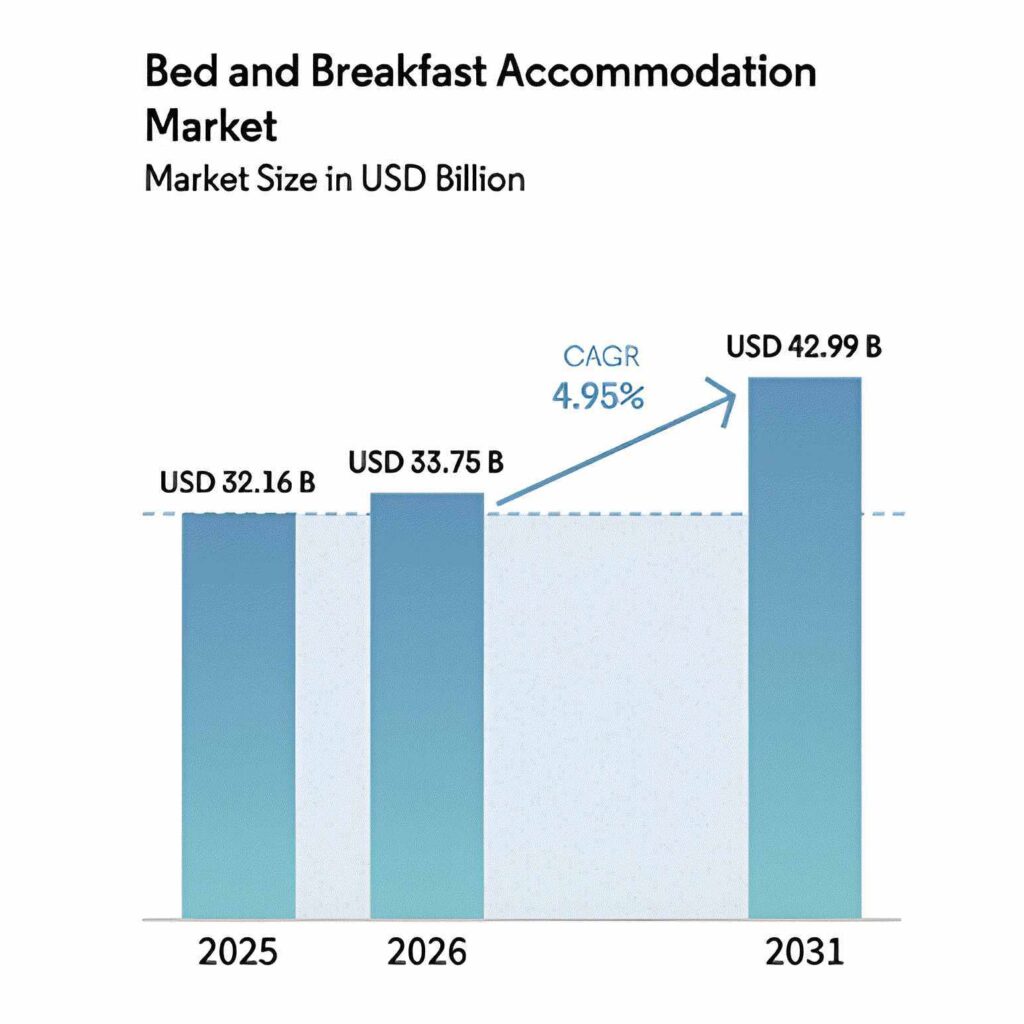
The B&B sector is hitting a massive growth spurt right now. Globally, the market is on track to climb from $32.16 billion in 2025 to nearly $43 billion by 2031, with rural spots grabbing a huge 42.98% slice of that pie.
Vermont is a powerhouse in this industry, pulling in $4.2 billion from 16 million visitors in 2025 alone. Lodging by itself brought in $1.5 billion of that spending. With the state’s B&B market valued at $75.2 million across 124 sites, there is a clear, proven appetite for unique boutique stays.
Food and the outdoors are the big drivers here. Visitors drop almost $876 million a year on local dining, while the outdoor economy adds $2.1 billion to Vermont’s GDP, ranking it second in the nation. Winter sports are the real heavy hitters, keeping rooms full across the Green Mountain corridor every single season.
Target Customer Profile
Our target guests are couples and small groups, mostly aged 35 to 60, coming from Boston, New York, and Hartford. It’s an easy two-to-five-hour drive for them.
The data on Vermont tourism supports our pricing. With a median household income of over $121,000 for summer visitors, our $175–$275 nightly rate hits the sweet spot for the 58% of travelers earning six figures.
The same demographic drives our fall and winter business. These travelers head up from the Mid-Atlantic and New England specifically for the mountains. They aren’t just looking for a bed; they want a reliable home base for skiing and hiking, which is exactly what we provide.
Competitive Analysis
Havenwood Inn enters the Cedarville market with a significant advantage: there is no direct boutique B&B competitor within a 20-mile radius. While other lodging options exist, they generally fall into two categories: high-volume chains that lack local character, or independent rentals that lack professional oversight.
Indirect Competitors
- Branded Hotels: Major chains like the Hilton Garden Inn in Burlington or Best Western in Waterbury are at least 20 miles away. While they offer predictability for business travelers at $180–$230 a night, they don’t provide a local breakfast program or the “Vermont experience” guests look for in Cedarville.
- Roadside Motels: Local spots like the Stowe Motel or Snowdrift charge $90–$130. These target budget-conscious travelers and don’t compete for the premium, experience-driven guests Havenwood is after.
- Short-Term Rentals: You’ll find about a dozen Airbnbs nearby, some fetching up to $350 a night. However, they lack on-site management, consistent cleaning protocols, and licensed food services, which gives a managed inn a major edge in reliability.
Direct Competitors
Our primary competition comes from established boutique inns in the broader Green Mountain region that target similar high-end travelers:
| Competitor | Location | Pricing | Key Difference |
| The Woodstocker B&B | Woodstock (35+ mi) | $250+ | Adult-only with great local food, but much further from the National Forest trailheads. |
| The Inn at Manchester | Manchester (40+ mi) | $275+ | A historic powerhouse near high-end shopping, but lacks our direct “gateway to the mountains” feel. |
| West Hill House B&B | Warren (30+ mi) | $160+ | Strong focus on outdoor recreation and sustainability, but it serves a completely different geographic corridor near Sugarbush. |
Competitive Position
Havenwood Inn holds a unique spot in the market as the only professionally run boutique B&B within a 20-mile radius of the Green Mountain National Forest gateway. It bridges the gap between Cedarville’s year-round attractions and the high-end service standards usually found in Vermont’s more established (and expensive) inns.
By keeping nightly rates between $175 and $275, Havenwood undercuts the regional B&B floor. This targets travelers who want that boutique feel but aren’t interested in driving 40 miles away to pay upwards of $300.
Guest Rooms, Breakfast & Services
Havenwood Inn generates revenue from three primary channels:
- Nightly room stays
- Event hosting
- Curated guest experiences
Event hosting and ancillary sales build on top of it during low-occupancy periods. Each channel serves a different guest need and operates on a different pricing structure.
Guest Rooms (Primary Revenue)
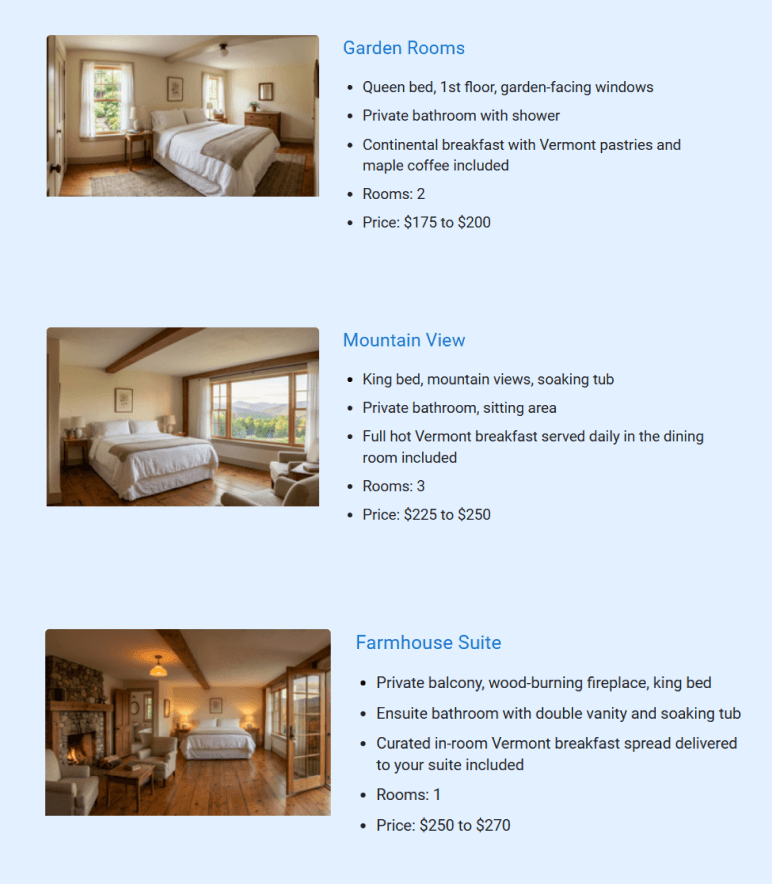
Havenwood Inn operates six guest rooms across three distinct tiers. Every room includes a private bathroom, high-speed WiFi, and access to shared common areas, including the wraparound porch, library, and gardens. Each stay includes a complimentary hot breakfast served daily from 7:30 to 9:30 AM in the main dining room, prepared fresh using locally sourced Vermont ingredients.
Event Hosting (Ancillary Revenue)
Havenwood Inn’s property is set up to accommodate small private events for groups up to 30 guests. The dining room, common areas, and grounds can support elopements, micro-weddings, and corporate retreats without disrupting overnight guests.
Event hosting is not included in the Year 1 through Year 3 financial projections. The first three years focus on establishing occupancy, building the direct booking base, and earning the review volume needed to reduce OTA dependency. Event hosting requires a separate marketing effort, supplemental staffing, and a licensing review for alcohol service at private functions.
Starting in Year 4, the inn plans to launch a structured event program targeting 8 to 12 annual bookings at site fees between $1,500 and $4,000. All event bookings will require a full-house buyout of all six rooms, protecting overnight guest experience and maximizing revenue per available room in a single transaction.
Ancillary revenue from the guest pantry and curated experience packages is active from opening day. Brewery tours at $75 per couple, guided hikes at $60, and a guest pantry stocking Vermont maple products, cheeses, and local crafts are projected to generate an additional $33 per occupied room night. This figure is included in the blended ADR of $258 used across all three years of financial projections.
Renovation Plan
The farmhouse at 742 Maple Ridge Road is structurally sound and commercially zoned. It does not need rebuilding. It needs updating.
Pre-Renovation Condition
The building is occupied and functional. The issues are cosmetic, not structural.
| Area | Existing Condition |
| Guest room flooring | Worn carpet and dated vinyl |
| Lighting | Basic, outdated fixtures throughout |
| Bathroom fixtures | Aging faucets, sinks, and hardware |
| Kitchen | Residential-grade appliances, limited prep surfaces |
| Common areas | Functional but tired finishes |
| Exterior | Paint wear, overgrown landscaping, aging signage |
| Parking | Surface cracks and wear |
The interiors are behind current boutique lodging expectations. With targeted updates, the property can support the $175 to $275 nightly rate and compete with established Vermont inns.
Renovation Scope
PrimeStone plans light to moderate updates focused on guest-facing improvements without over-improving the asset.
Guest Room Upgrades (all 6 rooms)
- New hardwood-style flooring throughout
- Updated lighting fixtures
- Refreshed bathroom fixtures, faucets, and hardware
- Fresh neutral paint
- New linens, window treatments, and soft furnishings
Common Area Upgrades
- Dining room refresh (new flooring, lighting, furniture)
- Library and porch staging
- Kitchen modernization for breakfast service (commercial-grade prep surfaces, updated appliances)
Exterior And Grounds
- Exterior paint and trim repairs
- Parking area resurfacing
- Landscape cleanup and seasonal garden prep
- Signage installation
Renovation Budget Breakdown
| Category | Budget |
| Guest rooms (6 rooms × ~$10,000) | $60,000 |
| Common areas and dining room | $18,000 |
| Commercial kitchen upgrades | $12,000 |
| Exterior and grounds | $5,000 |
| Total renovation budget | $95,000 |
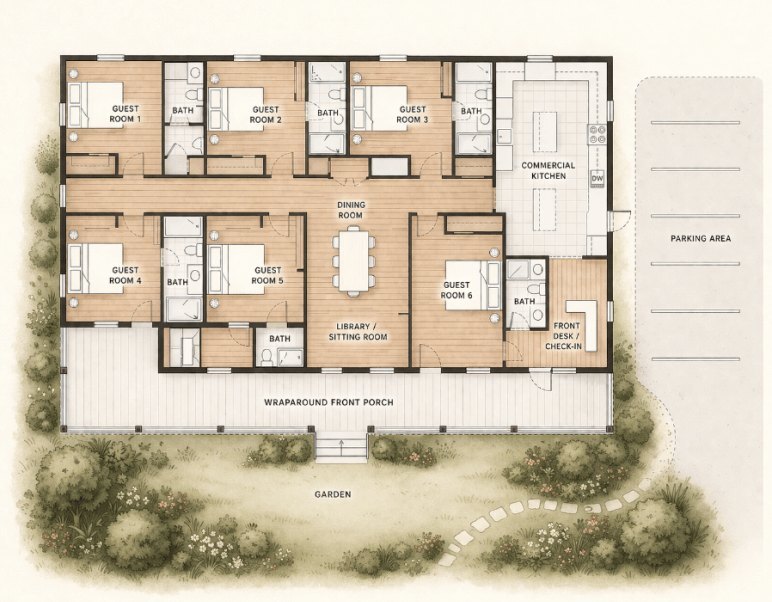
Renovations wrap up in May 2026, ahead of the June opening. David Nguyen oversees the crew directly, managing costs and timeline the same way he has across every property he has run. The floor plan below shows the finished layout across all six guest rooms, common areas, and shared spaces:
Marketing & Sales Strategy
Filling 1,200 room-nights in Year 1 requires a four-channel strategy built around OTA discovery in Year 1 and a steady migration to direct bookings by Year 3. Every dollar in the marketing budget is allocated to a specific channel with a measurable target. The total budget for marketing in Year 1 is $15,000.
Marketing Channels
OTA Listings: Havenwood Inn lists on Booking.com, Airbnb, VRBO, and TripAdvisor before the June 2026 opening.
Website and Direct Booking: The inn’s website goes live in April 2026 with a direct booking engine, professional photography, and seasonal rate pages. Direct bookers receive a best rate guarantee and a Vermont welcome gift on arrival.
Search and Reputation: Rachel manages SEO targeting “B&B in Cedarville, VT” and “Vermont inn near ski resorts.” Automated post-stay emails go out 24 hours after checkout, requesting a Google or TripAdvisor review.
Social Media: Havenwood Inn maintains an active Instagram and Facebook presence focused on Vermont seasonal content, breakfast photos, and guest experience moments. Posts go out three times per week, managed by Rachel using a simple content calendar.
Print and Signage: Branded rack cards are placed at local breweries, ski resort welcome desks, hiking outfitter shops, and the Cedarville visitor center before opening. Print materials carry the direct booking website URL and a QR code linking to the booking engine.
Local Partnerships: David and Rachel built referral partnerships with local breweries, ski resort concierge desks, hiking outfitters, and wedding planners before opening. Partners refer clients needing lodging, and Havenwood Inn refers guests to partner businesses.
Sales Strategy
Turning inquiries into confirmed bookings comes down to four things Havenwood Inn does consistently:
- Professional photography on every OTA listing and the direct website shows guests exactly what they are booking before they commit
- Seasonal packages give first-time visitors a reason to choose Havenwood Inn over a generic Airbnb listing at a similar price point
- Rachel handles every pre-arrival inquiry personally, answering questions about rooms, breakfast, and local activities within 24 hours
- Every guest interaction from booking confirmation to checkout is designed to make the stay feel personal, not transactional
A clear sales process ensures guests find Havenwood Inn at the discovery stage and choose to return at the retention stage.
Operations Plan
Havenwood Inn will implement a 16-hour daily hospitality cycle. Operational benchmarks are established from the 6:00 AM culinary startup through the 10:00 PM facility lockup.
The goal in Year 1 is simple: fill 1,200 room-nights and earn enough reviews to reduce dependence on OTA commissions by Year 2.
Operating Days & Hours
The Inn will maintain a 365-day operational calendar to capture Vermont’s primary tourism cycles: Ski, Mud, Summer, and Foliage.
| Operation | Hours |
| Front Desk | 7:00 AM – 10:00 PM |
| Breakfast Service | 7:30 AM – 9:30 AM |
| Check-out | 11:00 AM |
| Check-in Window | 3:00 PM – 9:00 PM |
| Late Arrivals | 24/7 access via SMS keypad code |
Guest Service Workflow
Guests find Havenwood Inn through OTA listings on Booking.com, Airbnb, VRBO, and TripAdvisor, or directly through the inn’s website. All bookings flow into Little Hotelier, which assigns the room, sends an automated confirmation email, and collects arrival time and dietary preferences within 24 hours of booking.
Two days before arrival, guests receive a pre-arrival email with directions, check-in instructions, and an encrypted keypad code for late arrivals. Rachel reviews the booking notes and prepares the room assignment based on guest preferences, length of stay, and any special occasions noted at booking.
Rooms are assigned at confirmation, not at check-in. Garden View rooms go to solo travelers and shorter stays. Mountain View rooms are prioritized for couples and weekend bookings. The Farmhouse Suite is reserved for special occasions and anniversary stays. If a preferred room type is unavailable, Rachel upgrades where occupancy allows.
Check-in runs from 3:00 PM to 9:00 PM. Rachel greets every arriving guest at the front desk, confirms their room assignment, and hands them a printed local card covering the five nearest trailheads, three craft breweries, and two farm stands within 15 minutes of the inn. Late arrivals use the keypad code sent via SMS and find a welcome card and a Vermont welcome gift in the room.
Checkout is at 11:00 AM. Guests receive an automated reminder at 9:00 AM on departure day. Keys are returned at the front desk or dropped in the key box. A review request and a Returner 10% direct booking code go out automatically 24 hours after checkout.
Daily Operational Workflow
Our daily operations are built around a tight, coordinated schedule to ensure the property runs smoothly. Rachel kicks off the day with kitchen prep at 6:00 AM, leading directly into our signature two-hour breakfast service.
The most critical period occurs between 11:00 AM and 3:00 PM. During this window, David handles maintenance and supply orders while the housekeeping team resets every departing room for the next guest arrival.
The day winds down with Rachel managing bookings and late check-ins through the evening. David completes a final building lockup and security sweep at 10:00 PM to close out the shift.
| Time | Task | Responsible |
| 6:00 AM | Kitchen startup and breakfast prep | Rachel |
| 7:30 AM | Breakfast service opens | Rachel |
| 9:30 AM | Service closes; dining room cleanup | Rachel + Staff |
| 11:00 AM | Guest checkout; room turnover starts | Housekeeper |
| 11:00 AM | Property walkthrough and repairs | David |
| 1:00 PM | Supply orders and vendor follow-ups | David |
| 2:00 PM | Booking updates and review responses | Rachel |
| 3:00 PM | Check-in window opens; rooms ready | Rachel |
| 9:00 PM | Final check-ins completed | Rachel |
| 10:00 PM | Building lockup and light check | David |
Staffing Plan
Havenwood Inn opens as an owner-operated property. Rachel and David Nguyen handle the bulk of daily responsibilities between them, keeping Year 1 payroll controlled while occupancy builds. Combined owner compensation is $80,000 in Year 1 and Year 2, stepping up to $85,000 in Year 3.
Rachel runs front of house from 7:00 AM to 3:00 PM daily, covering morning breakfast service, guest check-ins, and the online booking calendar. David covers the back end on a flexible daily schedule, managing property maintenance, supplier relationships, and grounds upkeep. Both owners are on-site from opening day.
Two staff members join before the June 2026 opening. A full-time housekeeper works 8:00 AM to 2:00 PM daily, managing room turnovers, laundry, and common area cleaning within the four-hour checkout-to-check-in window. A part-time breakfast cook supports Rachel from 6:30 to 10:00 AM, covering food prep and service alongside her.
Guest Booking & Technology
Havenwood Inn uses Little Hotelier as its cloud-based property management system, integrated directly with Booking.com, Airbnb, VRBO, and TripAdvisor. Availability and rates sync in real time across all channels, eliminating double-bookings. Direct website bookings feed into the same calendar and bypass OTA commissions entirely.
Guest pantry sales are processed through Square, and all financial data syncs to QuickBooks for monthly reporting and SBA compliance tracking. Event bookings are managed separately by Rachel with a 30-day minimum advance notice, a signed contract, and a deposit required to confirm the date.
Licensing, Permits & Compliance
Havenwood Inn will secure all required licenses and permits before the June 2026 opening.
Business & Operating Licenses
- Vermont business registration
- Vermont Innkeeper’s license
- Certificate of occupancy and zoning approval
Health & Food Service
- Vermont Department of Health Food Service permit
- Vermont meals and rooms tax registration (9% remitted monthly)
Safety & Compliance
- Annual fire marshal inspection
- ADA compliance for ground-floor guest rooms and common areas
Alcohol Service
- Vermont liquor license for wine and beer service at hosted events
Insurance
- $2M commercial general liability policy
- Property insurance covering the building and contents
- Workers’ compensation insurance for all employees
Facility & Property Management
Physical plant operations will be internalized under David Nguyen’s oversight. This includes direct management of HVAC monitoring, plumbing maintenance, and groundskeeping.
The annual calendar will trigger specific seasonal prep. Winterization of pipes and snow removal contracts will be finalized by November. Spring garden refreshes will occur in May to protect the property’s $175–$275 market positioning.
The maintenance budget starts at $6,000 in Year 1. It will scale to $8,000 by Year 3 as guest traffic increases. Because the pre-opening renovation will address all structural issues, no additional major capital expenditures (CAPEX) will be projected for the first 36 months of operation.
Financial Plan
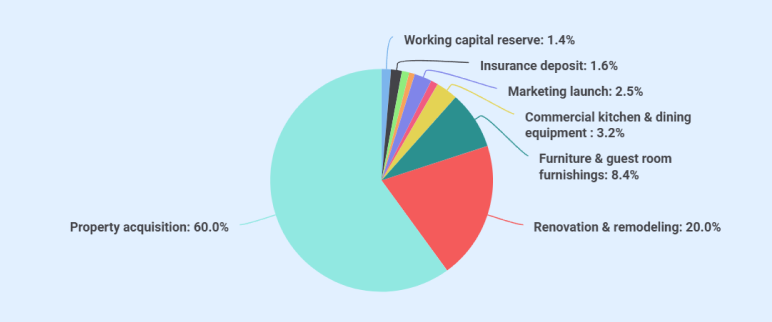
Havenwood Inn requires $475,000 in total startup capital to launch operations. These funds cover property acquisition, historic renovation, guest room furnishings, commercial kitchen equipment, technology systems, and six months of working capital reserve.
Startup Costs
| Expense | Amount |
| Property acquisition (historic farmhouse, 6 bedrooms + common areas) | $285,000 |
| Renovation & remodeling (bathroom upgrades, common areas, ADA compliance) | $95,000 |
| Furniture & guest room furnishings (beds, linens, décor for 6 rooms + lobby) | $40,000 |
| Commercial kitchen & dining equipment (breakfast service) | $15,000 |
| Technology systems (PMS booking software, POS, WiFi infrastructure) | $5,000 |
| Marketing launch (website, signage, OTA listing setup, photography) | $12,000 |
| Licenses & permits (innkeeper’s license, food service permit, fire inspection) | $4,000 |
| Professional fees (legal, accounting, property inspection) | $5,000 |
| Insurance deposit (prepaid property + liability + workers’ comp) | $7,500 |
| Working capital reserve (cash operating float) | $6,500 |
| Total Startup Costs | $475,000 |
Source of Funds
| Source | Amount |
| SBA 7(a) Loan (Green Mountain National Bank) | $350,000 |
| Owner equity contribution (Rachel & David Nguyen) | $125,000 |
| Total Startup Capital | $475,000 |
Key Financial Assumptions
| Item | Assumption |
| Average revenue per occupied room-night (blended) | $258 (room rate avg $225 + $33 ancillary per night) |
| Occupied room-nights per year | Year 1: 1,200 (55% occ.); Year 2: 1,380 (63%); Year 3: 1,546 (71%) |
| Available room-nights per year | 2,190 (6 rooms × 365 days) |
| Revenue growth rate | |
| Direct materials/food & amenities cost | 18% of revenue |
| Direct labor cost (housekeeping + breakfast cook) | 15% of revenue |
| Payroll tax rate | 10% of wages |
| Owner/admin salary | Year 1–2: $80,000; Year 3: $85,000 |
| DSO (Days Sales Outstanding) | 5 days |
| DPO (Days Payable Outstanding) | 15 days |
| Inventory days on hand | 5 days |
| Lender | Green Mountain National Bank |
| Loan principal | $350,000 |
| Loan term | 10 years (120 monthly payments) |
| Annual interest rate | 7.50% fixed |
| Monthly payment | $4,155 |
| Interest expense (Yr 1–3) | Yr 1: $25,421; Yr 2: $23,525; Yr 3: $21,481 |
| Principal repayment (Yr 1–3) | Yr 1: $24,433; Yr 2: $26,330; Yr 3: $28,374 |
| Ending loan balance (Yr 1–3) | Yr 1: $325,567; Yr 2: $299,237; Yr 3: $270,863 |
| Building depreciation ($228K ÷ 27.5 yr) | $8,291/year |
| Renovation depreciation ($95K ÷ 15 yr) | $6,333/year |
| Furniture depreciation ($40K ÷ 7 yr) | $5,714/year |
| Kitchen equipment depreciation ($15K ÷ 7 yr) | $2,143/year |
| Technology depreciation ($5K ÷ 3 yr) | $1,667/year |
| Total annual depreciation | $24,148 |
| Land (not depreciated) | $57,000 (20% of $285K acquisition) |
Income Statement
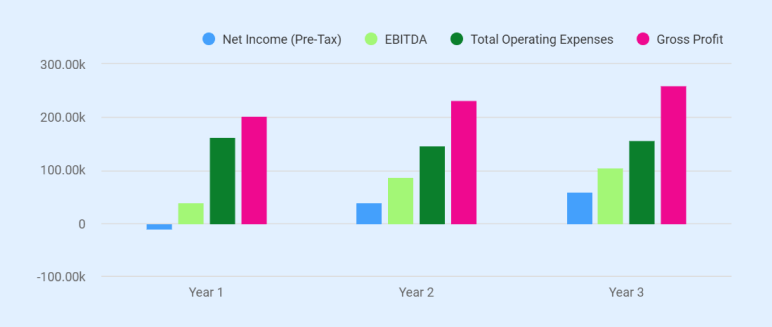
| Year 1 ($) | Year 2 ($) | Year 3 ($) | |
| Occupied Room-Nights | 1,200 | 1,380 | 1,546 |
| Total Revenue | 309,600 | 356,040 | 398,765 |
| COGS | |||
| Direct materials/food & amenities (18%) | 55,728 | 64,087 | 71,778 |
| Direct labor housekeeping & breakfast (15%) | 46,440 | 53,406 | 59,815 |
| Payroll taxes on direct labor (10%) | 4,644 | 5,341 | 5,982 |
| Total COGS | 106,812 | 122,834 | 137,575 |
| Gross Profit | 202,788 | 233,206 | 261,190 |
| Gross Margin | 65.5% | 65.5% | 65.5% |
| Operating Expenses | |||
| Owner/admin salaries | 80,000 | 80,000 | 85,000 |
| Payroll taxes on owner salaries (10%) | 8,000 | 8,000 | 8,500 |
| Property taxes | 4,800 | 4,800 | 4,800 |
| Insurance (property + liability + workers’ comp) | 7,500 | 7,800 | 8,100 |
| Accounting & legal | 4,500 | 3,500 | 3,500 |
| Utilities (electric, water, gas, internet, phone) | 9,600 | 10,000 | 10,400 |
| Marketing (ongoing OTA commissions, digital ads, print) | 15,000 | 18,000 | 20,000 |
| Supplies & consumables | 3,600 | 4,000 | 4,400 |
| Repairs & maintenance | 6,000 | 7,000 | 8,000 |
| Technology subscriptions (PMS, POS, channel mgr) | 3,600 | 3,800 | 4,000 |
| Marketing launch one-time (Year 1 only) | 12,000 | – | – |
| Licenses & permits one-time (Year 1 only) | 4,000 | – | – |
| Professional services one-time (Year 1 only) | 5,000 | – | – |
| Total Operating Expenses | 163,600 | 146,900 | 156,700 |
| EBITDA | 39,188 | 86,306 | 104,490 |
| Depreciation | 24,148 | 24,148 | 24,148 |
| EBIT | 15,040 | 62,158 | 80,342 |
| Interest expense | 25,421 | 23,525 | 21,481 |
| Net Income (Pre-Tax) | (10,381) | 38,633 | 58,861 |
Cash Flow Statement
| Year 1 ($) | Year 2 ($) | Year 3 ($) | |
| Beginning Cash | 27,500 | 23,020 | 59,273 |
| Operating Activities | |||
| Net income (pre-tax) | (10,381) | 38,633 | 58,861 |
| Depreciation (non-cash add-back) | 24,148 | 24,148 | 24,148 |
| Change in accounts receivable | (4,241) | (636) | (586) |
| Change in inventory | (1,463) | (220) | (202) |
| Change in accounts payable | 4,390 | 658 | 606 |
| Change in prepaid expenses | 7,500 | 0 | 0 |
| Net Cash from Operations | 19,953 | 62,583 | 82,827 |
| Investing Activities | |||
| Capital expenditures | 0 | 0 | 0 |
| Net Cash from Investing | 0 | 0 | 0 |
| Financing Activities | |||
| Loan principal repayment | (24,433) | (26,330) | (28,374) |
| Net Cash from Financing | (24,433) | (26,330) | (28,374) |
| Net Change in Cash | (4,480) | 36,253 | 54,453 |
| Ending Cash | 23,020 | 59,273 | 113,726 |
Balance Sheet (Day 0)
| Line Item | Amount ($) |
| ASSETS | |
| Cash (working capital + one-time expense float) | 27,500 |
| Prepaid expenses (insurance deposit) | 7,500 |
| Gross PP&E (property, renovations, furniture, equipment, tech) | 440,000 |
| Total Assets | 475,000 |
| LIABILITIES & EQUITY | |
| SBA 7(a) term loan (Green Mountain National Bank) | 350,000 |
| Owner’s capital paid-in (Rachel & David Nguyen) | 125,000 |
| Total Liabilities + Equity | 475,000 |
Balance Sheet (Years 1-3)
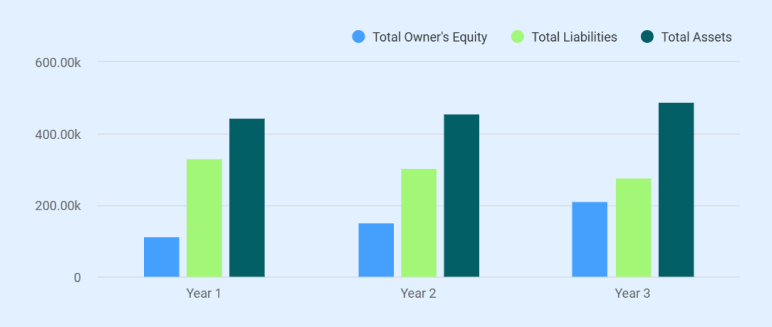
| Year 1 ($) | Year 2 ($) | Year 3 ($) | |
| ASSETS | |||
| Cash | 23,020 | 59,273 | 113,726 |
| Accounts receivable | 4,241 | 4,877 | 5,463 |
| Inventory | 1,463 | 1,683 | 1,885 |
| Prepaid expenses | 0 | 0 | 0 |
| Net PP&E | 415,852 | 391,704 | 367,556 |
| Total Assets | 444,576 | 457,537 | 488,630 |
| LIABILITIES | |||
| Accounts payable | 4,390 | 5,048 | 5,654 |
| SBA term loan | 325,567 | 299,237 | 270,863 |
| Total Liabilities | 329,957 | 304,285 | 276,517 |
| EQUITY | |||
| Paid-in capital | 125,000 | 125,000 | 125,000 |
| Retained earnings | (10,381) | 28,252 | 87,113 |
| Total Owner’s Equity | 114,619 | 153,252 | 212,113 |
Break-Even Analysis
| Item | Value |
| Average revenue per room-night | $258 |
| Direct materials per night (18%) | $46 |
| Direct labor per night (15%) | $39 |
| Payroll taxes on direct labor (10% of $39) | $4 |
| Total variable cost per room-night | $89 |
| Contribution margin per room-night | $169 |
| Contribution margin (%) | 65.5% |
| Annual fixed operating costs (Year 2 steady-state) | $146,900 |
| Break-even room-nights per year | 869 nights |
| Break-even room-nights per month | 72 nights |
| Break-even occupancy rate | 39.7% |
| Break-even revenue (annual) | $224,202 |
The Quickest Way to turn a Business Idea into a Business Plan
Fill-in-the-blanks and automatic financials make it easy.
