




Cannabis is an industry like no other—licensing rules are strict, compliance demands are high, and investors expect a clear plan backed by real numbers.
A simple outline might just not be enough; you need a comprehensive template to ensure you don’t miss out on critical information.
We’ve curated this template considering all the licensing and regulatory requirements, legal landscape, market dynamics, and more.
Download this cannabis cultivation business plan template; it has everything you need to draft a detailed plan.
Keep reading for assistance using the template or drafting an investor/lender-ready plan:
How to create a solid cannabis cultivation business plan?
If you’re serious about getting licensed and funded, you have to draft every business plan section with clarity and confidence. Each one has a job to do.
Here’s how to write them and, more importantly, how to make them work specifically for a cannabis cultivation business:
1. Executive Summary
The executive summary isn’t just an introduction to your cannabis cultivation business plan. It’s your pitch in written form, and it should give any reader, regulator, or investor the full picture in less than a page or two.
Start with who you are, what you’re building, and where you’re operating. If your property is already secured and zoned for cultivation, lead with that. It shows you’re beyond the idea stage.
Keep it lean, confident, and more specific. Something like:
“Green Valley Farms LLC is a licensed cannabis cultivation company based in Mendocino County, California. We have secured a 10‑acre parcel zoned for agricultural use and approved for commercial cannabis cultivation.”
Then, make sure you cover these key points in your plan summary:
- Your chosen cultivation license and category
- Cultivation model, whether it’s indoor, outdoor, or greenhouse
- Competitive edge that makes you different (like sustainable methods or advanced tech)
- Funding needs and main uses (if applicable)
- Financial outlook, including revenue potential & growth forecast
By addressing each of these points clearly, you’ll give investors, lenders, and regulators a complete picture of your cultivation business before they even turn the page.
Say goodbye to boring templates
Build your business plan faster and easier with AI
Plans starting from $14/month

2. Business Overview
In cannabis, you can’t just say, “We grow weed.” You need to show that you understand the business side, the legal landscape, and your place in it.
Here’s what you need to include in this section:
- Legal entity – Are you an LLC, corporation, or partnership? This matters for licensing and taxation.
- Location specifics – Describe your site. Also, note the required distance from schools, churches, and other restricted areas.
- Mission statement – Keep it short and real. For example:
“To produce consistent, high‑quality cannabis flower using sustainable methods, while maintaining full compliance with state regulations.”
Company history (if any) – If you’ve already been growing under medical laws or have related agriculture or horticulture experience, say so.
After that, set clear goals and outline how they connect where you are now with where you plan to be. Break them into two categories so they’re easy to follow:
- Short‑term goals for the first 12 months like securing licensure, finishing your build‑out, hitting your first harvest, and signing a few wholesale supply deals.
- Long‑term objectives for 3–5 years, such as expanding your canopy, adding premium cultivars, launching value‑added products, or moving toward in‑house processing.
In addition, cover your regulatory compliance. Name your governing body (e.g., California Department of Cannabis Control) and confirm you meet all eligibility requirements. This shows investors that you’re ready to operate within the rules from day one.
3. Market Analysis
This is where many cannabis plans collapse as they copy‑paste generic market data and call it a day. That won’t cut it. Your market analysis should prove that you know your state and your market niche.
The following are the key elements to include in the market research section:
Market size and growth
Start with the state and regional market size. Use credible sources, and focus on your specific sector (here: cultivation). Something like:
The cannabis market in the United States is projected to generate $46.99 billion in revenue in 2025. It’s expected to grow at a compound annual growth rate (CAGR) of 3.36% between 2025 and 2030 to reach $55.43 billion.
Target customers
Identify your potential customers. In cultivation, your customers aren’t end‑consumers—they’re licensed buyers. The table below shows who could be your target customers and what their specific needs are.
| Customer segment | Key needs |
|---|---|
| Licensed dispensaries | Consistent supply, lab-tested quality, strong shelf appeal |
| Cannabis wholesalers/distributors | Reliable bulk volumes, variety of strains, competitive per-pound pricing, clear packaging & labeling |
| Extraction companies | Fresh-frozen or biomass material with high cannabinoid and consistent availability |
| Medical cannabis retailers | CBD-dominant or balanced THC/CBD strains and pesticide-free cultivation |
| Pre-roll manufacturers | Bulk flower and trim suitable for pre-rolls, consistent grind quality, steady supply schedule |
Further, explain why they’d choose your product over someone else’s. This is where you connect your strain selection, quality level, and pricing strategy to actual buyer needs.
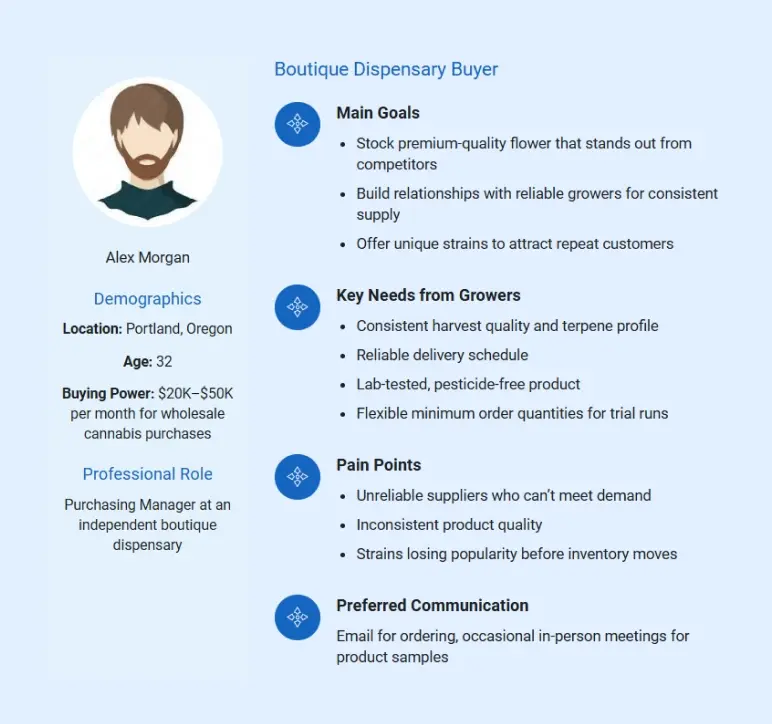
If required, create a customer persona that describes your ideal buyer with demographics, buying habits, and key preferences. For instance:
Key trends
Next, address demand trends: What product types and strains are selling well? Are consumers leaning toward high‑THC flower, balanced CBD strains, or terpene‑rich craft products?
Competitive analysis
Identify 2–3 main competitors in your area. What strains do they grow? What are their price ranges?
Also, evaluate the strengths and weaknesses compared to your planned approach. This helps position your business as either competing on quality, price, or a unique selling point.
Finally, analyze the pricing strategies. Cannabis is notorious for price swings. In some states, wholesale flower went from $3,000/lb to under $1,000/lb in just a few years. If you don’t show you’ve accounted for this, investors will assume you’re guessing.
Your goal here is to prove you’ve looked at the hard numbers, identified your market niche, and have a realistic plan to stay profitable even if the market shifts.
4. Products And Services
This section spells out exactly what you’ll grow, why you’re growing it, and how it’s going to appeal to buyers.
It’s not enough to say “premium flower”—every grower says that. You need to show why your strains, cultivation methods, and post-harvest processes will produce a product people are willing to pay for at your target price point.
Choose strains with a mix of market demand, growing practicality, and brand potential. Avoid going all-in on one hype strain; they peak and fade fast.
Here’s what you can discuss in this section:
- Strain lineup (names, genetics, and why they were chosen)
- Product formats (wholesale flower, clones, seeds, biomass for extraction, pre-rolls)
- Quality standards (organic inputs, pesticide-free, hand-trimmed, lab-tested)
- Post-harvest process ( drying, curing, trimming, packaging, lab testing)
- Unique differentiators (terpene focus, exclusive genetics, sustainability certifications)
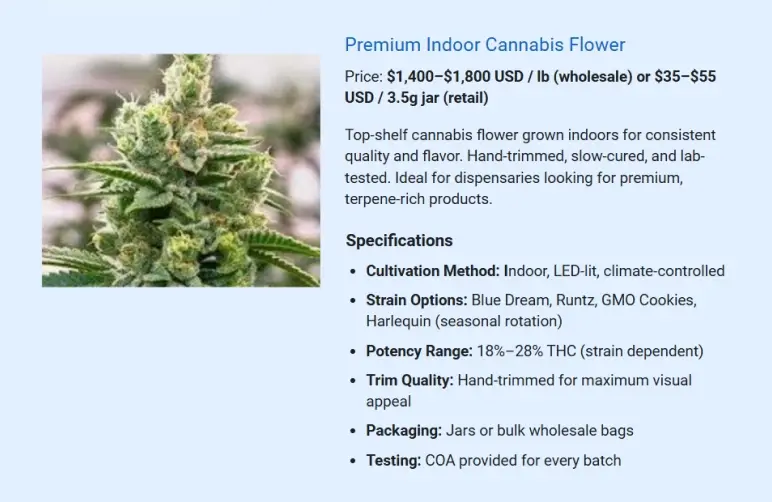
Below is a sample product description created in Upmetrics to demonstrate how to present yours:
5. Sales And Marketing Strategies
Cannabis marketing is tricky. You can’t run ads on Google or Facebook, and you’re limited by strict compliance rules. That means you need a realistic, relationship‑driven plan.
Here’s how to break your marketing and sales approach into clear focus areas:
Distribution channels
Decide how you’ll get your product to market. Will you sell directly to dispensaries? Work through a licensed distributor? Or both? Show you understand the rules in your state.
Brand positioning
Be clear about where you sit in the market. Are you the “craft, small‑batch grower,” or the “reliable volume supplier”? This matters for pricing and marketing strategy.
Compliant marketing tactics
Focus on strategies that work within cannabis regulations. Event sponsorships, budtender training programs, in‑store promotions, and coverage in cannabis‑focused media can all help you stay visible while staying compliant.
Sales relationships
In cannabis, relationships sell more product than ads. Building trust with buyers early and locking in supply agreements before your first harvest gives you a strong advantage with both regulators and investors.
6. Operations Plan
This section lays out the day-to-day process of growing, harvesting, and scaling your cannabis operation.
A well-thought-out operations plan shows you can produce consistent quality and meet supply commitments without breaking compliance rules.
When you plan this section, try to break down the entire cultivation cycle from sourcing seeds to post-harvest packaging. Be specific about equipment, staffing, and compliance systems.
The following are the key elements to include in this section:
- Facility type and size (canopy square footage)
- Lighting, HVAC, irrigation, and security systems
- Cultivation cycles (harvests/year, yield expectations)
- Supplier list (genetics, soil, nutrients)
- Staffing plan (growers, trimmers, compliance)
- Compliance systems (plant tracking, testing)
- Scaling plan (expanding canopy, automation)
In short, your operations plan proves you can deliver on your sales promises. Next, you’ll show you have the team to make it happen.
7. Management Team
Cannabis cultivation success depends heavily on experienced leadership and compliance management. Investors and licensing boards also review your team for background qualifications.
And in this section, introduce the people running your cannabis cultivation business—the decision-makers, compliance keepers, and operational leads.
It’s not just a résumé list. It’s proof that your team has the skills to run a grow successfully and keep it legal.
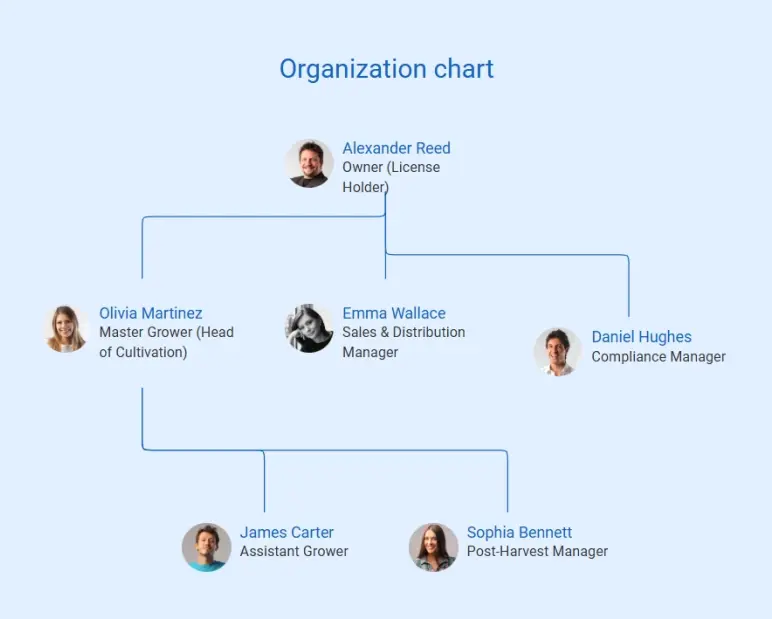
When you introduce your management team, start with the leadership roles, including business owner, head of cultivation, compliance officer, etc. Then state the relevant experience that makes them fit for the job.
Be clear about their responsibilities so it’s obvious who makes which decisions. You can also include an organization chart here to show your team’s structure and reporting lines.
If your team is missing key experience, don’t fake it. Bring in part-time consultants or advisors to fill the gap, especially in compliance and finance.
Finally, confirm that your team meets your state’s licensing and background check requirements, something that both regulators and investors will want to see.
8. Financial Plan
This section is where you show exactly how the numbers work!
It’s a financial blueprint for your cannabis cultivation business, showing what it will cost to launch, how much it will cost to operate, how much revenue you can realistically make, and when you expect to break even.
Here’s what you need to cover in your cannabis cultivation financial plan:
Startup costs
Break this into categories so it’s clear where your money is going:
| Category | Estimated range |
|---|---|
| Land or lease deposit | $30,000 – $100,000 |
| Licensing & legal fees | $5,000 – $50,000 |
| Facility buildout | $100,000 – $500,000 |
| Security systems (cameras, alarms, access control) | $10,000 – $50,000 |
| Equipment and tools (trimming machines, drying racks, etc.) | $50,000 – $200,000 |
| Initial inventory (seeds/clones, soil/coco, nutrients) | $5,000 – $20,000 |
| Payroll (pre-revenue) | $20,000 – $80,000 |
| Lab testing & compliance fees | $3,000 – $10,000 |
| Total startup estimate | $300,000 – $2,000,000 |
Operating expenses (monthly)
Include operating expenses month-by-month for the first year, because cannabis cultivation has long lead times before revenue comes in.
- Rent/lease: $5,000 – $20,000 (market & size dependent)
- Utilities: $8,000 – $20,000 (indoor grows are power-hungry)
- Nutrients & consumables: $3,000 – $8,000
- Payroll: $15,000 – $40,000
- Compliance testing: $500 – $2,000 per batch
- Insurance: $500 – $2,000
- Marketing/sales: $1,000 – $3,000
Revenue projections
Base your numbers on realistic wholesale prices and yield per sq. ft., not best-case scenarios:
Example for a 3,000 sq. ft. flowering canopy:
Yield: 0.5 lbs per sq. ft. per cycle → 1,500 lbs/year at 5 harvests
Wholesale price: $1,400/lb (current state average for quality indoor)
Annual gross revenue: ~$2.1M
Profit and loss statement
This is the actual money you’ll keep after covering all expenses. Here’s an example of financial projections for years 1–3:
| Year | Revenue | Expenses | Net profit/loss |
|---|---|---|---|
| 1 | $400,000 | $380,000 | $20,000 |
| 2 | $1,500,000 | $1,100,000 | $400,000 |
| 3 | $2,100,000 | $1,300,000 | $800,000 |
Break-even analysis
This tells you the point where your total revenue finally matches your total costs, and you stop losing money.
For example:
With $350K in startup costs and a projected Year 2 net profit of $400K, break-even is expected between Months 18–22, depending on wholesale price stability.
Price scenario planning
If required, build your projections at three price points:
- Conservative (low market pricing)
- Realistic (current average)
- Optimistic (premium pricing if market conditions improve)
That way, you’re prepared for price drops, which in cannabis, are not a matter of “if” but “when.”
In fact, most cannabis business owners overestimate revenue and underestimate costs all the time. We even noticed dozens of plans where founders assumed $2,000/lb pricing in a market that’s been under $1,400 for two years straight, or forgot to budget for compliance testing fees.
And yes, investors spot that instantly. Licensing regulators don’t care about your profits, but they do care whether you can fund your operation without running out of cash mid-license term.
So, ensure you begin with real market data for pricing and yields. Then layer in actual vendor quotes for buildout, equipment, and supplies, not just “Google averages.”
9. Appendix
This section clearly shows how much money you need to launch your cannabis cultivation business and exactly how you plan to use it.
Investors, lenders, and even licensing authorities need to know you’ve done the math and that your request is grounded in actual startup costs and realistic operating budgets.
Too vague, and they’ll assume you’re just guessing. Too high without justification, and they’ll think you don’t understand your own business.
Start by listing your funding needs into specific categories so anyone reading this can see exactly where the money will go. Give a realistic cost estimate. Something like this:
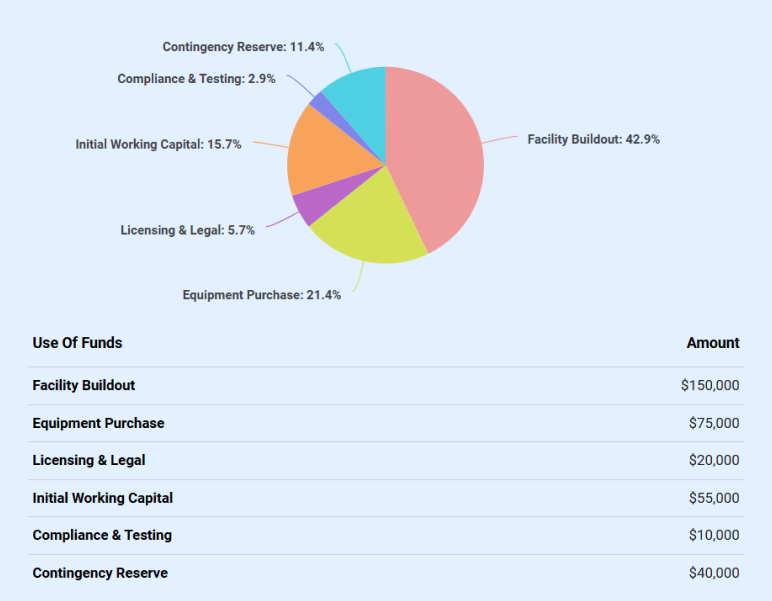
If required, back these numbers up with vendor quotes, state fee schedules, or data from similar-sized grows.
In cannabis cultivation, always include a contingency reserve in your funding ask. Licensing delays, equipment backorders, or power upgrades can easily push costs higher than expected.
Moreover, highlight what investors get in return (if you’re pitching to them). Equity percentage, repayment terms, or exit strategy. This is so because private capital often moves faster than bank financing, but investors expect a clear return plan.
Download a free cannabis cultivation business plan template
Ready to kickstart your cannabis cultivation business plan, but don’t know where to begin? Worry not! Grab our free cannabis cultivation business plan template PDF to get started.
This professional-looking template is specifically built for growers like you. It comes with real-life examples and clear prompts for creating a plan that works for funding, licensing, and running a profitable, well-organized business.
The Quickest Way to turn a Business Idea into a Business Plan
Fill-in-the-blanks and automatic financials make it easy.

Conclusion
Now that we’ve explained how to draft a solid cannabis cultivation business plan, it’s much easier for you to map out your goals, stay compliant, and build a plan that works.
However, if you’re still unsure about the details or want a faster, easier way to put it all together, Upmetrics can help.
It’s designed to make your planning process a breeze with its advanced AI Assistant, ready-to-use templates, financial forecasting features, and market analysis tools that save you time.
So, why wait? Take the next step and start planning your cultivation business today!


