




You’ve Googled “how to write a coaching business plan” and ended up more confused than when you started. You got templates with empty brackets, and guides that explain what to write, but never actually show you.
Hours wasted and still no clearer on what a finished plan looks like. I know the frustration.
That’s exactly why I put this together.
It’s a complete sample business plan of Catalyst Coaching Group, a professional coaching practice launching in Eugene, Oregon. It covers actual numbers, real market research, and financials that lenders can actually follow.
Use it as your reference. And build your own plan from here.
Executive Summary
Most coaching practices in the Eugene area offer one thing: Hourly sessions with a single coach. Catalyst Coaching Group is built differently. It combines International Coaching Federation (ICF)-certified one-on-one coaching, structured group programs, corporate workshops, and a self-paced online course under one practice.
Eugene’s professional community is growing, but the support infrastructure hasn’t kept up. Mid-career professionals navigating transitions and first-time entrepreneurs building businesses need more than a weekly check-in. They need a structured program with a clear outcome.
That’s what separates Catalyst from the solo coaches it competes with.
The owner, Maya Thornton, spent 8 years at a mid-size Portland tech company running leadership programs for 200-plus employees. She was good at the job. What frustrated her was that the big programs she built rarely moved people as much as a simple one-on-one conversation did.
She left her HR Director role in early 2026 to build a practice around what actually worked. She chose Eugene because she knew it well enough to see what was missing: A real coaching practice, not just a freelancer with a Zoom link.
Lane County’s residents include a substantial base of college-educated professionals in the 30-to-50 age range. That’s the demographic this practice is built around.
Maya holds a Professional Certified Coach (PCC) credential from the International Coaching Federation (ICF) and an MBA (Master of Business Administration) from Portland State University. She brings 200-plus professional contacts in Oregon into this from day one; that network is the client pipeline for Year 1, not paid ads or cold outreach.
The practice aims to help mid-career professionals and aspiring entrepreneurs in the Eugene area build a clear, concrete plan for what comes next. Not clarity in the abstract. An actual plan with steps.
Four Revenue Streams
Catalyst Coaching Group generates revenue through four service lines:
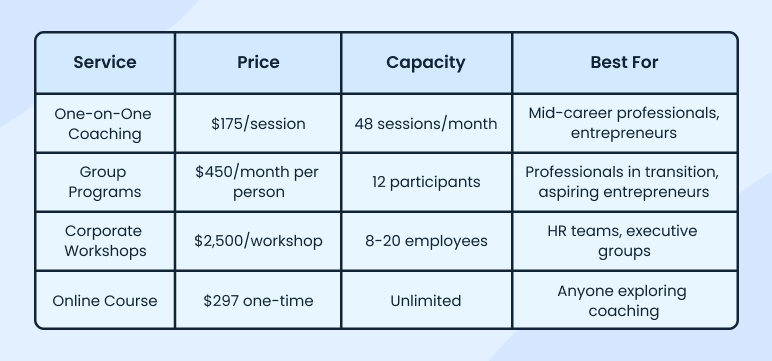
| Service | Format | Price |
| One-on-One Coaching | 60-min sessions, in-person or Zoom | $175 per session |
| Group Coaching Programs | 6-person cohorts, 12-week cycles | $450/month per participant |
| Corporate Workshops | Half-day, delivered on-site | $2,500 per workshop |
| Online Course | Self-paced, 6 modules | $297 one-time |
Running four services means the business doesn’t live or die on any single one. If corporate bookings go quiet in Q3, and they sometimes do, the group cohorts are still running. That’s the practical reason for the structure, not the marketing reason.
Funding Request
Catalyst needs $90,000 to open:
- $75,000 SBA 7(a) loan from Summit Pacific Credit Union, 7-year term, 7.50% fixed rate, $1,150/month payment
- $15,000 owner equity from Maya Thornton, drawn from personal savings set aside over three years in her corporate role
Financial Highlights
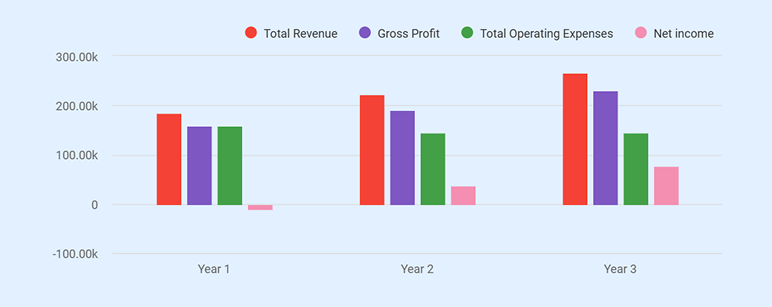
The financial projections below reflect conservative assumptions: 20% annual revenue growth, an 86.2% gross margin, and nothing outside the four service lines. Year 1 ends at a net loss of ($9,668). That loss is driven by approximately $15,000 in one-time launch expenses.
Without those costs, Year 1 would be marginally profitable. The ongoing business covers its cost base from Year 2 forward, reaching $37,883 in net income and full profitability.
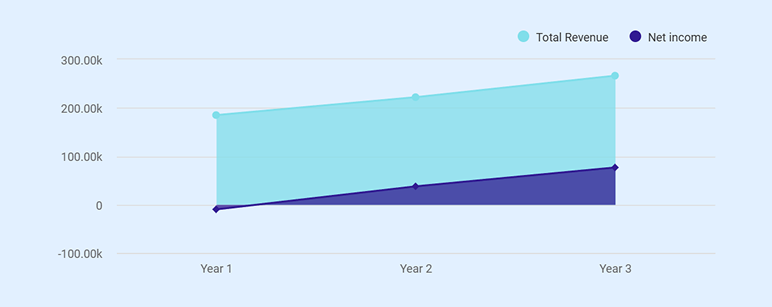
| Item | Year 1 ($) | Year 2 ($) | Year 3 ($) |
| Coaching Sessions | 740 | 888 | 1,066 |
| Total Revenue | $185,000 | $222,000 | $266,400 |
| Gross Profit | $159,470 | $191,364 | $229,637 |
| Net Income (Pre-Tax) | ($9,668) | $37,883 | $76,864 |
| Ending Cash | $49,867 | $81,711 | $151,523 |
The assumption worth watching is 62 sessions per month in Year 1. That’s the number this plan is least certain about. It’s grounded in Maya’s existing network and three referral partnerships being confirmed before launch, not wishful thinking, but it’s still a projection for a brand-new practice.
If bookings ramp slower than expected, the $49,867 in ending cash is what keeps the doors open while things adjust.
Business Overview
Catalyst Coaching Group is registered in Oregon as a single-member limited liability company (LLC) and officially opened in April 2026. The office is at 1455 Oak Street, Suite 210, Eugene, OR 97401. It’s a 600-square-foot leased suite in downtown Eugene.
Maya picked a real office over working from home because clients needed somewhere that felt like a proper business. That decision was made early and hasn’t changed. The space has three areas:
- A private room for one-on-one sessions
- A group area that seats eight
- A small reception up front
It sits in downtown Eugene, one block off the Willamette Street business corridor, where most target clients already work. Anyone outside that area can join sessions on Zoom.
Owner Profile
Maya Thornton is 38 years old and the sole owner of the practice. Her last role was HR Director at a mid-size Portland tech company, where she ran leadership programs for a team of over 200 people. The programs were well-designed and well-funded.
But the real breakthroughs kept happening in smaller settings, not in the big workshops. A 45-minute one-on-one conversation moved people more than a full-day session ever did. She saw that pattern repeat enough times that staying in the corporate role stopped making sense.
That’s what led her to start a life coaching business. Not a sudden decision. Just years of noticing the same thing.
Maya holds a Professional Certified Coach (PCC) credential from the International Coaching Federation (ICF) and an MBA (Master of Business Administration) from Portland State University. The ICF credential matters most on the corporate side. Most HR teams won’t approve an outside facilitator without it.
How the Business Runs
Maya handles all coaching and facilitation. A part-time virtual assistant manages scheduling, client intake, and invoicing for 20 hours each week. That’s the full staffing picture for Year 1.
The four services work as a progression, not just a menu. Someone unsure about coaching starts with the $297 online course. If it resonates, there’s a clear next step into a group program or a full coaching engagement. Most people don’t walk in ready to commit on day one, so having that entry point matters.
Future Goals
Year 1 is about building a working foundation. The targets are:
- Run two full group cohort cycles with six participants each, starting in January and April
- Sign two corporate workshop clients before June 2026
- Have three referral partners sending consistent leads by month three
Those three things drive the revenue numbers. Hit them, and Year 1 is a success beyond just the financials.
Year 2 is about turning the foundation into a running business:
- Deliver 888 sessions and hit $222,000 in revenue
- Run all four quarterly cohort cycles at full capacity (12 participants each)
- Grow corporate workshop clients from two to four
- Reach $37,883 in net income, the first profitable year
Year 3 goals are more directional. The plan is to expand cohort capacity and grow corporate contracts. We aim for 1,066 sessions and $266,400 in revenue.
How fast that happens depends largely on how Eugene’s mid-size employers respond to the workshop offering. Maya revisits the Year 3 targets at month 18 with actual data in hand.
Market Analysis
Industry Overview
Coaching has grown into a serious profession over the past several years. According to the ICF Global Coaching Study, the number of coaches worldwide crossed 100,000 for the first time in 2022, a 54% jump from 2019. Global revenue that year hit $4.564 billion, up 60% from 2019.
The numbers have kept climbing. The recent 2025 ICF Global Coaching Study shows the global number of coach practitioners reached a record 122,974, with the profession generating an estimated $5.34 billion in annual revenue.
In the U.S. specifically, the business coaching market reached around $20 billion in 2025, growing at a 4.5% annual rate, according to IBISWorld.
More clients are looking for coaches. More coaches are entering the market, too. According to the U.S. Bureau of Labor Statistics, employment of training and development specialists is projected to grow 8% through 2033, faster than the average for all occupations. A clear niche and a structured plan matter more now than they did five years ago.
Industry Trends
In the past five years, a few things have changed that matter directly to the coaching practice. Here’s what’s driving the demand Catalyst is entering.
Remote Work and Career Uncertainty
Remote work shifted how professionals think about their careers. Over 34.3 million Americans teleworked or worked at home for pay as of April 2025, representing 21.6% of the workforce.
Many of those professionals are mid-career, working through uncertainty about whether their current path still makes sense. That uncertainty is a direct driver of coaching demand.
Corporate Training Budgets Are Shifting
Corporate training budgets are shifting toward external providers, too. Corporate coaching spend is growing at 8.4% annually, driven by leadership development and management programs. Many mid-size employers have moved away from building internal programs and now bring in outside coaches instead.
Entrepreneurship Is Rising
Americans filed 5.2 million new business applications in 2024, up 48.6% from 2019. First-time founders increasingly need a structured thinking partner, not just a consultant with a plan.
Local Market Opportunity
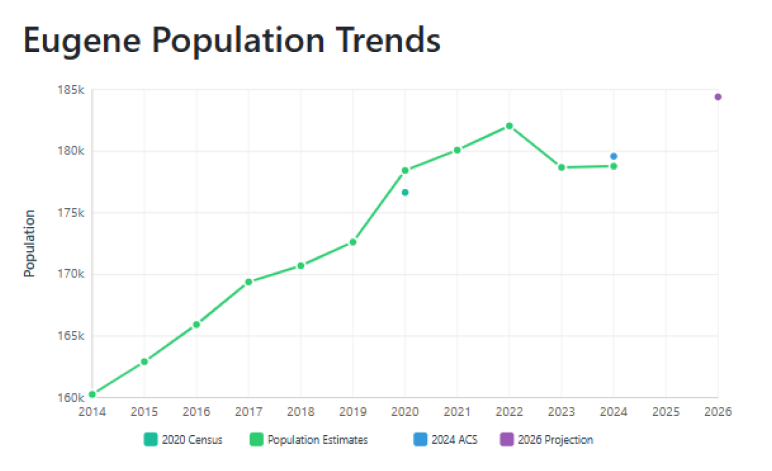
Eugene has the right profile for this practice. The city’s projected 2026 population is 184,409, the third largest in Oregon. Lane County’s total population is 382,647, with most residents living in the Eugene and Springfield urban area.
The workforce numbers support demand. Eugene’s economy employs 183,000 people, with management occupations accounting for 19,209 workers and educational services employing 21,320.
Households in the 25-to-44 age range report a median income of $74,667, while those in the 45-to-64 range report $88,835. Both groups fall inside Catalyst’s target income bracket of $75,000 to $150,000.
Two additional local dynamics strengthen the case:
- Nearly one in four workers in Oregon is now 55 or older, creating a steady wave of mid-career professionals navigating transitions and retirement decisions.
- And Lane County jobs are projected to increase 6% by 2034, with the strongest growth in health care, education, and professional services.
More professionals are moving into and through careers in a city with no established coaching practice. That’s an opportunity, not a risk.
Most coaches who serve this kind of client are based in Portland, about 110 miles away. Eugene has no full-service, ICF-certified coaching practice with a physical office, group programs, and corporate workshops under one roof. That’s the gap Catalyst is built to fill.
Writing market analysis from scratch?
Build a lender-ready business plan in a few hours
Target Customer Profile
Catalyst works with two types of individual clients and one type of organizational buyer.
Individual Clients (B2C)
| Segment | Demographics | Primary Pain Point | Service Match |
| Mid-Career Professionals | Ages 30-50, income $75K-$150K, college-educated | Feeling stuck, no clear next step | One-on-One Coaching, Group Programs |
| First-Time Entrepreneurs | Ages 25-45, early-stage business | Overwhelmed, need accountability | One-on-One Coaching, Online Course |
Organizational Buyers (B2B)
| Segment | Profile | Primary Need | Service Match |
| Corporate Teams | Mid-size companies, 50-500 employees, HR-led | Leadership and manager development | Corporate Workshops |
Buying Behavior and Decision Journey
Hiring a coach isn’t a quick decision. Most people take a few weeks from the first search to the first booking. They look up coaches online, check LinkedIn profiles, read through bios and credentials, and then request a consultation.
85% of coaching clients value coaches who hold a recognized credential as a professional standard of quality assurance. That’s why the ICF credential matters. A polished website and a clear booking process matter too. Social media follower counts don’t.
The discovery call is usually what moves someone from interested to enrolled. Catalyst offers a free 30-minute call before recommending any service. Most clients need that step before they’re ready to commit. What usually gets them to book it in the first place is a referral from someone they already trust.
Competitive Analysis
The Eugene area has roughly 12 to 15 active coaching professionals, based on a search of the Yelp local business listings. Most are solo practitioners offering one thing: Hourly sessions at a single price point.
A few Portland-based firms serve the broader Oregon market, but they tend to focus on corporate clients only. No practice in the immediate Eugene area currently combines ICF certification, individual coaching, group programs, corporate workshops, and an online course under one roof.
That gap is what this analysis is built around.
How the Competition Breaks Down
| Competitors | Certification | Services | Price Range | Location | Key Limitation |
| Clarity Path Coaching (Solo Local Coach) | None | Individual sessions only | $125/session | Eugene area | No credential, one service only |
| Pacific Leadership Group (Portland Coaching Firm) | Varies | Corporate workshops only | $300/hour | Portland | No individual clients, too far |
| NextStep Coaching Co. (Online-Only Coach) | Varies | Individual + group via Zoom | $200/session | No local presence | No in-person, no corporate |
| Catalyst Coaching Group | ICF PCC | Individual, group, corporate, online course | $175 to $2,500 | Eugene + virtual | New practice, no local reviews yet |
The solo local coach is the most direct competitor for individual clients. The price is lower at $125 per session, but there’s no ICF credential and no group or corporate offering.
For clients who check certifications before committing, that matters. Most corporate HR departments won’t approve an uncredentialed outside coach regardless of price.
The Portland firm isn’t competing for the same clients. They’re corporate-only and charge $300 per hour. A mid-career professional in Eugene looking for personal coaching isn’t their client and never was. The distance and pricing alone take them out of the picture.
The online-only coach is the most credible competitive threat. They offer both individual and group sessions, and Zoom removes geography as a barrier. Their $200 session rate is close to Catalyst’s $175.
For clients who are comfortable with remote sessions and don’t care about meeting in person, they’re a real alternative. Catalyst’s advantage in that head-to-head comes down to two things: the ICF PCC credential and the structured group cohort model, which the online-only coach doesn’t offer locally.
For clients who want both a credentialed coach and a group program they can attend in person, there’s no direct competitor.
Catalyst’s Position
Catalyst is the only coaching practice in Eugene combining an ICF PCC credential, four service lines, a physical office, and virtual availability. That’s not a marketing claim. It’s just what the competitive picture actually looks like right now.
The $175 session rate sits between the uncredentialed local coach at $125 and the Portland firm at $300. Maya has no interest in competing on price. The credential and the service range are the differentiators, not the hourly rate.
The one real disadvantage at launch is that Catalyst enters Eugene without a local client base or any reviews on the ground. Maya’s existing network offsets some of that. But the first six months will require building credibility in a market that doesn’t know the practice yet.
Coaching Services & Programs
Each coaching service is designed around a specific client need and a specific level of commitment. One-on-one coaching and group programs carry the majority of Year 1 projected revenue.
The corporate workshops bring in high-value contracts at lower volume. The online course is the entry point. Here is how each one works.
One-on-One Coaching Sessions
One-on-one is the heart of what Catalyst does. Sessions run 60 minutes at $175 each, in person at 1455 Oak Street or over Zoom.
Most clients book twice a month and stay for at least three months. That three-month minimum works out to $1,050 and exists for a simple reason: One or two sessions rarely move the needle. The clients who commit to three months are the ones who actually make progress.
Every engagement starts with a goal-setting assessment before the first session. From there, sessions focus on wherever the client is stuck:
- Career crossroads and transitions
- Leadership challenges
- Building or planning a business
- Figuring out what comes next
Maya can handle up to 48 individual one-on-one sessions a month.
Group Coaching Programs
Group programs bring six people together once a week for 90 minutes over 12 weeks. The cost is $450 per month per person, or $1,350 for the full cycle. Cohorts start four times a year: January, April, July, and October.
Two tracks run in parallel:
- Career Clarity for professionals in the middle of a transition. By week 12, each person has a clear next step and a group that holds them to it.
- Launch Ready for people sitting on a business idea. The 12 weeks turn vague thinking into a structured plan with real accountability.
Both tracks run in person at the Oak Street office. Six people per cohort, two cohorts at once, 12 participants total at full capacity.
Corporate Workshops
Corporate workshops are four-hour sessions delivered on-site at the client’s location. The price is $2,500 per workshop for groups of 8 to 20 people. Every booking includes:
- A pre-workshop assessment
- A facilitator guide for the HR team
- A 30-day follow-up call after the session
Three topics are available: Leading Through Change, Building High-Performance Teams, and Coaching Skills for Managers.
The target clients are HR departments and executive teams at mid-size companies with 50 to 500 employees. These are organizations that want professional development but don’t have the internal capacity to run it.
Maya spent eight years working inside that kind of organization. She understands what those teams need before she walks in the door.
Online Self-Paced Course
“Build Your Next Chapter” is a six-module course on Catalyst’s LMS (learning management system) platform, available for a one-time purchase of $297. There is no capacity limit.
Each module includes:
- A video lesson between 30 and 45 minutes
- A downloadable worksheet
- Access to a private community forum
The course ends with one concrete deliverable: a personalized 90-day roadmap that the student builds for their own situation.
For many clients, this is the first thing they try before deciding whether to go deeper with a group program or one-on-one coaching.
Marketing & Client Acquisition Strategy
A coaching practice doesn’t grow through ads. It grows through trust.
Catalyst’s marketing focus is on building that trust in Eugene’s professional community before the practice even opens. No paid ads in Year 1. The budget doesn’t support it, and the target client doesn’t respond to them anyway.
Marketing Budget
The $8,000 launch budget covers the website build, branding, and the first workshop campaign to get the practice off the ground.
After that, the ongoing annual marketing budget is $6,000, broken down as follows:
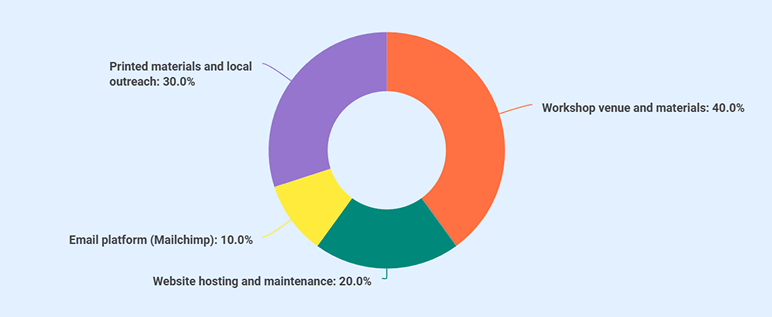
| Item | Estimated Annual Cost |
| Workshop venue and materials | $2,400 |
| Website hosting and maintenance | $1,200 |
| Email platform (Mailchimp) | $600 |
| Printed materials and local outreach | $1,800 |
| Total | $6,000 |
Acquisition Channels
1. Referral Partnerships
Before launch, Maya is building referral relationships with three to five local professionals: Therapists, accountants, and HR consultants. These are people whose clients regularly face career or business decisions, but whose own work stops short of coaching.
A therapist working with someone through burnout might have a client who needs career clarity, not more therapy sessions. An accountant helping a first-time entrepreneur might have a client who needs a thinking partner, not just tax advice. Referrals like these convert faster than any other lead source because the client already trusts the person who sent them.
This is the highest-priority channel in Year 1. Getting three committed referral partners in place before opening is one of the first things Maya is working toward.
2. Free Community Workshops
Once a month, Maya runs a free 60-minute workshop at a Eugene community venue or local business association. Topics are practical and specific:
- “5 Questions Every Career Changer Should Ask” or
- “How to Build a 90-Day Plan When You Feel Stuck”
These sessions give prospective clients a real feel for how Maya works before they spend anything. Someone who attends a workshop and finds it useful is far more likely to book a call than someone who just reads a website.
Every session ends with a simple invitation: if you want to keep going, book a free 30-minute discovery call.
3. LinkedIn
Maya’s LinkedIn profile is the practice’s main professional channel. She posts weekly:
- Practical coaching observations
- Anonymized client situations
- Honest takes on career & leadership decisions
The goal isn’t a large following. It’s staying visible to the 200-plus Oregon professionals already in her network and building relationships with local HR directors who hire outside facilitators for corporate workshops. The corporate side of the business gets built here more than anywhere else.
4. Website & SEO (Search Engine Optimization)
Catalyst’s website has a dedicated page for each service, clear pricing, and an easy path to book a free discovery call. Organic search traffic is a Year 2 and Year 3 growth channel.
In Year 1, the website functions primarily as a credibility anchor: A place for prospects who find Catalyst through referrals or workshops to verify Maya’s ICF credential and book a call.
5. Email Newsletter
A bi-weekly email goes to everyone who attends a workshop or opts in through the website. The list starts small with workshop attendees and website opt-ins from month one. But it compounds over time as each cohort cycle adds new contacts.
Each email is short: One practical coaching insight and one reminder of upcoming cohort starts or open one-on-one spots.
Client Booking Flow & Retention
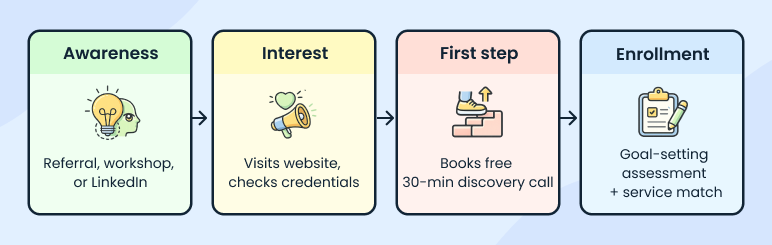
The discovery call is the most important step. Most people who book one have already attended a workshop or been referred by someone they trust. The call confirms fit and removes the last hesitation before enrollment. Most clients move from the first touchpoint to enrollment within two to four weeks.
Retention is built into the service structure. Clients who complete a group cohort are natural candidates for one-on-one coaching. Clients who finish a one-on-one engagement often return when their next career or business decision requires a thinking partner. The goal is a long-term relationship, not a single transaction.
Operations Plan
Every lead Catalyst brings in through marketing has to be converted, served, and retained. That happens through a well-planned daily operation, not just a good service offering.
Operating Days & Hours
| Time Block | Mon | Tue | Wed | Thu | Fri | Sat | Sun |
| 9:00 AM – 6:00 PM | Sessions & admin | Sessions & admin | Sessions & admin | Sessions & admin | Sessions & admin | – | Closed |
| 9:00 AM – 1:00 PM | – | – | – | – | – | Workshops & overflow | – |
| 6:30 PM – 8:00 PM | – | Group cohort | – | Group cohort | – | – | – |
Saturday is a half-day only. Corporate workshops run on-site at client locations, typically weekday mornings from 9:00 AM to 1:00 PM, arranged through direct outreach.
A Typical Operating Day
A standard weekday follows a consistent pattern. Mornings are reserved for coaching sessions starting at 9:00 AM, running 60 minutes each with 10-minute breaks. Most mornings have two to three sessions booked.
The midday block is for admin and business development. The VA handles incoming emails, appointment confirmations, and invoicing. Maya uses HubSpot to track corporate prospects, creates content for LinkedIn and the blog, and makes outreach calls. This split keeps the admin off Maya’s plate during peak session hours.
Afternoons bring two to three more sessions. The day closes with session notes, client follow-ups, and assessment reviews before 6:00 PM.
On Tuesday and Thursday evenings, the group cohort runs from 6:30 PM to 8:00 PM. Those are the longest days. Five sessions plus an evening cohort is close to the upper limit. That ceiling is built into the weekly capacity planning and reflected in the 48-session monthly maximum.
Scheduling & Booking System
Catalyst uses Acuity Scheduling, integrated directly with the website. Clients see real-time availability and book discovery calls, individual sessions, or group cohort spots without any back-and-forth.
Three policies keep the calendar running cleanly:
(1) Individual Sessions
24-hour cancellation policy, charged in full if missed. Maya’s calendar fills two to three weeks out. A late cancellation leaves a slot that can’t be filled.
(2) Group Cohorts
Enrollment closes one week before each cycle starts. No mid-cycle additions. The group dynamic depends on consistent attendance from the same six people.
(3) Corporate Workshops
Booked through direct outreach and a customized proposal. Not available through the online scheduler.
Technology & Systems
All tools are cloud-based. Monthly tech spend runs approximately $100, well within the $4,800 annual technology budget.
| Tool | Purpose |
| Acuity Scheduling | Client booking and calendar management |
| HubSpot Free | Customer relationship management (CRM) |
| Zoom Pro | Virtual coaching sessions and group cohorts |
| Teachable | Online course hosting and LMS delivery |
| QuickBooks | Accounting and invoicing |
| Mailchimp | Email newsletter |
Licensing & Compliance
Coaching is unregulated in Oregon. No state license is required to open or run a coaching practice. That said, Catalyst follows a clear set of professional and legal standards.
Professional Credential
Maya holds an ICF PCC credential, requiring 500+ documented coaching hours, mentor coaching, and a formal performance evaluation. Renewed every three years through 40 hours of continuing education.
Business Registrations
- Oregon LLC, registered April 2026
- City of Eugene business license, obtained before opening
Insurance
- Professional liability (errors and omissions) insurance of $3,600/year, prepaid at launch
- General liability insurance that covers the office and all on-site corporate workshop locations
Client Protection
Every client signs a coaching agreement before the first session. It defines the scope of coaching, confirms coaching is not therapy, and outlines the referral process for clients who need licensed mental health support.
ICF Code of Ethics
Maya follows the ICF Code of Ethics for all client engagements. In practice, that means everything discussed in a session stays in the session. Maya doesn’t share client information with third parties and doesn’t take on clients where a conflict of interest exists.
Management & Staffing
The team at Catalyst is structured around the business model. Maya leads the practice, supported by a part-time virtual assistant and contract facilitators when the workload requires it.
Maya Thornton (Owner & Lead Coach)
Maya is the practice. She handles all coaching delivery, program design, workshop facilitation, business development, and marketing content. There is no separation between her and the business at this stage, which is both the strength and the constraint of the Year 1 model.
Credentials & Background:
- ICF Professional Certified Coach (PCC)
- MBA from Portland State University
- 8 years as HR Director, managing leadership programs for 200+ employees
- 200+ professional contacts across Oregon’s business community
Her corporate background is directly relevant to the corporate workshop side of the business. She’s walked into rooms like the ones she’s now being hired to facilitate. That context matters when working with HR teams and executive groups.
Compensation:
Maya takes an owner’s draw of $72,000 in Year 1. As a single-member LLC, Catalyst doesn’t run payroll for the owner. Her compensation comes as a draw against business earnings, which pass through to her personal tax return. She makes quarterly estimated tax payments to cover her self-employment tax obligation.
The $72,000 draw is below her previous corporate salary. It reflects what the business can realistically support in Year 1 while servicing the SBA loan and building a cash reserve.
Hiring Plan
Maya is the only full-time employee at launch. Two additional roles support the practice from day one, both structured to keep overhead low while the client base builds.
| Role | Type | Start | Hours/Week | Annual Cost |
| Virtual Administrative Assistant | Part-time, Remote | April 2026 | 20 hrs/week | $20,000 |
| Contract Facilitators | Per session, as needed | As required | Variable | Within the COGS budget |
Virtual Administrative Assistant
A remote virtual assistant works 20 hours per week, Monday through Friday. This role covers email management, appointment scheduling, client intake, invoicing, and social media scheduling.
The VA keeps Maya out of administrative back-and-forth during session hours. Without it, admin work bleeds into coaching time and reduces billable capacity.
Contract Facilitators
For overflow group sessions or large corporate workshops requiring co-facilitation, Catalyst brings in contract facilitators on a per-session basis.
These are experienced coaches from Maya’s professional network, hired for specific engagements only. Their costs sit within the 8% direct labor budget already built into the cost of goods sold (COGS) in the financial projections. No additional headcount is needed to support this in Year 1.
If demand for individual sessions consistently exceeds capacity by month 12, the first hire would be a part-time associate coach. That decision gets revisited at the Year 1 review.
Financial Plan
Catalyst Coaching Group’s financial plan is built on conservative assumptions: 20% annual revenue growth, industry-standard margins, and a clear path to profitability by Year 2. Every figure in this section ties directly to the operational assumptions laid out in the sections above.
Startup Costs
Getting Catalyst off the ground requires $90,000. The table below shows exactly where that money goes.
| Expense | Amount |
| Office furniture & fixtures | $7,000 |
| Computer & tech equipment | $3,000 |
| Website & LMS platform development | $6,000 |
| Branding & design package | $3,000 |
| Marketing launch campaign | $8,000 |
| Continuing education & credential renewal | $3,500 |
| Legal / LLC formation & contracts | $2,000 |
| Assessment tools & licenses | $1,500 |
| Professional liability insurance (Year 1 prepaid) | $3,600 |
| Office lease deposit (2 months) | $3,000 |
| Working capital reserve | $49,400 |
| Total Startup Costs | $90,000 |
Source of Funds
| Source | Amount |
| SBA 7(a) Loan (Summit Pacific Credit Union) | $75,000 |
| Owner equity contribution (Maya Thornton) | $15,000 |
| Total Startup Capital | $90,000 |
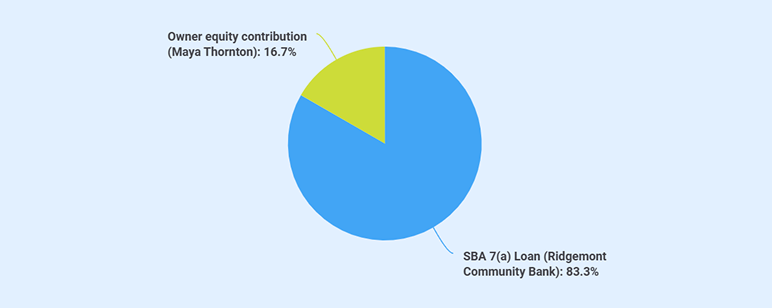
The SBA loan carries a 7-year term at 7.50% fixed rate, with a monthly payment of $1,150. Maya’s $15,000 equity contribution comes from personal savings set aside during her corporate career.
Key Assumptions
| Item | Assumption |
| Revenue model | Blended across 4 service lines |
| Average revenue per session (blended) | $250 |
| Sessions per month | Year 1: 61.7; Year 2: 74.0; Year 3: 88.8 |
| Annual sessions | Year 1: 740; Year 2: 888; Year 3: 1,066 |
| Year-over-year revenue growth | 20% |
| Direct materials cost | 5% of revenue |
| Direct labor cost (contract coaches) | 8% of revenue |
| Payroll tax rate | 10% |
| Owner salary | $72,000/year |
| Admin salary (part-time VA) | $20,000/year |
| AR collection terms | Net 15-day (DSO = 15 days) |
| AP payment terms | Immediate (DPO = 0) |
| Inventory days on hand | 0 (service business) |
Income Statement (3-Year Projection)
| Category | Year 1 ($) | Year 2 ($) | Year 3 ($) |
| Coaching Sessions (annual) | 740 | 888 | 1,066 |
| Total Revenue | 185,000 | 222,000 | 266,400 |
| COGS | |||
| Direct materials (5%) | 9,250 | 11,100 | 13,320 |
| Direct labor — contract coaches (8%) | 14,800 | 17,760 | 21,312 |
| Payroll taxes on direct labor (10%) | 1,480 | 1,776 | 2,131 |
| Total COGS | 25,530 | 30,636 | 36,763 |
| Gross Profit | 159,470 | 191,364 | 229,637 |
| Gross Margin | 86.2% | 86.2% | 86.2% |
| Operating Expenses | |||
| Owner/admin salaries | 92,000 | 92,000 | 92,000 |
| Payroll taxes on salaries (10%) | 9,200 | 9,200 | 9,200 |
| Rent/office lease | 18,000 | 18,000 | 18,000 |
| Insurance | 3,600 | 3,600 | 3,600 |
| Accounting/legal/professional | 4,000 | 4,000 | 4,000 |
| Phone/utilities | 2,400 | 2,400 | 2,400 |
| Marketing (ongoing) | 6,000 | 6,000 | 6,000 |
| Fuel/travel | 2,400 | 2,400 | 2,400 |
| Supplies/consumables | 1,200 | 1,200 | 1,200 |
| Repairs/maintenance | 600 | 600 | 600 |
| Technology/software | 4,800 | 4,800 | 4,800 |
| Marketing launch (one-time) | 8,000 | – | – |
| Certifications & training (one-time) | 3,500 | – | – |
| Legal / LLC setup (one-time) | 2,000 | – | – |
| Assessment tools (one-time) | 1,500 | – | – |
| Total Operating Expenses | 159,200 | 144,200 | 144,200 |
| EBITDA | 270 | 47,164 | 85,437 |
| Depreciation | 4,600 | 4,600 | 4,600 |
| EBIT | (4,330) | 42,564 | 80,837 |
| Interest expense | 5,338 | 4,681 | 3,973 |
| Net Income (Pre-Tax) | (9,668) | 37,883 | 76,864 |
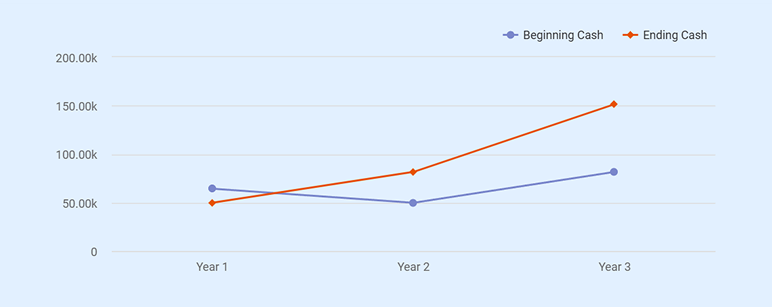
Cash Flow Statement
| Category | Year 1 ($) | Year 2 ($) | Year 3 ($) |
| Beginning Cash | 64,400 | 49,867 | 81,711 |
| Operating Activities | |||
| Net income (pre-tax) | (9,668) | 37,883 | 76,864 |
| Depreciation (non-cash) | 4,600 | 4,600 | 4,600 |
| Change in accounts receivable | (7,603) | (1,520) | (1,825) |
| Change in inventory | 0 | 0 | 0 |
| Change in accounts payable | 0 | 0 | 0 |
| Change in prepaid expenses | 6,600 | 0 | 0 |
| Net Cash from Operations | (6,071) | 40,963 | 79,639 |
| Investing Activities | |||
| Capital expenditures | 0 | 0 | 0 |
| Net Cash from Investing | 0 | 0 | 0 |
| Financing Activities | |||
| Loan principal repayment | (8,462) | (9,119) | (9,827) |
| Net Cash from Financing | (8,462) | (9,119) | (9,827) |
| Net Change in Cash | (14,533) | 31,844 | 69,812 |
| Ending Cash | 49,867 | 81,711 | 151,523 |
Opening Balance Sheet (at Launch)
| Line Item | Amount ($) |
| ASSETS | |
| Cash | 64,400 |
| Inventory | 0 |
| Prepaid expenses (insurance + lease deposit) | 6,600 |
| Gross PP&E (equipment, computers, website, branding) | 19,000 |
| Total Assets | 90,000 |
| LIABILITIES & EQUITY | |
| SBA 7(a) term loan | 75,000 |
| Owner’s capital — Maya Thornton (paid-in) | 15,000 |
| Total Liabilities + Equity | 90,000 |
Balance Sheet (Years 1-3)
| Category | Year 1 ($) | Year 2 ($) | Year 3 ($) |
| ASSETS | |||
| Cash | 49,867 | 81,711 | 151,523 |
| Accounts receivable | 7,603 | 9,123 | 10,948 |
| Inventory | 0 | 0 | 0 |
| Prepaid expenses | 0 | 0 | 0 |
| Net PP&E | 14,400 | 9,800 | 5,200 |
| Total Assets | 71,870 | 100,634 | 167,671 |
| LIABILITIES | |||
| Accounts payable | 0 | 0 | 0 |
| SBA term loan | 66,538 | 57,419 | 47,592 |
| Total Liabilities | 66,538 | 57,419 | 47,592 |
| EQUITY | |||
| Paid-in capital | 15,000 | 15,000 | 15,000 |
| Retained earnings | (9,668) | 28,215 | 105,079 |
| Total Equity | 5,332 | 43,215 | 120,079 |
Break-Even Analysis
| Item | Value |
| Average revenue per session (blended) | $250 |
| Direct materials (5%) | $12.50 |
| Direct labor (8%) | $20.00 |
| Payroll taxes on labor (10% of $20) | $2.00 |
| Total variable cost per session | $34.50 |
| Contribution margin per session | $215.50 |
| Contribution margin (%) | 86.2% |
| Annual fixed operating costs (Year 2 steady-state) | $144,200 |
| Break-even sessions per year | 669 sessions |
| Break-even sessions per month | 55.8 sessions |
| Break-even revenue (annual) | $167,250 |
Break-even requires 669 sessions per year, or 55.8 per month. Year 1 targets 740 sessions, which puts the practice 10.6% above break-even from the start. That margin is not large.
A 10% shortfall in session volume would push the practice back below break-even, which is why the working capital reserve and the referral partnership pipeline are both critical in the first six months.
Loan Repayment Schedule
| Item | Assumptions |
| Lender | Summit Pacific Credit Union |
| Principal Amount | $75,000 |
| Term | 7 years (84 months) |
| Interest rate | 7.50% fixed |
| Monthly payment | $1,150 |
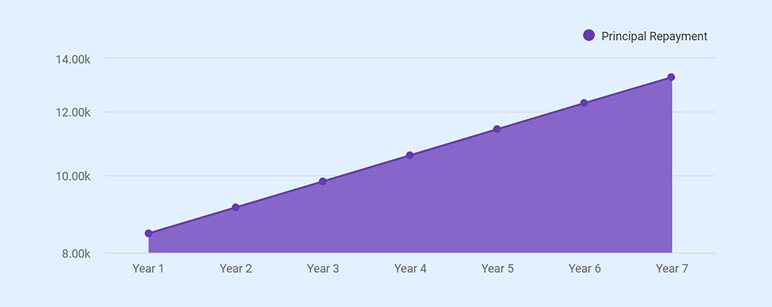
Total interest paid over the life of the loan is approximately $21,600. The loan is fully retired by the end of Year 7. Annual debt service stays fixed at $13,800 throughout, making cash flow planning straightforward.
| Line item | Year 1 | Year 2 | Year 3 | Year 4 | Year 5 | Year 6 | Year 7 | Total |
| Beginning Balance | $75,000 | $66,538 | $57,419 | $47,592 | $36,998 | $25,576 | $13,263 | – |
| Principal Repayment | $8,462 | $9,119 | $9,827 | $10,594 | $11,422 | $12,313 | $13,263 | $75,000 |
| Interest Expense | $5,338 | $4,681 | $3,973 | $3,206 | $2,378 | $1,487 | $537 | $21,600 |
| Total Payments | $13,800 | $13,800 | $13,800 | $13,800 | $13,800 | $13,800 | $13,800 | $96,600 |
| Ending Balance | $66,538 | $57,419 | $47,592 | $36,998 | $25,576 | $13,263 | $0 | – |
The debt service coverage ratio (DSCR) measures whether the business generates enough operating income to cover loan payments. SBA lenders typically look for a DSCR above 1.25.
| Year 1 | Year 2 | Year 3 | |
| EBITDA | $270 | $47,164 | $85,437 |
| Total Debt Service | $13,800 | $13,800 | $13,800 |
| DSCR | 0.02 | 3.42 | 6.19 |
Year 1 DSCR of 0.02 reflects the one-time startup costs pulling EBITDA down to $270. Strip those out, and Year 1 EBITDA would be $15,270, producing a DSCR of 1.11. That still falls below the SBA’s 1.25 benchmark. The $49,867 in ending cash is what bridges that Year 1 shortfall, covering debt service while the client base builds.
By Year 2, DSCR reaches 3.42, well above the 1.25 threshold, and the business services the loan comfortably from that point forward.
The Quickest Way to turn a Business Idea into a Business Plan
Fill-in-the-blanks and automatic financials make it easy.
