




Executive Summary
VoltWorks Electrical Contractors, Inc. is a licensed S-Corporation in Raleigh, North Carolina. The company provides three main services:
- Municipal projects like streetlights, traffic signals, and public buildings.
- Commercial projects such as offices, retail stores, and small factories.
- Residential renewable work like EV chargers, solar-ready wiring, panel changes, and backup power systems.
The business is co-owned by Derrick Lawson (60%), a Master Electrician, and Simone Greene (40%), who manages operations and growth. Together, they have more than 25 years of experience. The company also has an Unlimited Electrical License, crews trained under the Occupational Safety and Health Administration (OSHA-30) program, and a 24/7 emergency line.
Opportunity
Raleigh and Wake County are growing quickly. Cities are upgrading traffic and lighting systems, businesses are updating power capacity, and many homes are adding EV chargers and preparing for solar. VoltWorks aims to serve this middle market—too complex for small contractors but not large enough for national firms. The company’s strengths include strict code compliance, completing projects on time, and delivering full project reports.
Funding Context
VoltWorks is pursuing a $250,000 DOE SBIR Phase I grant to design and test smart-grid-ready wiring kits. The grant is limited to research and workforce training, while normal contracting operations are funded by owner equity.
Use of Funds
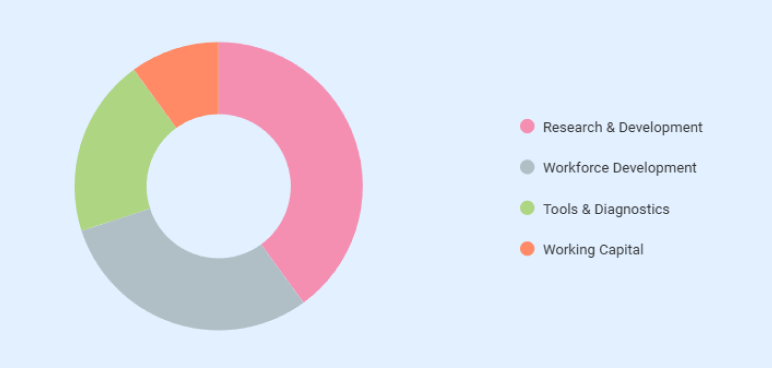
- $100,000 – Research & Development: Build and test wiring kits.
- $75,000 – Workforce Development: Apprenticeships, certifications, and safety training.
- $50,000 – Tools & Diagnostics: New tools and EV installation equipment.
- $25,000 – Working Capital: Supplies, travel, and pilot projects.
Operations & Capacity
The launch team will include 1 Master Electrician, 4 Journeymen, 3 Apprentices, 1 Project Manager, and 2 Admin staff. Two field crews will use three service vans, working Monday–Saturday from 7 AM to 6 PM, with emergency service always available. Safety steps include daily checklists, torque logs, and thermal scans.
Services Snapshot
VoltWorks offers a full range of electrical contracting services designed for municipal, commercial, and residential clients. Core services include:
- Wiring and Service Upgrades: We handle new wiring, rewiring, and power upgrades for homes and buildings.
- Generators and Backup Power: We install standby generators and transfer switches to keep power running.
- EV Charger Installation: We set up Level-2 chargers for houses, offices, and apartments.
- Solar-Ready Conduit: We add pre-wiring and bonding to prepare buildings for solar use.
- Preventive Maintenance: We offer contracts for checks, scans, and load testing.
- 24/7 Emergency Response: Our crews are on call for urgent electrical repairs.
Want a professional plan like this sample?
Upmetrics AI generate a complete, investor-ready plan for you

Go-to-Market
Sales channels include government bids (BidNet, SAM.gov), local general contractor partnerships, Google ads for residential installs, and LinkedIn outreach. Promotional offers for new clients include free EV site checks and free energy audits.
Positioning & Edge
VoltWorks will compete by focusing on safety, quality, and renewable-ready skills:
- Holds an unlimited license and follows OSHA standards.
- Starts with two field crews and an apprentice program.
- Builds vendor ties with Graybar, Siemens/Eaton, and Greenlee to avoid supply delays.
- Uses clear documentation for inspections and approvals.
Financial Preview
Startup costs are about $240,000. Year 1 revenue goal is $2.1M, with a 35% gross margin and 12% net margin. Break-even requires about $65,000 per month, which equals three medium contracts or about 60 EV installs per year. Cash flow will be supported with a line of credit and progress billing.
The table below highlights VoltWorks’ key financial targets for startup costs, revenue, margins, break-even, and cash flow management in Year 1.
| Item | Amount / Target | Notes |
|---|---|---|
| Startup Costs | $240,000 | Covers operations, tools, insurance, and marketing |
| Year 1 Revenue Target | $2.1M | Based on mix of municipal, commercial, and residential projects |
| Gross Margin | 35% | Reflects typical contracting markups and cost controls |
| Net Margin | 12% | After overhead, insurance, and admin expenses |
| Break-even Requirement | $65,000 per month | Achievable with three medium contracts or 60 EV installs annually |
| Cash Flow Management | Line of Credit + Progress Billing | Buffers 60–90 day municipal receivables |
Milestones
- Business incorporated and licensed.
- Grant application submitted.
- Vendor accounts and fleet set up.
- Apprentices onboarded.
- First municipal bids in Q3.
- Break-even expected in 14 months.
Impact
With this grant and startup investment, VoltWorks will deliver safe and reliable renewable-ready installs. Clients will benefit from on-time, inspection-ready work, while the community gains skilled workers and faster clean energy adoption.
Company Overview
VoltWorks Electrical Contractors, Inc. began operations in February 2026 as a North Carolina S-Corporation. The company is located in East Raleigh, an area with quick access to I-440 and the county’s government offices. This position makes it easy to respond to municipal projects and reach commercial and residential clients across the Triangle.
The firm is co-owned by:
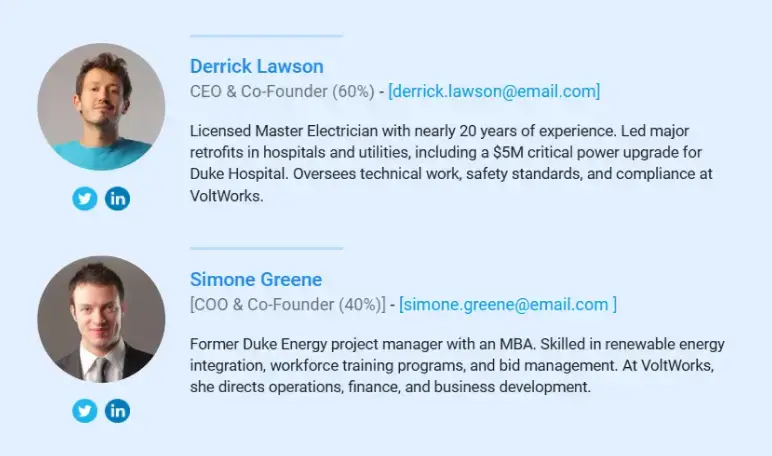
From their combined backgrounds, VoltWorks gains both strong field expertise and disciplined management.
The business operates out of a 3,200 sq. ft. office and warehouse in East Raleigh. The site serves as:
- An administration and training hub
- Storage for panels, conduit, and protective gear
- Parking space for three service vans (with room for fleet expansion)
- A practice area for apprentices to work on National Electrical Code (NEC ) mockups.
Further, compliance and readiness are built into the structure:
- Unlimited Electrical License (North Carolina)
- Supervisors certified with OSHA-30
- Bonding capacity of $1M per project
- $2M liability coverage and workers’ compensation
- Enrollment in the NC Apprenticeship Program for workforce growth
Our Mission
VoltWorks’ mission is to serve municipal, commercial, and residential clients in Raleigh and the Triangle region by providing safe, reliable, and renewable-ready electrical work. Our team combines technical skills, trained workers, and modern tools. We aim to deliver jobs that pass inspections the first time, reduce risks for clients, and support the shift to clean energy.
Vision Statement
Our vision is to become the leading mid-market electrical contractor in North Carolina. We want to be recognized for dependable project closeouts, a strong apprentice pipeline, and expertise in renewable integration. VoltWorks aims to bridge traditional electrical work with future-ready solutions like EV charging and solar wiring, helping communities move toward a resilient and energy-efficient future.
In line with these goals, VoltWorks sets the following business commitments:
- Train new workers through Wake Tech apprenticeships in EV and solar.
- Buy at least 60% of materials from local North Carolina suppliers.
- Use bilingual supervisors to improve communication on job sites.
- Support carbon reduction with energy-efficient retrofits and renewable installs.
Found this sample helpful? Ready to build a plan like it?
Try Upmetrics’ AI Business Plan Generator to create your own
Industry and Market Analysis
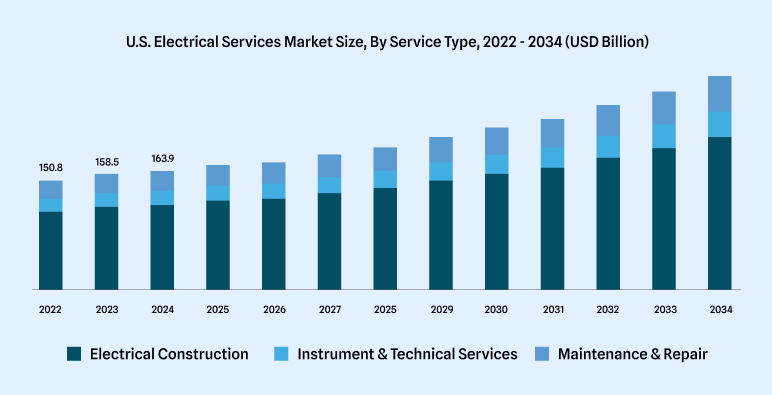
The U.S. electrical services market was valued at $163.9 billion in 2024 and is projected to reach $294.6 billion by 2034, growing at a CAGR of 6.3% from 2025 to 2034.
The chart below shows the U.S. electrical services market size by service type from 2022 to 2034, highlighting steady long-term growth across construction, technical services, and maintenance.
In North Carolina, demand is rising as the Triangle region continues to grow. Wake County has about 1.23 million residents in 2025 and has grown by roughly 10% over the past decade. Growing adoption of electric vehicles and solar energy is creating a steady need for EV charger installs, solar-ready wiring, and panel upgrades.
Target Market Segments
Municipal Contracts
- Work includes streetlight, traffic signal, and public building upgrades.
- Cities are adding energy retrofits to save money and improve safety.
- Typical job size: $250k–$500k.
- Projects awarded through BidNet, SAM.gov, and county bid systems.
Mid-Sized Commercial Clients
- Work covers wiring for offices, shops, warehouses, and healthcare sites.
- Data centers and medical buildings need steady and reliable power.
- Jobs range from 8,000–20,000 sq. ft., worth $150k–$400k.
- Clients want code compliance, quick schedules, and clear closeouts.
Residential Renewable Integration
- Work includes EV chargers, solar-ready wiring, and panel upgrades.
- Typical costs: $1,200 EV charger, $3,800 solar conduit, $2,400 panel upgrade.
- Growth comes from rising EV and solar use in Wake County.
- VoltWorks plans 50+ installs in Year 1 with certified crews.
Market Size (TAM / SAM / SOM)
| Layer | Meaning | Value |
|---|---|---|
| TAM (Total Market) | All electrical contracting in NC | $6.2B |
| SAM (Serviceable Market) | Triangle region share (~15%) | $930M |
| SOM (Target Market) | VoltWorks’ achievable share (~0.5% by Year 3) | $4.9M |
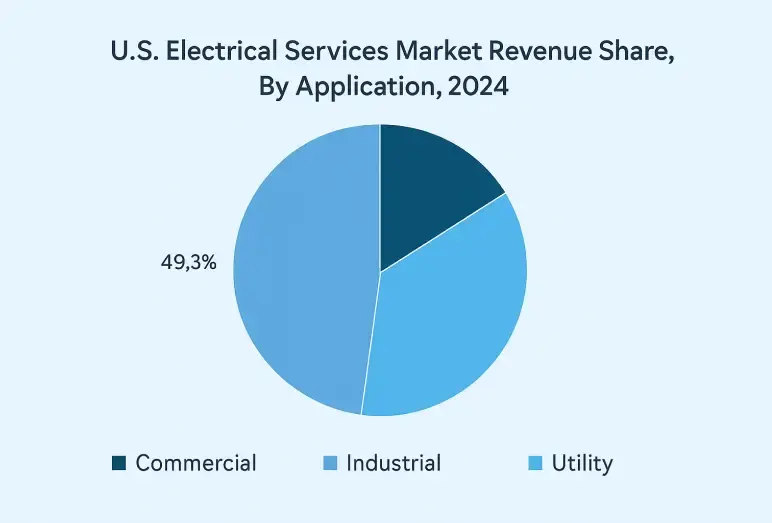
The chart shows how revenue in the U.S. electrical services market is split by application in 2024. Commercial projects account for nearly half of the market, while industrial and utility projects share the rest.
This matters because VoltWorks’ TAM/SAM/SOM focuses on the Triangle region, where commercial and municipal work make up the largest share of opportunities.
It shows why VoltWorks is targeting mid-sized commercial clients and renewable-ready municipal projects as its entry point.
Competitor Landscape
VoltWorks competes with both large utilities and local contractors. Key competitors include:
PowerSecure – Focused on large projects and utility jobs.
- Strengths: Size, reach, and strong resources.
- Weaknesses: Not flexible for smaller contracts.
White Electric – Well-known in commercial work.
- Strengths: Strong ties with general contractors.
- Weaknesses: No focus on renewable energy.
ARC Electric – Popular in residential markets.
- Strengths: Trusted local brand.
- Weaknesses: Lacks EV and solar certifications.
Competitive Advantages
- Special skills in EV and solar-ready installs (Tesla-certified).
- Apprentice program with Wake Tech to fill labor needs.
- Focus on safety, licensing, and compliance.
- Bilingual supervisors to improve communication on sites.
Pricing & Positioning
| Service | VoltWorks Price | Market Range | Added Value |
|---|---|---|---|
| EVSE Install (L2) | $1,200 | $1,000–$1,400 | Includes permits + inspections |
| Solar Conduit Prep | $3,800 | $3,500–$4,200 | NEC-compliant bonding |
| Panel Upgrade | $2,400 | $2,200–$2,800 | Same-week service |
| Commercial Wiring | $6.50/sq. ft. | $6.25–$6.75 | Standardized submittals |
VoltWorks keeps prices in line with the market but adds extra value by handling compliance and paperwork, making jobs easier for clients.
Market Outlook
The Triangle region will add over 120,000 new residents by 2030, which means more homes, offices, and facilities that need electrical work. Federal incentives for EVs, solar, and energy savings will also push growth.
VoltWorks is in a strong position because it blends traditional contracting with renewable-ready services. This strategy will help win contracts, train new workers, and grow into smart-grid products backed by SBIR funding.
Stop searching the internet for industry & market data
Get AI to bring curated insights to your workspace

Services & Pricing
VoltWorks offers a wide range of electrical and renewable services. We focus on giving safe, reliable, and code-compliant work for municipal, commercial, and residential clients. Our prices are clear, our vendor support keeps costs steady, and our service approach ensures quality at every step.
Service Portfolio
We provide the following core services with average prices:
| Service | Price | What’s Included |
|---|---|---|
| Commercial wiring | $6.50 per sq. ft. | Wiring for new buildings or upgrades; includes conduit, breakers, inspections; jobs 8,000–20,000 sq. ft. |
| Panel upgrades | $2,400 flat fee | New breakers, surge protection, NEC labels, and inspection help |
| EV charger install (Level 2) | $1,200 average | Load check, permits, new breaker, final inspection; Tesla-certified installers |
| Solar-ready conduit install | $3,800 average | Pre-wiring and bonding to prepare homes or buildings for solar |
| Maintenance contracts | $350 per month/site | Quarterly checks, thermal scans, and fast response service |
| Emergency service (24/7) | $125/hr (journeyman) | On-call emergency work at a premium rate |
| Seasonal add-ons | $500–$1,200 | Winter: breaker and light checks; Summer: cooling load and surge upgrades |
Vendor Partnerships
VoltWorks works with trusted vendors to make sure materials and tools are ready on time. These vendor ties cut delays, control costs, and give access to needed support.
- Graybar: Provides conduit, wire, breakers, and switchgear with fast supply.
- Siemens / Eaton: Deliver panels and gear that follow national codes.
- Greenlee: Tools and machines that help crews work faster and avoid downtime.
- Fastenal: Safety items and supplies that meet OSHA and NFPA rules.
These vendor links keep VoltWorks prices fair, reduce wait times, and make sure all jobs meet safety and code rules.
Service Margins
Our prices are set to stay fair for clients and give us a healthy profit.
| Service | Gross Margin | Notes |
|---|---|---|
| Commercial wiring | 22–25% | Large jobs with competitive rates |
| Panel upgrades | 30% | Easy to repeat, quick jobs |
| EV charger installs | 35–40% | Low material cost, high labor value |
| Solar conduit installs | 28–32% | Works well with apprentice support |
| Maintenance contracts | 40%+ | Recurring, steady income |
| Seasonal add-ons | 25–30% | Extra services added to regular jobs |
Seasonal Add-Ons
VoltWorks provides seasonal services to keep systems running smoothly all year:
- Winter: Breaker testing and emergency light checks (about $500). These services help buildings avoid outages during storms and ensure safety lighting is ready when needed.
- Summer: Cooling load upgrades and surge protection (about $1,200). These upgrades protect equipment from heat-related strain and sudden power spikes.
By offering these add-ons, VoltWorks helps clients prevent costly downtime and keep systems reliable in both peak cold and hot seasons.
Differentiation in Service Delivery
We do not just focus on price, but also on how we deliver:
- Clear paperwork: Panel schedules, torque logs, and inspection forms to avoid delays.
- Renewable skills: Trained in EV and solar wiring to reduce failed inspections.
- Apprentice use: Journeymen handle complex work; apprentices lower cost and gain training.
Example Service Scenario
To make this clearer, here’s a real-world project breakdown:
- Wiring for 12,000 sq. ft. office → $78,000
- Panel upgrade → $2,400
- Maintenance contract → $350 per month ($4,200 per year)
Total contract value: ~$82,200
Gross margin: ~25%
Recurring income: $4,200 each year from the maintenance contract
This example shows readers what a real job looks like in terms of cost, profit, and steady income. It explains how VoltWorks mixes one-time projects with service contracts, giving both quick revenue and lasting stability for the company.
By giving clear prices, using trusted vendors, keeping fair margins, and sharing full reports, VoltWorks makes sure every job is safe, finished on time, and ready for the future.
Marketing & Sales Strategy
VoltWorks will grow by winning government contracts, building steady commercial work, and serving homeowners who need EV and solar-ready upgrades.
The company’s goal is to secure city projects, expand into mid-size business spaces, and build a base of residential clients. With this mix, VoltWorks aims to reach $2.1M in Year 1 and grow to $4.9M in Year 3, while keeping the cost to get each new customer under $400.
Marketing Channels and Budget Allocation
VoltWorks will spend money across different channels. Most will go to government bidding, then commercial outreach, residential ads, and trade shows. This keeps the company from relying on just one channel.
| Channel | Share of Effort/Budget | Details |
|---|---|---|
| Government & Municipal Bidding | 40% | Focus on $250k–$500k projects such as streetlight and traffic upgrades. |
| Commercial Outreach | 30% | LinkedIn ads, GC partnerships, and free energy audits. |
| Residential EV & Solar Services | 20% | Google Local Ads, HOA newsletters, EV site survey promotions. |
| Trade Shows & Community | 10% | NC Green Building Expo, EV Summit Raleigh, Wake Tech programs. |
This balance will give VoltWorks steady leads from the public, business, and home markets.
Customer Acquisition Strategy
Different types of customers cost different amounts to acquire. Government jobs are costly to bid for but bring very large contracts. Commercial jobs bring steady revenue and long-term maintenance contracts. Residential installs are smaller but grow fast and often lead to repeat work.
| Customer Type | CAC (est.) | LTV (est.) | Notes |
|---|---|---|---|
| Government | $2,000 | $500,000+ per contract | High cost to bid, but very large projects. |
| Commercial | $375 | $50,000+ plus $4,200/yr | Good retention through maintenance contracts. |
| Residential | $250 | $1,200–$3,800+ | Repeat work possible through upgrades/inspections. |
To bring in customers, VoltWorks will offer free energy audits to commercial clients, free EV site checks for homeowners, and a $200 discount when panel upgrades are combined with EV installs. Customers will stay with the company through annual inspections, maintenance plans, and a $100 referral credit.
Brand Positioning
VoltWorks will market itself as Raleigh’s renewable-ready electrical contractor. The brand will stand on four promises: always follow code and safety rules, provide renewable-ready solutions, train a strong workforce, and support the local community. These promises will be clear in all ads, proposals, and events.
Sales Process
Sales will start by capturing leads. Government leads will be tracked in Procore and SAM.gov, while commercial and home leads will be stored in HubSpot CRM. Each lead will get a reply within 24 hours. The Project Manager will then review the request, check if it fits the company’s capacity, and prepare a proposal.
Proposals will use standard templates that highlight compliance and renewable options. Once contracts are signed and insurance is verified, clients will be added to the CRM for tracking. At the end of each project, VoltWorks will give inspection reports, ask for reviews, and offer maintenance or renewal options.
Long-Term Marketing Leverage
In the first year, VoltWorks will rely on government bids and digital ads. Over time, the company will reduce costs by shifting to referrals, SEO, and contracts that bring recurring revenue.
SEO will help VoltWorks rank higher for searches like “EV charger install Raleigh.” Partnerships with property managers and contractors will bring more repeat work.
Maintenance agreements will add a steady monthly income. By Year 3, about 30% of new business is expected to come from repeat and referral clients, lowering CAC and raising profits.
Operations Plan
VoltWorks is led by Derrick Lawson, CEO and Master Electrician. He manages technical work and makes sure all jobs meet safety rules. Simone Greene, COO, looks after bids, scheduling, training, and grant reporting.
The field team includes 1 Master Electrician, 4 Journeymen, and 3 Apprentices trained through Wake Tech. A Project Manager handles schedules, budgets, and inspections. Two administrative staff manage payroll, billing, and compliance. This setup allows VoltWorks to run two field crews or combine them into one larger team for bigger projects.
Hours of Operation & Coverage
VoltWorks works Monday to Saturday, 7:00 AM to 6:00 PM. Emergency service is available 24/7 with crews on rotation. Staggered shifts make sure both daytime projects and evening service calls are covered.
Facility & Fleet
The company works from a 3,200 sq. ft. office and warehouse. The space includes offices, tool storage, and a training area for apprentices. The fleet has three leased vans, each fitted with shelving, secure storage, PPE kits, and tools. Vans are stocked with enough materials to complete 2–3 jobs without restocking.
Workflow & Job Execution
- Getting Contracts: Projects are won through bid portals or Requests for Proposals (RFPs).
- Planning: Drawings are checked for code compliance, and materials are ordered.
- On-Site Work: Crews begin with safety talks. Journeymen lead, apprentices assist.
- Tracking: Progress is logged in Procore. Torque logs are kept. Inspections are scheduled.
- Close-Out: Clients receive as-built drawings, warranties, and compliance reports.
- After-Sales: Customers are offered maintenance contracts and annual inspections.
Compliance & Safety Systems
VoltWorks is licensed to do all types of electrical work in North Carolina. The company carries $1M bond, $2M liability insurance, and $1M workers’ compensation. Supervisors are trained with Occupational Safety and Health Administration (OSHA) 30, and apprentices complete OSHA 10. Safety is managed with lockout/tagout steps, daily safety meetings (toolbox talks), and tracking of protective gear through Fastenal’s system.
Technology Integration
VoltWorks uses both field and office tools to keep jobs safe and on time.
- Greenlee & Fluke tools: For bending conduit, testing power, and thermal scans.
- Procore: For project plans, bids, inspections, and schedules.
- QuickBooks + ADP: For payroll, invoicing, and job costs.
- Field Tablets: For timesheets, safety checks, photos, and daily reports.
- Simple CRM/job tracker: To track service calls and EV installs.
These tools reduce mistakes, keep crews organized, and make sure projects finish smoothly.
Operational Differentiators
VoltWorks stands out from other contractors through its strong systems and unique strengths:
- Apprenticeship program with Wake Tech ensures steady staffing.
- Standard documentation helps pass inspections quickly.
- Stocked vans and a warehouse allow several projects to run at once.
- 24/7 emergency response builds trust with municipalities and hospitals.
- Expertise in EV chargers and solar prep supports long-term growth.
Milestones & Timeline
VoltWorks has a step-by-step plan that covers company setup, funding, operations, and long-term growth. Each phase has clear goals and outcomes to show progress.
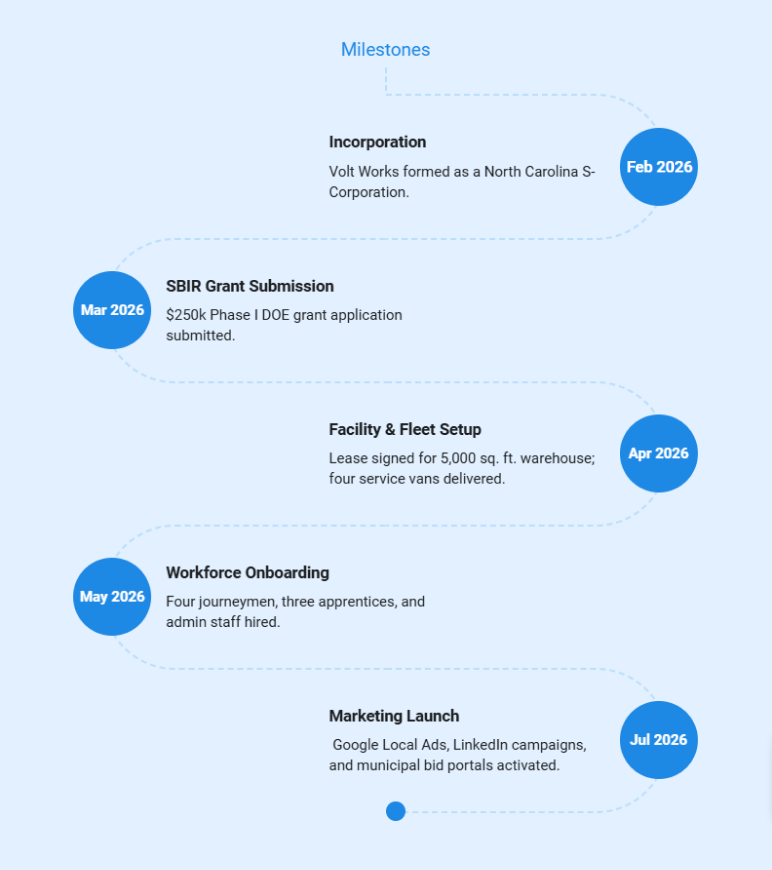
This roadmap shows VoltWorks can start quickly, reach break-even within 14 months, grow with steady contracts, and expand into new markets while building renewable-ready expertise.
Don’t spend weeks on your first draft
Complete your business plan in less than an hour
Founder Team & Story
The strength of VoltWorks comes from its founders, who combine deep technical expertise with proven business leadership. Together, they bring over 25 years of experience in electrical contracting, renewable projects, and operations management.
Leadership Team
- Derrick Lawson (CEO, 60%)
Master Electrician, 18 years’ experience. Led major hospital retrofits and public works projects in North Carolina. Holds Unlimited Electrical License and OSHA 30 certification. At VoltWorks, he manages safety, compliance, training, and final inspections.
- Simone Greene (COO, 40%)
MBA from UNC Chapel Hill. 10 years at Duke Energy managing renewable and grid upgrade projects. Skilled in contracts, finance, and workforce programs. At VoltWorks, she runs operations, bids, finances, and vendor relations.
Team Synergy
- Derrick = Field expertise and code-first execution.
- Simone = Business growth, contracts, and energy-sector know-how.
- Together = Balance of technical strength and strategic management.
- Shared goal = Grow local workforce through Wake Tech apprenticeships.
Founder Narrative
Derrick started out wiring storm-hit homes and learned the importance of safe, reliable work. Built a career on passing inspections the first time and mentoring younger electricians.
Simone worked inside Duke Energy, helping prepare the grid for solar and EV adoption. Gained experience dealing with regulators, municipalities, and contractors.
They launched VoltWorks to fill a gap in Raleigh: mid-sized projects that need compliance and renewable readiness, but are overlooked by big firms.
Advisory Support
- Retired NC contractors provide bid strategy advice.
- Wake Tech staff help shape apprentice training.
- A CPA consultant ensures clean books and grant reporting.
Financial Plan
The financial plan of VoltWorks Electrical Contractors, Inc. is based on realistic revenue assumptions, standard margins for the contracting industry, and conservative cost estimates. The startup cost is estimated at $296,000, which will be funded by $180,000 in owner equity and a $250,000 DOE SBIR Phase I grant.
Key Assumptions
- Average commercial contract: $25,000
- Residential installs: $1,200–$3,800 each
- Gross margin target: 35%
- Net margin target: 12%
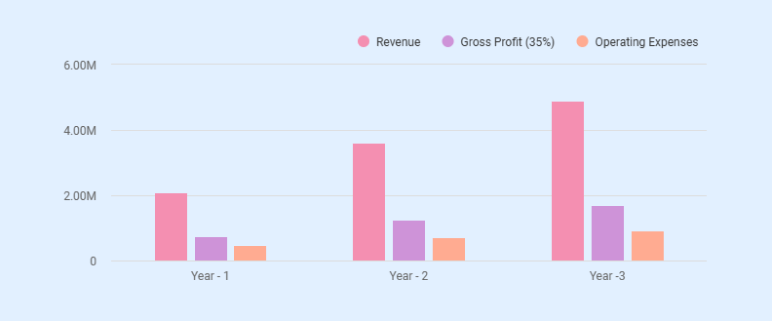
- Revenue growth: Year 1 $2.1M, Year 2 $3.6M, Year 3 $4.9M
- Government contracts have 60–90 day receivable cycles
- Maintain $200,000 line of credit as a working capital buffer
Startup Costs
| Category | Cost (USD) | Notes |
|---|---|---|
| Warehouse/Office Lease | $70,000 | Deposit + first-year improvements (ongoing rent shown in P&L) |
| Fleet Vehicles | $25,000 | 3 leased vans, deposits only (monthly lease shown in P&L) |
| Tools & Equipment | $85,000 | Siemens/Eaton panels, Greenlee pullers, Fluke testers, lifts, PPE |
| Insurance & Bonding | $22,000 | $2M liability, $1M workers’ comp, $1M bonding (renewals in P&L) |
| Software | $18,000 | Procore, QuickBooks, field tablets (annual renewals in P&L) |
| Marketing & Bids | $30,000 | Google Ads, LinkedIn, bid portals, trade shows |
| Working Capital Reserve | $46,000 | Payroll buffer + upfront materials |
| Total Startup | $296,000 | Funded by $180,000 equity + $250,000 DOE SBIR grant |
Projected Profit & Loss (3 Years)
| Category | Year 1 | Year 2 | Year 3 |
|---|---|---|---|
| Revenue | |||
| Municipal Contracts | $1,000,000 | $1,600,000 | $2,200,000 |
| Mid-Sized Commercial | $750,000 | $1,300,000 | $1,900,000 |
| Residential Renewable | $350,000 | $700,000 | $800,000 |
| Total Revenue | $2,100,000 | $3,600,000 | $4,900,000 |
| COGS (65%) | |||
| Labor (crews, apprentices) | $750,000 | $1,300,000 | $1,800,000 |
| Materials (wires, panels) | $400,000 | $650,000 | $850,000 |
| Equipment & Fuel | $100,000 | $160,000 | $200,000 |
| Subcontractors | $115,000 | $230,000 | $335,000 |
| Total COGS | $1,365,000 | $2,340,000 | $3,185,000 |
| Gross Profit (35%) | $735,000 | $1,260,000 | $1,715,000 |
| Operating Expenses | |||
| Salaries (admin & mgmt) | $180,000 | $240,000 | $300,000 |
| Marketing & Sales | $50,000 | $90,000 | $120,000 |
| Rent & Utilities | $70,000 | $75,000 | $80,000 |
| Insurance & Compliance | $30,000 | $35,000 | $40,000 |
| Training & Safety | $25,000 | $40,000 | $50,000 |
| Technology (software, tablets) | $25,000 | $40,000 | $60,000 |
| Miscellaneous | $100,000 | $200,000 | $270,000 |
| Total Operating Expenses | $480,000 | $720,000 | $920,000 |
| Net Income | $255,000 | $540,000 | $795,000 |
| Net Margin | 12% | 15% | 16% |
Projected Balance Sheet (End of Year 1)
| Assets | USD | Liabilities & Equity | USD |
|---|---|---|---|
| Current Assets | Current Liabilities | ||
| Cash & Bank Balances | $120,000 | Accounts Payable (vendors) | $85,000 |
| Petty Cash & Reserves | $30,000 | Short-term Line of Credit (LOC) | $200,000 |
| Accounts Receivable (Client Invoices) | $280,000 | Accrued Expenses (utilities, payroll) | $25,000 |
| Prepaid Expenses (insurance, rent) | $20,000 | Other Current Liabilities | $15,000 |
| Total Current Assets | $450,000 | Total Current Liabilities | $325,000 |
| Fixed Assets | Equity | ||
| Tools & Equipment (net) | $75,000 | Owner Equity | $180,000 |
| Vehicles (leased deposits) | $25,000 | Retained Earnings | $225,000 |
| Total Fixed Assets | $100,000 | Total Equity | $405,000 |
| Total Assets | $550,000 | Total Liabilities & Equity | $550,000 |
Projected Cash Flow (Year 1)
| Quarter | Cash Inflow | Cash Outflow | Net Cash Flow | Ending Balance |
|---|---|---|---|---|
| Q1 | $250,000 | $180,000 | +$70,000 | $70,000 |
| Q2 | $400,000 | $360,000 | +$40,000 | $110,000 |
| Q3 | $650,000 | $590,000 | +$60,000 | $170,000 |
| Q4 | $800,000 | $750,000 | +$50,000 | $220,000 |
| Total Y1 | $2,100,000 | $1,880,000 | +$220,000 | $220,000 |
Break-Even Analysis
| Metric | Value | Details |
|---|---|---|
| Fixed Monthly Expenses | $65,000 | Payroll, lease, insurance, fleet, marketing |
| Average Contribution / Job | $3,400 | Blended EV installs, service calls, and small jobs |
| Break-Even Volume | 19 projects per month | OR 3 municipal contracts annually |
| Break-Even Timeline | April 2027 (Month 14) | Expected under base-case scenario |
Funding Request
VoltWorks requires $296,000 in startup funding. The plan is structured as follows:
- Owner Equity ($180,000): Committed capital from retained earnings and family investment.
- DOE SBIR Phase I Grant ($250,000): Non-dilutive federal funding to support R&D, training, and tooling.
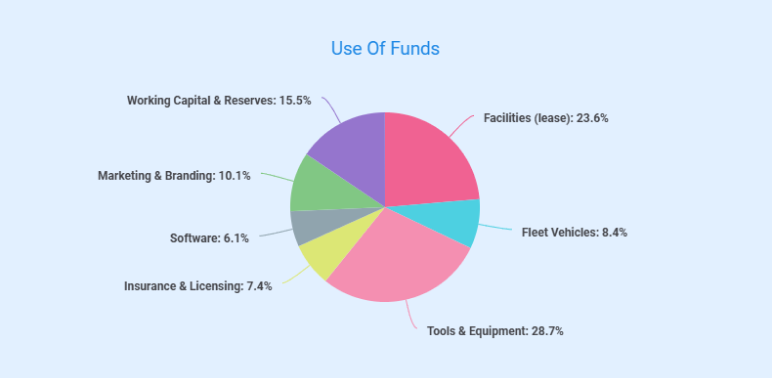
Use of Funds
| Category | Amount |
|---|---|
| Facilities (lease + deposit) | $70,000 |
| Fleet Vehicles (deposits only) | $25,000 |
| Tools & Equipment | $85,000 |
| Insurance & Licensing | $22,000 |
| Software | $18,000 |
| Marketing & Branding | $30,000 |
| Working Capital & Reserves | $46,000 |
| Total Uses | $296,000 |
Risk & Mitigation
Payments from city and commercial clients can take 60–90 days. This may put stress on payroll and supplier bills. VoltWorks will keep a $200k credit line, use staged billing, and factor invoices if delays go beyond 90 days.
Skilled electricians are hard to find. A shortage could slow projects or increase costs. The company will train apprentices through Wake Tech, pay competitive wages, and promote a safe workplace to keep staff long-term.
Compliance with NEC, OSHA, and state licensing is strict. Any failure could mean fines or failed inspections. VoltWorks will keep licenses current, give OSHA training to all staff, and track daily safety checks through short safety meetings (often called toolbox talks)
Material costs for panels, conduit, and breakers often rise or face delays. This can cut into margins. To control this, VoltWorks will sign vendor contracts, hold buffer stock, and use backup suppliers.
Incentives for EV or solar may change. This could reduce demand for renewable work. The company will balance revenue with municipal and commercial wiring jobs and tap into other rebate programs if needed.
Electrical work carries safety risks such as shocks, burns, or falls. Incidents can cause injuries and legal costs. VoltWorks carries $2M liability and $1M workers’ comp insurance, enforces PPE rules, and assigns a safety officer on projects.
Large national contractors may bid aggressively on mid-sized projects. This could lower VoltWorks’ win rate. The company will focus on sub-$500k projects, offer faster scheduling, and highlight renewable expertise and apprentice-driven cost savings.
Risk Summary Table
| Risk | Impact | Action |
|---|---|---|
| Delayed Payments | Payroll or supplier strain | $200k credit line, staged billing, factoring |
| Worker Shortage | Project delays, higher costs | Apprenticeship pipeline, fair pay, safe work |
| Compliance Failures | Fines, failed inspections | License upkeep, OSHA training, safety checks |
| Material Costs | Margin loss, schedule delays | Vendor contracts, buffer stock, backup supply |
| Policy Changes | Lower EV/solar demand | Balance with city/commercial jobs, rebates |
| Safety Incidents | Injuries, legal claims | Insurance, PPE rules, safety officer |
| Big Competitors | Lower contract win rate | Focus on sub-$500k jobs, faster service, renewables edge |
The Quickest Way to turn a Business Idea into a Business Plan
Fill-in-the-blanks and automatic financials make it easy.
