




Executive Summary
Pixel Arena is a gaming and LAN (local area network) center that is a startup in Austin, Texas. It’s owned by Jason Lee and is organized as an LLC. The business is not a large-volume entertainment facility but a small, managed, community-focused gaming space. It is a leased retail space of about 1,100 sq ft, having a total of 18 gaming stations, 12 PCs, and 6 consoles.
Opportunity
A lot of gamers face practical limits with real-life constraints that cannot be overcome by home configurations. High-performance gaming computers cost thousands of dollars, need constant updates, and need space, which is not available in many apartments and dormitories. Online play also lacks face-to-face interaction, which reduces the social side of gaming.
Pixel Arena Gaming Cafe exists to address these gaps. It offers the use of high-end quality gaming devices with no ownership costs. The café combines:
- Reliable hardware with supervision
- Welcoming environment
- Opportunities for in-person social gaming enjoyment
Target Customers
The gaming cafe will target the following categories of audiences:
- College students who want to game with friends between classes
- Young professionals seeking a social outlet after work
- Casual gamers exploring new titles without expensive purchases
- Esports enthusiasts looking for practice space and tournaments
Our Approach
Pixel Arena operates differently from large gaming centers. We keep our space small and manageable. Jason personally oversees operations every day, ensuring consistent quality and safety. One part-time gaming attendant assists during each shift.
We charge customers by the hour for gaming access. Rates average $7.50 per hour. Members who buy monthly plans get discounted rates. About 20% of our business comes from these memberships. We also sell pre-packaged snacks and non-alcoholic beverages.
Pixel Arena explicitly avoids certain activities:
- No gambling or betting
- No alcohol service
- No late-night club operations
- No cash prize tournaments
Financial Overview
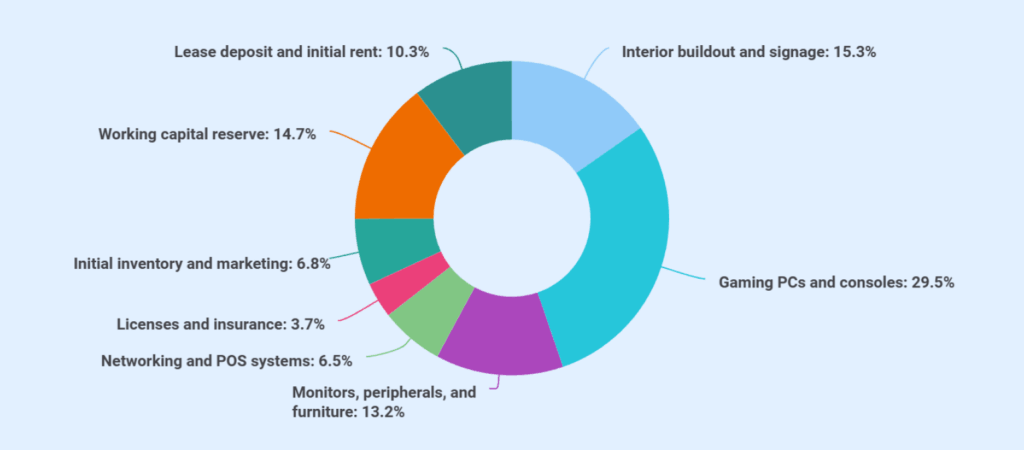
Starting Pixel Arena requires $95,000 in total funding. Jason contributes $20,000 from personal savings. Frost Bank provides a $75,000 term loan with a 7-year repayment at 8.5% interest.
These funds cover:
| Category | Cost (USD) |
|---|---|
| Lease deposit and initial rent | $9,800 |
| Interior buildout and signage | $14,500 |
| Gaming PCs and consoles | $28,000 |
| Monitors, peripherals, furniture | $12,500 |
| Networking, servers, POS setup | $6,200 |
| Licenses, permits, legal, insurance | $3,500 |
| Pre-launch marketing | $4,000 |
| Initial snacks and beverage inventory | $2,500 |
| Working capital reserve (opening cash) | $14,000 |
| Total | $95,000 |
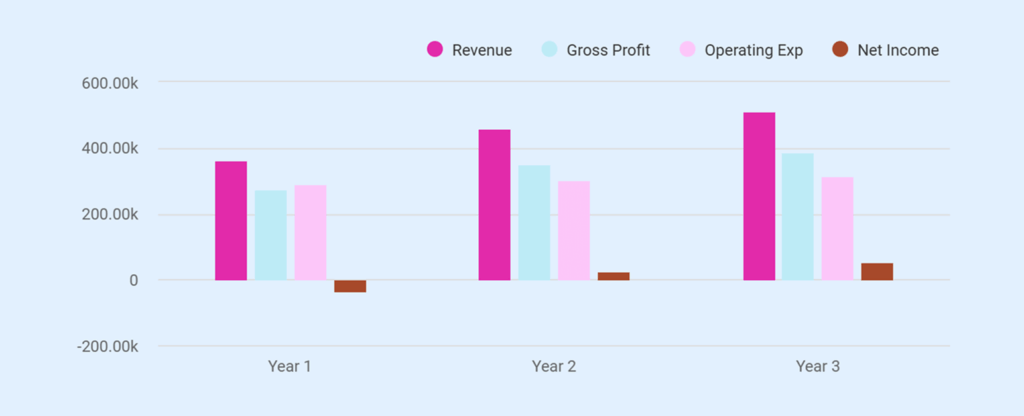
The first year records a projected operating loss of $36,700. The turnover is at $362,000; however, there are difficulties with the start-up expenses and demand fluctuations. Year 2 is characterised by a net income of $25,900 on a revenue of $458,000 net income.
By the third year, the business becomes stabilized, with a profit of $51,600 based on a revenue of $512,000.
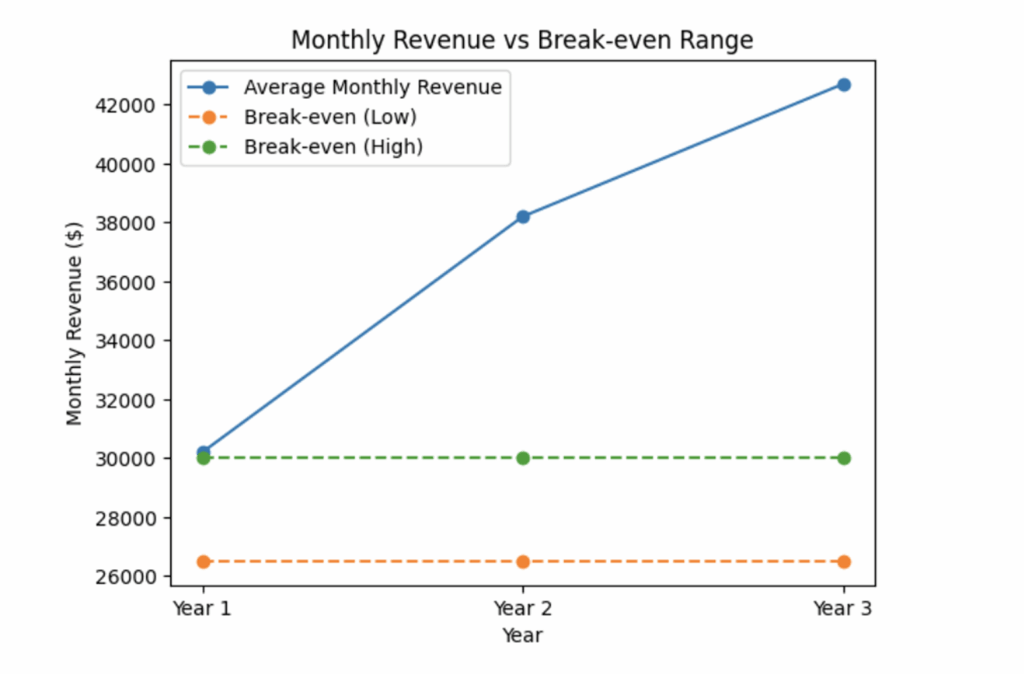
Break-even monthly revenue will be about $26,500-30,000. Year 1 will be at an average of $30,200 each month, which will put us quite close to break-even. Years 2 and 3 would break even above the comfortable limit of $38,200 and $42,700 per month.
Looking Forward
Pixel Arena does not aspire to volatile profit, but sustainable profits. It’s based on the retention of loyal customers and the quality of equipment.
After the business reaches stability in the third year, Pixel Arena may pursue limited and controlled growth. Possibly, the company may include a small number of VR stations or host larger, organized tournaments. These changes focus on improving customer experience rather than rapid expansion.
Long-term success depends on creating a space where Austin gamers feel comfortable and return often. Consistent service, reliable equipment, and fair pricing build trust. When the business delivers steady value to its community, financial stability follows.

Company Overview
Legal Structure & Business Identity
Pixel Arena Gaming Café operates as a single-member limited liability company in Texas. Jason Lee owns and manages the business completely. This legal company structure provides personal liability protection while maintaining simple tax treatment.
| Company detail | Information |
|---|---|
| Legal name | Pixel Arena Gaming Café LLC |
| Operating name | Pixel Arena |
| Entity type | Single-member LLC |
| State of formation | Texas |
| Business stage | Startup |
| Owner and manager | Jason Lee |
Ownership
Pixel Arena Gaming Café is 100% owned by Jason Lee. No other partners, members, or investors have ownership interests. The single-member ownership gives absolute power over business functioning and strategy.
Ownership Characteristics:
Jason Lee holds full ownership of the business and retains 100% control. He provides an initial cash contribution of $20,000 and serves as the sole decision-maker for all operational and strategic matters. All profits generated by the business belong to the owner.
Personal liability remains limited to the assets of the company under the LLC structure. Succession and continuity provisions are addressed within the operating agreement to ensure clarity in future ownership or management transitions.
The operating agreement introduces rules of governance even in the case of single-member LLCs. These documents protect limited liability status and clarify business operations. Jason maintains the operating agreement, meeting minutes, and financial records separate from personal affairs.
Business Classification
Pixel Arena operates in the entertainment and hospitality industry. Specific classifications include:
Primary industry: Gaming café / LAN center
Secondary industry: Food and beverage retail (limited scope)
NAICS Code: 713990 (All Other Amusement and Recreation Industries)
Business type: Brick-and-mortar retail service
Service model: Hourly rental of gaming equipment
The business explicitly excludes certain activities that include:
- Gambling or betting operations
- Alcohol sales or service
- Nightclub or late-night entertainment
- Adult-oriented content or services
- Permanent food preparation (pre-packaged only)
These exclusions simplify licensing requirements and reduce regulatory compliance burdens. The business model focuses purely on gaming services with minimal ancillary offerings.
Business Location and Facilities
Physical Address:
Pixel Arena Gaming Café LLC
318 West Oak Street, Suite 102
Austin, TX 78701
Phone: (512) 825-4849
Email: info@pixelarenagaming.com
Website: www.pixelarenagaming.com
Facility Description
The 1,100-square-foot retail unit provides adequate space for 18 gaming stations plus supporting areas. The previous tenant operated a small design studio, leaving the space in good condition, requiring minimal buildout.
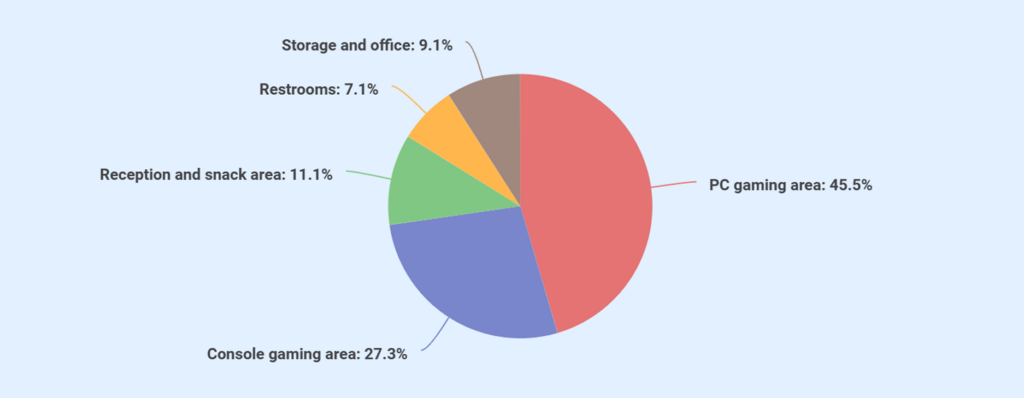
Space Layout and Allocation:
| Area | Sq Ft | % of total |
|---|---|---|
| PC gaming area | 500 | 45% |
| Console gaming area | 300 | 27% |
| Reception and snack area | 120 | 11% |
| Restrooms | 80 | 7% |
| Storage and office | 100 | 9% |
| Total | 1,100 | 100% |
Existing Infrastructure:
The suite includes several features reducing buildout costs:
- Electrical: 200-amp service with multiple circuits
- HVAC: Recently serviced commercial air conditioning
- Lighting: Fluorescent fixtures with some LED upgrades
- Flooring: Commercial-grade vinyl tile in good condition
- Walls: Finished drywall painted a neutral color
- Ceiling: Drop ceiling with acoustic tiles
- Internet: Fiber optic service available at the building
Required Improvements:
Modest buildout work prepares the space for gaming operations:
- Install additional electrical outlets for gaming stations
- Add dedicated circuits for high-draw equipment
- Upgrade lighting in gaming areas for optimal visibility
- Paint walls in brand colors (dark blue and gray)
- Install exterior signage (window decals and blade sign)
- Add cable management systems for a clean appearance
- Build a small reception counter and snack display
Total buildout and signage budget: $14,500
A business plan shouldn’t take weeks
Mission, Vision, and Values
Mission Statement
Pixel Arena creates safe, supervised gaming experiences where people connect through shared passion for games. We provide high-quality equipment, fair pricing, and a genuine community in downtown Austin.
Our mission focuses on three core elements:
1. Quality Gaming Access
- Many gamers lack access to high-performance equipment
- Gaming PCs cost thousands of dollars
- Apartments prohibit gaming setups
- Internet quality varies widely
Pixel Arena solves these problems by providing top-tier hardware at affordable hourly rates.
2. Social Connection
Online gaming offers convenience but lacks face-to-face interaction. Young adults crave real social experiences. Gaming together in person builds friendships and community. Pixel Arena facilitates these connections through shared physical space.
3. Safe, Supervised Environment
Parents worry about online gaming risks. Unsupervised spaces create problems. Pixel Arena maintains constant adult oversight. Clear policies prevent harassment and inappropriate behavior. Families trust us to provide safe gaming for teenagers and young adults.
Vision Statement
We, at Pixel Arena, want to become Austin’s most trusted community gaming space within three years. Customers choose us not just for equipment, but for the welcoming atmosphere and consistent quality. Regular visitors will feel genuine ownership in our community. We will measure success beyond financial metrics.
For Pixel Arena, success means:
- Regular customers know Jason and the staff by name
- Discord community engages daily between visits
- Customers bring friends and recommend Pixel Arena
- Tournaments and events sell out consistently
- Financial stability supports sustainable operations
Our long-term vision includes modest expansion. After achieving stable profitability, we’re planning to add VR stations, host larger tournaments, or extend operating hours. Growth serves community needs rather than maximum profit.
Core Values
The following 5 values guide every business decision at Pixel Arena:
1) Community First
Pixel Arena focuses on serving gamers rather than chasing short-term profit. The business puts customer satisfaction first when making decisions. Fair policies and consistent service matter more than quick revenue. Long-term relationships drive sustainable success.
2) Quality Equipment
Gamers deserve hardware that works reliably and performs well. We invest in quality components rather than the cheapest options. Regular maintenance prevents failures. Broken equipment gets fixed or replaced immediately.
3) Supervised Safety
Gaming always happens under responsible adult supervision. Part-time employees monitor customer behavior and enforce policies consistently. Harassment, bullying, and inappropriate conduct result in immediate consequences.
4) Fair Access
Gaming should be accessible to everyone, not just those with expensive home setups. Hourly rates keep costs reasonable. Memberships reward loyalty without requiring long commitments. Walk-ins are always welcome without reservations or minimums.
5) Responsible Operations
Pixel Arena operates responsibly in all aspects. We exclude gambling, alcohol, and high-risk activities. Tax and legal compliance happen consistently. Environmental practices minimize waste. Employment practices treat staff fairly.
Market and Target Audience
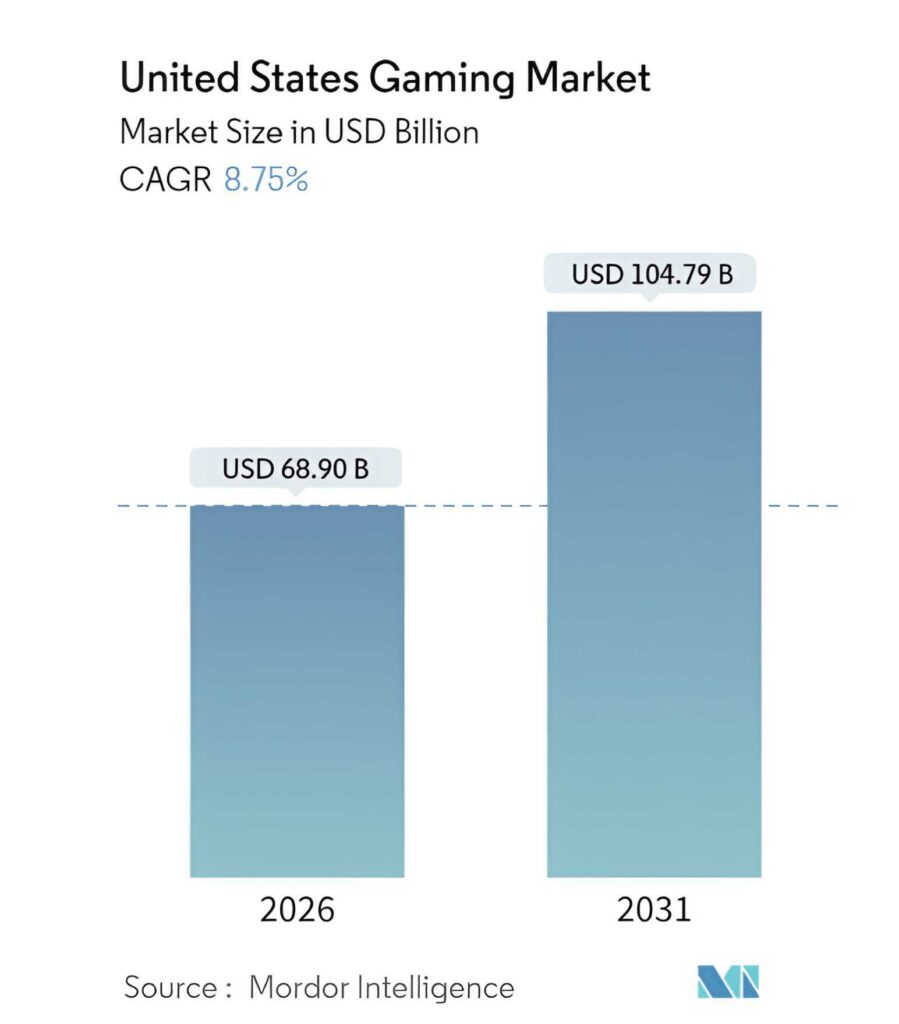
The US gaming market is projected to hit a high of $68.9 billion by 2026, compared to $63.36 billion in 2025. It is projected that the market will be expanding to a total of $104.79 billion by the year 2031, and this represents an average of 8.75% growth rate, which is expected to be experienced between the years 2026 and 2031.
In the United States, gaming takes place across several platforms, including mobile, console, and PC systems. The market share is as follows:
| Gaming segment | Market share (2024) |
|---|---|
| Mobile gaming | 49% |
| Console gaming | 27% |
| PC gaming | 23% |
Mobile dominates overall gaming revenue due to massive user bases and freemium models. However, PC and console gaming generate higher revenue per user. Gaming cafés serve the PC and console segments, where equipment costs create barriers to home gaming.
PC Gaming Market
PC gaming creates the main opportunity for Pixel Arena. Playing on a PC needs expensive equipment, a technical setup, and enough space at home. Many people enjoy PC games but cannot afford or manage these requirements. Shared gaming cafés solve this problem by giving access without ownership.
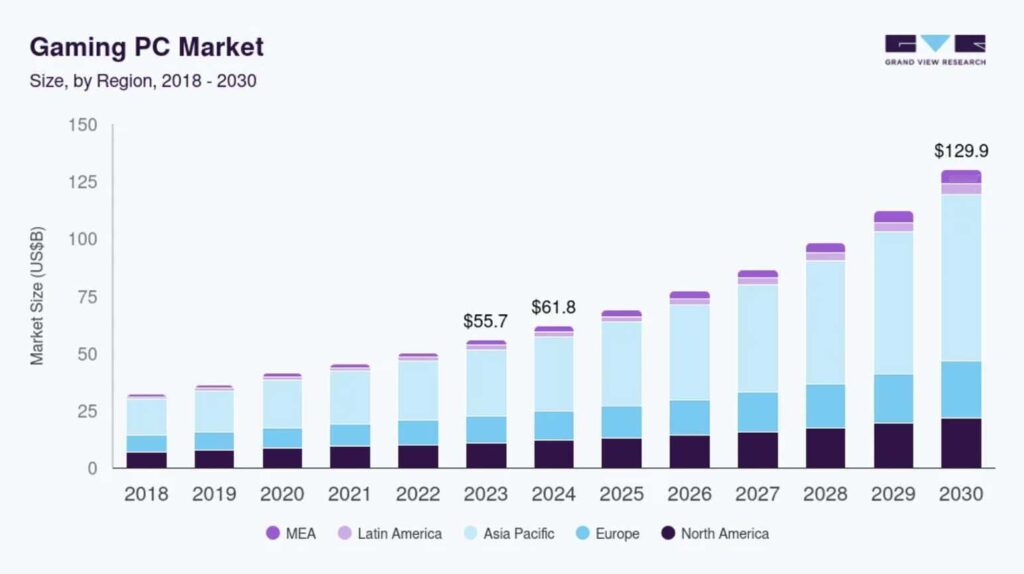
According to research, the global PC gaming market is estimated at $61.84 billion in 2024 and is expected to reach $129.93 billion in 2030.
PC gaming growth directly benefits gaming cafés. Hardware prices continue rising, with mid-range systems costing $1,500 to $2,500 and high-end builds exceeding $3,000. Many players cannot justify this expense for occasional use. Pixel Arena converts this barrier into demand by offering access to high-performance systems on an hourly basis.
Esports further strengthens this opportunity. Competitive PC titles dominate organized gaming, and players require reliable equipment and a fast internet connection to practice effectively. Gaming cafés meet this need without the burden of ownership.
Local Market Insights
Austin provides a strong local foundation for a PC-focused gaming café. The city is a mix of population growth, youthful residents, and a workforce that works in technology-based companies.
The population of Austin is approximately estimated to be 979,700 in 2025. The Austin metropolitan area has over 2.5 million inhabitants, and it is projected to grow at an average of 1.7% per year. The downtown and neighbouring areas of the campus grow at a higher rate than the metro.
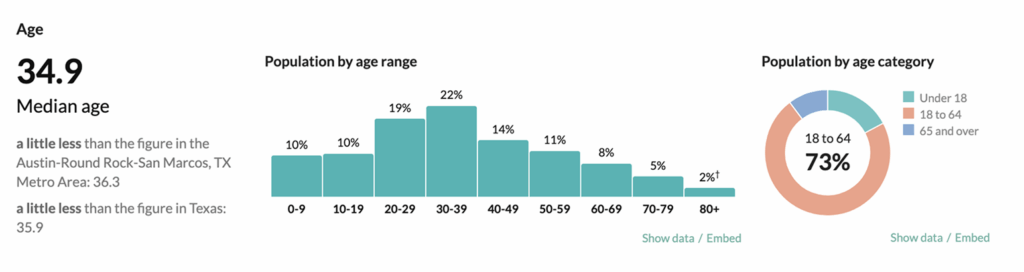
Age distribution strongly favours gaming demand. About 73% of Austin’s population falls within the 18 to 64 working-age range. The median age sits between 34.9 and 35.9 years, closely matching the national average gamer age of 34. The single largest age group is 30 to 34 years.
The economic situation is favorable to leisure spending. The median household income stands at $85,000, and unemployment stands at about 3.5%, which is lower than it is in other areas in the country. There is a high number of people employed in technology, healthcare, education, and professional services, which encourages a constant income and consistent spending on leisure activities.
These types of demographic and market bases present obvious opportunities to Pixel Arena. The demographics, income rates, and standards of lifestyle of the city are similar to the model of a PC gaming cafe.
The following are the reasons why Pixel Arena is likely to be in demand locally:
- Population growth expands the customer base without requiring new locations.
- A young working-age population closely matches typical PC gamer demographics.
- Strong student and early-career presence supports frequent and repeat visits.
- Higher household incomes allow regular spending on paid gaming experiences.
- A tech-driven workforce shows strong interest in PC and esports gaming.
- Low unemployment supports consistent entertainment demand year-round.
Target Customers
Pixel Arena serves a focused but diverse customer base unified by interest in PC and console gaming.
| Target customer | Why they choose Pixel Arena | Why they are a strong fit |
|---|---|---|
| College students (18–24) | Access to high-end gaming PCs without buying equipment | High gaming frequency, social play habits, and flexible schedules |
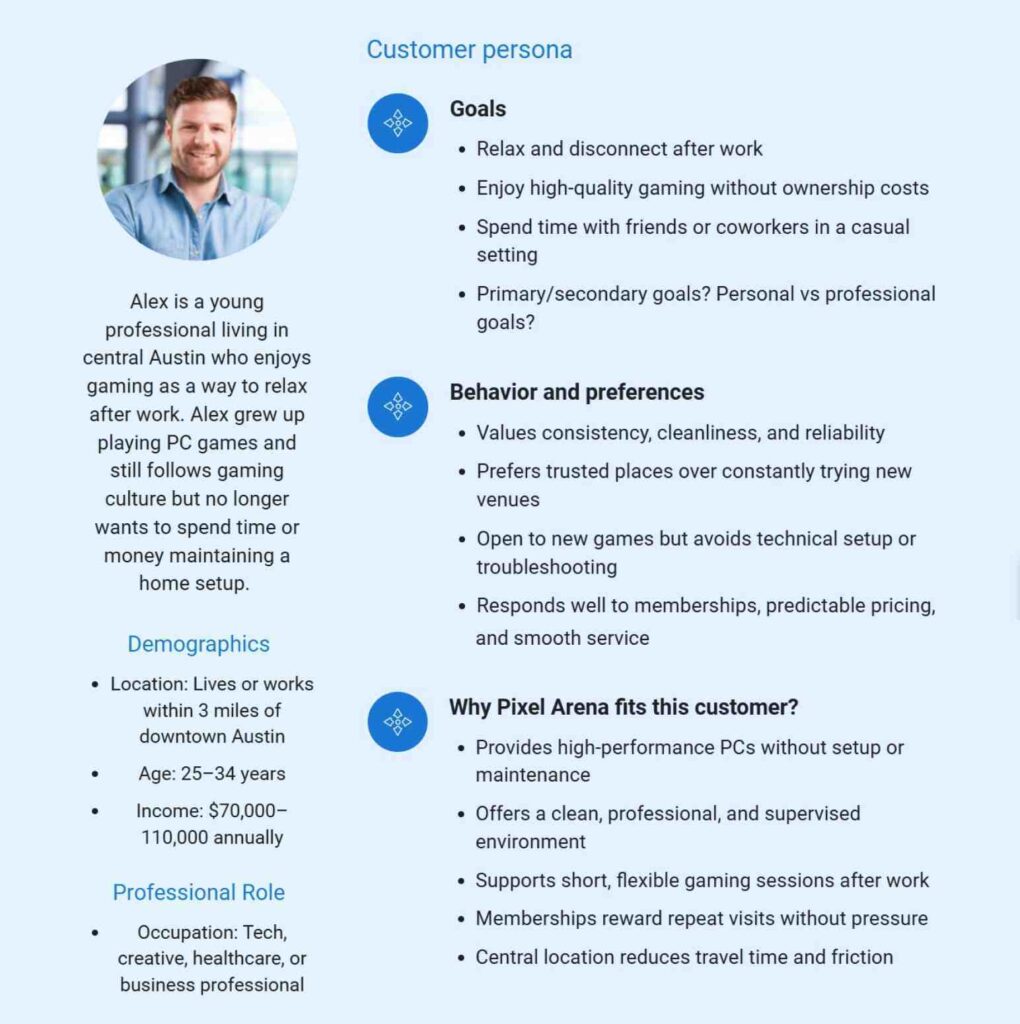
| Young professionals (25–35) | Clean, reliable gaming experience without setup or maintenance | Strong spending capacity and consistent demand after work hours |
| Casual gamers (16–30) | Safe, beginner-friendly place to try gaming with friends | Group visits, low-pressure entry, and long-term conversion potential |
Customer Persona
Competitor Analysis
At Pixel Arena, we divided competition analysis into direct and indirect competitors:
Direct Competitors
| Competitor | Location | Strengths | Weaknesses |
|---|---|---|---|
| GameZone Arena | North Austin | Large venue with 40+ stations; capable of hosting large tournaments; established brand | Far from downtown and UT campus; higher hourly pricing; impersonal scale; parking issues |
| Cyber Lounge | East Austin | Lower pricing; loyal local customer base; established neighborhood presence | Older equipment; limited hours; dated interiors; weaker service and amenities |
Indirect Competitors
| Competitor type | Strengths | Limitations compared to Pixel Arena |
|---|---|---|
| Home gaming | Convenience; privacy; no hourly fees after purchase | High upfront costs; limited social interaction; maintenance burden; space and internet constraints |
| Bars and entertainment venues | Social setting; group-friendly; food and drinks available | Higher cost per hour; not gaming-focused; alcohol-centered environment |
| Online gaming and streaming | Easy access; no travel; free-to-play options | Lacks in-person social experience; limited hardware quality |
| University computer labs | Free student access; campus proximity | Gaming prohibited; low-performance systems; restricted hours; unsuitable for social play |
Competitive Differentiation
Pixel Arena brings together location, scale, and service in a way local competitors do not offer. The owner’s presence plays a key role in building stability and trust. Jason works on-site every day, which allows quick problem-solving and strong relationships with customers.
The 18-station layout creates the right balance between social energy and personal attention. The space stays active without feeling crowded or noisy. Customers receive support when needed, but the environment remains calm and comfortable.
The Central Austin location near the UT campus adds another advantage. Students can walk in easily, and downtown workers can reach the café without a long travel. This access sets Pixel Arena apart from suburban gaming venues.
High-quality equipment and regular maintenance ensure reliable performance. Modern PCs, high-refresh monitors, and routine upkeep reduce downtime and frustration during gameplay.
Community-first operations strengthen loyalty. Fair pricing, clear rules, and casual events encourage customers to return without pressure. Together, these factors position Pixel Arena as a focused, high-quality gaming café built for repeat local customers rather than discount-driven volume traffic.
adsfsdg
Source of Revenue
Pixel Arena operates on a simple and proven business model. Customers pay hourly rates to access gaming equipment in our supervised facility. Additional revenue comes from memberships, events, and light snack sales.
Primary Revenue: Hourly Gaming
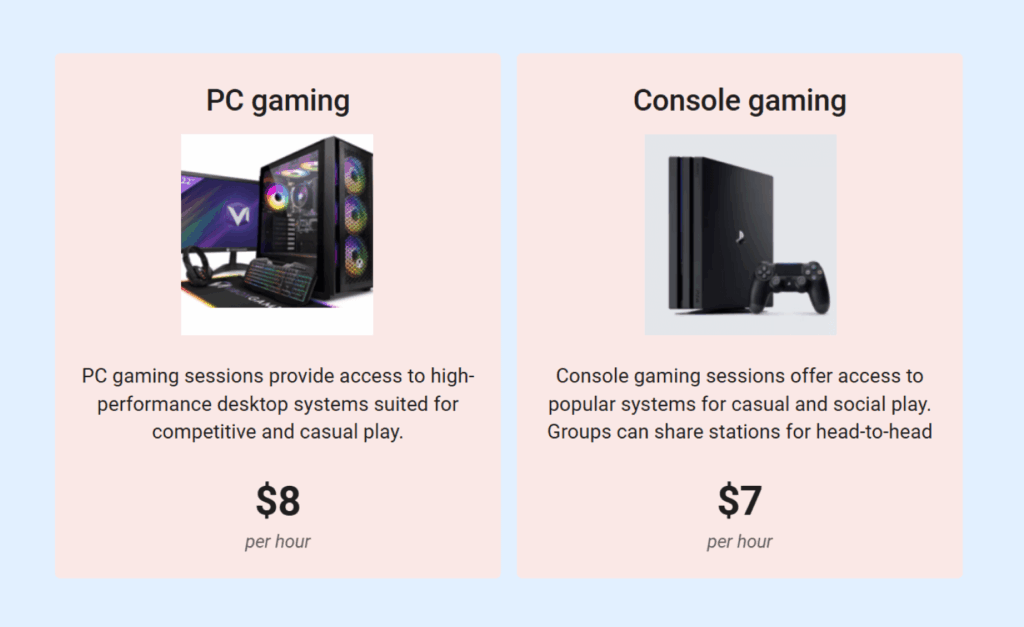
Walk-in customers pay by the hour for PC or console access. Rates average $7.50 per hour blended across all station types. Customers pay when they finish gaming sessions. The POS system tracks time automatically and calculates charges.
Additional pricing elements:
| Pricing element | Detail |
|---|---|
| Member discount | 15–20% off standard rates |
| Effective realized rate after discounts | $6.90 per hour |
Secondary Revenue: Memberships
Monthly memberships provide discounted gaming hours. Members pre-purchase hour bundles at reduced rates. Memberships generate predictable recurring revenue and encourage regular visits.
Three membership tiers serve different usage patterns:
| Membership tier | Monthly fee | Included hours | Additional benefits |
|---|---|---|---|
| Bronze | $45 | 10 hours | Overflow billed at member rates |
| Silver | $80 | 20 hours | Lower overflow rates and priority booking |
| Gold | $130 | 40 hours | Best rates and guaranteed availability |
Approximately 20% of gaming usage comes from members. Memberships smooth revenue during slower periods when walk-in traffic drops.
Tertiary Revenue: Events and Food
Events include tournaments, group bookings, and birthday parties. These activities fill capacity during traditionally slow periods. Event revenue supplements core gaming income.
Snack and beverage sales provide convenience for customers. Pre-packaged items require no preparation. Food represents 12-15% of total revenue.
Service Model
Service at Pixel Arena focuses on speed, clarity, and self-directed play. Customers check in at the counter, choose a PC or console station, and receive quick assistance from our part-time employee (John) to start their session. He activates the selected station, begins time tracking, and confirms basic rules before play starts.
Most players play on their own or with their group without needing constant staff assistance, which keeps the floor calm and organized. Our employee remains available throughout the session to handle technical issues, extend play time, or complete snack and beverage purchases. When a customer finishes gaming, John closes the session, processes payment, and resets the station for the next user.
The service model avoids activities that add risk, noise, or regulatory burden. Operations exclude:
- Gambling
- Betting
- Alcohol sales and service
- Late-night cafe operation
- Adult-oriented content and services
- On-site cooking or preparation
Operations Plan
Operations at Pixel Arena focus on smooth daily flow, clear roles, and consistent service. The goal is to run the café efficiently while keeping the space organized, safe, and welcoming for all customers.
Operating Hours
Operating hours match customer availability patterns:
| Day | Operating hours | Daily hours |
|---|---|---|
| Monday to Friday | 2:00 PM – 10:00 PM | 8 |
| Saturday and Sunday | 12:00 PM – 11:00 PM | 11 |
| Total weekly hours | 62 | |
| Annual operating hours | 3,224 |
Staffing Structure
The staffing model relies on direct owner involvement supported by limited part-time help. The structure keeps labor efficient while maintaining control over daily operations and customer experience.
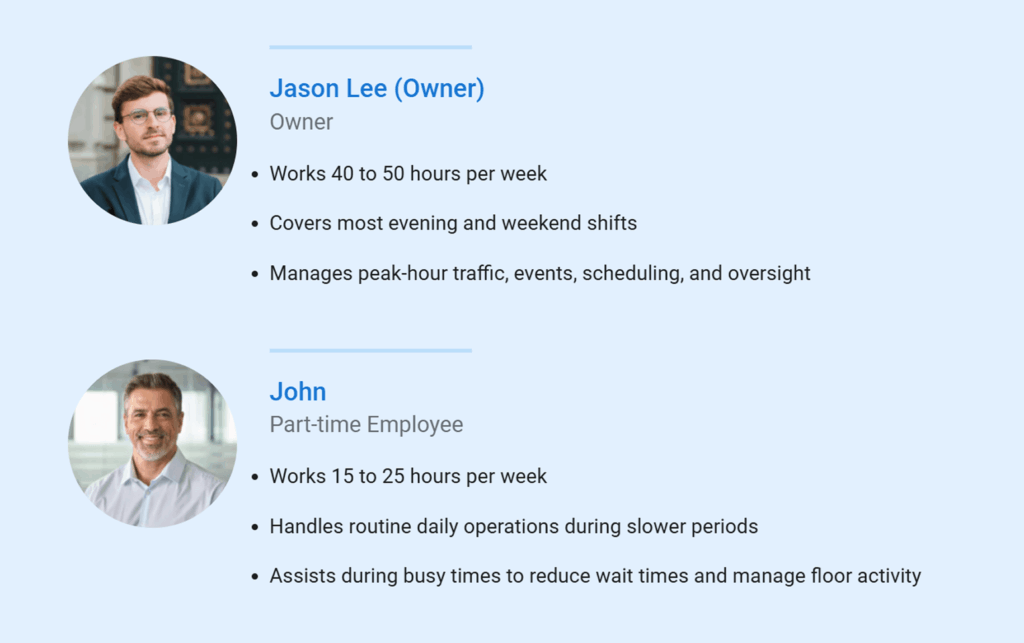
Total weekly labor ranges from 55 to 75 hours, closely matching the café’s operating schedule. Owner coverage remains highest during peak demand, while part-time support fills gaps during lower-traffic hours.
Peak vs Off-Peak Coverage
| Operating period | Customer volume | Staffing approach | Focus |
|---|---|---|---|
| Off-peak hours (weekday afternoons) | Low to moderate | One staff member on duty | Walk-ins, setup, basic support |
| Peak hours (evenings and weekends) | High | Owner + part-time staff | Fast check-ins, event support, floor control |
Event Operations
Pixel Arena hosts events to increase repeat visits and community engagement. Weekly casual tournaments run during normal hours and use existing stations. Monthly larger tournaments receive dedicated time blocks and added staff coverage. Events follow simple rules, use non-cash prizes, and end on time to avoid disrupting regular customers.
Cafe Inventory Management
Snack sales support gaming sessions without adding operational complexity or regulatory risk. Pixel Arena limits food and beverage offerings to simple, ready-to-sell items that require no preparation and minimal handling.
Here’s how we manage our cafe inventory:
- Stock only pre-packaged snacks and non-alcoholic drinks
- Reorder weekly based on sales patterns
- Store items in sealed, labeled containers
- Track inventory through the POS system
- Avoid food preparation or cooking on-site
Legal Compliance and Insurance
Pixel Arena operates in full compliance with local and state regulations. The business registers with the State of Texas and maintains a valid City of Austin business license. It registers for Texas sales tax collection and reports sales as required.
Our gaming cafe carries general liability insurance and insures gaming equipment and furnishings to protect business assets. Operations comply with fire safety and occupancy rules, and the facility meets ADA accessibility requirements to ensure safe and inclusive access for all customers.
Tools, Technology, and Systems
Pixel Arena relies on dependable technology to keep daily operations smooth and consistent. Systems focus on reducing errors, preventing downtime, and supporting a fast customer experience without adding unnecessary complexity.
- A POS system manages time tracking, billing, and payment processing
- High-speed fiber internet ensures stable, low-latency gaming sessions
- Network monitoring tools identify issues early and reduce outages
- Scheduling software helps manage staff shifts and coverage
- Discord supports customer communication, event coordination, and community engagement
Equipment Maintenance
| Maintenance area | Frequency | Purpose |
|---|---|---|
| PC and console inspection | Daily | Identify issues early and prevent service disruptions |
| Cleaning and software updates | Weekly | Maintain performance, hygiene, and system stability |
| Peripheral replacement | As needed | Avoid gameplay interruptions from worn equipment |
| Spare equipment management | Ongoing | Enable quick swaps during failures |
| Hardware refresh planning | Scheduled | Reduce breakdown risk and extend equipment lifespan |
Does your plan sound generic?
Refine your plan to adapt to investor/lender interests
Marketing Plan
The purpose of the marketing plan at Pixel Arena is to attract new customers, encourage repeat visits, and build a loyal local gaming community to support steady revenue growth. Here’s how we’ll use different channels to reach our customers:
Marketing Channels
Pixel Arena uses simple, local-focused marketing. The goal is to attract nearby customers, increase repeat visits, and build a small gaming community.
Digital channels drive daily discovery. The digital channels we’ll use are as follows:
| Channel | Purpose |
|---|---|
| Google Business Profile | Capture local search traffic and drive walk-ins |
| Website | Provide clear information, pricing, and booking access |
| Social media (Instagram, Facebook, Discord) | Build awareness, announce events, grow community |
| Email marketing | Retain customers and promote events |
Local marketing builds foot traffic and trust. Here’s the list of local tactics we’ll use to attract customers:
| Channel | Purpose |
|---|---|
| Campus outreach | Reach students and student organizations |
| Physical signage | Increase walk-in visibility and brand presence |
| Local partnerships | Share audiences with nearby businesses |
| Events and tournaments | Create repeat visits and community habits |
This mix keeps marketing costs controlled. It focuses on spending where customers already look and return often.
We have a marketing budget of $7,200 annually that will be used in the following categories:
| Category | Monthly | Annual |
|---|---|---|
| Google Business / Local SEO | $250 | $3,000 |
| Social Media & Content | $150 | $1,800 |
| Campus & Partnerships | $100 | $1,200 |
| Events & Prizes | $75 | $900 |
| Website & Email | $25 | $300 |
| Total Marketing Budget | $600 | $7,200 |
Additional: Website development $500 (one-time), Signage $3,500 (in buildout); Pre-launch marketing $4000 (one-time)
Customer Acquisition Plan
Pixel Arena follows a phased customer acquisition plan that builds awareness first, then focuses on steady, repeat traffic. The approach stays local, measurable, and easy to manage for an owner-operated business.
Launch Phase (Months 1-3)
The launch stage is concerned with awareness, initial visits, and initial response.
The cafe launches with a simple website, active social networks, and a Discord server before going online. The opening date is also announced by placing campus flyers and describing pricing in an easy-to-understand manner.
It is followed by a soft opening with fewer hours and reduced prices. This would give the staff time to debug systems, optimize processes, and warm up early customers to do Google reviews.
The business will be celebrated with a great opening that will include small tournaments, a free first hour, and massive photo and video sharing on social networks.
Growth Phase (Months 4-12)
Once launched, it is followed by steady growth per month. Google Business Profile keeps abreast of photos, posts, and reviews.
Referral reward programmes motivate customers to invite their friends and relatives. Social media is not complex and is constantly working with reminders of events and real customer content.
Customer Retention Strategy
The membership program converts frequent visitors into regular customers by reducing hourly costs and improving access.
- Bronze – $45 per month
Includes 10 hours, 15% discount on extra time, priority booking, and free tournament entry. Designed for students and occasional gamers.
- Silver – $80 per month
Includes 20 hours, 20% discount, stronger booking priority, exclusive events, and snack discounts. Designed for regular gamers.
- Gold – $130 per month
Includes 40 hours, 25% discount, guaranteed availability, and personal locker access. Designed for daily or competitive gamers.
Moreover, Discord serves as the primary community hub. It hosts announcements, general chat, game-specific channels, and group-finding coordination. Voice channels support live interaction.
Jason stays active daily, which keeps the environment moderated, welcoming, and responsive. This regular presence builds trust, strengthens relationships, and encourages customers to stay engaged and return often.
Loyalty Program
A simple loyalty system rewards both members and non-members without complexity.
Non-members earn rewards through a punch card system. Ten visits earn two free gaming hours. This encourages repeat visits before committing to a membership.
Usage milestones reward long-term engagement.
- 25 hours earns a $5 credit
- 50 hours earns a branded t-shirt
- 100 hours earns a wall plaque
- 250 hours earns lifetime VIP status
These rewards create visible recognition inside the café and motivate continued usage.
Don’t spend weeks on your first draft
Complete your business plan in less than an hour
Financial Plan
The financial plan provides an overall view of revenue expectations, cost structure, funding use, and the path to break-even and long-term stability.
Startup Costs & Source of Funds
| Category | Cost (USD) |
|---|---|
| Lease deposit and initial rent | $9,800 |
| Interior buildout and signage | $14,500 |
| Gaming PCs and consoles | $28,000 |
| Monitors, peripherals, furniture | $12,500 |
| Networking, servers, POS setup | $6,200 |
| Licenses, permits, legal, insurance | $3,500 |
| Pre-launch marketing | $4,000 |
| Initial snacks and beverage inventory | $2,500 |
| Working capital reserve (opening cash) | $14,000 |
| Total Startup Costs | $95,000 |
Source of Funds
| Source | Amount (USD) |
|---|---|
| Bank term loan – Frost Bank | $75,000 |
| Owner cash contribution | $20,000 |
| Total Funding | $95,000 |
Income Statement
| Line Item | Year 1 ($) | Year 2 ($) | Year 3 ($) |
|---|---|---|---|
| Revenue | 362,000 | 458,000 | 512,000 |
| Gaming sessions revenue | 318,000 | 402,000 | 448,000 |
| Snacks and beverages | 44,000 | 56,000 | 64,000 |
| Cost of Goods Sold (COGS) | 86,000 | 108,000 | 124,000 |
| (Includes game licensing fees, transaction fees, consumables) | |||
| Gross Profit | 276,000 | 350,000 | 388,000 |
| Gross margin % | 76.2% | 76.4% | 75.8% |
| Operating Expenses (OPEX) | 289,000 | 301,000 | 314,000 |
| Rent | 38,400 | 39,600 | 40,800 |
| Utilities and internet | 11,400 | 11,800 | 12,200 |
| Fixed part-time staff (operations support) | 62,000 | 66,000 | 70,000 |
| Marketing | 7,200 | 7,200 | 7,200 |
| Software and subscriptions | 4,200 | 4,400 | 4,600 |
| Insurance | 2,160 | 2,220 | 2,280 |
| Repairs and maintenance | 4,000 | 4,500 | 5,000 |
| Operational drag (semi-variable cost) | 14,500 | 18,300 | 20,500 |
| Owner compensation | 0 | 18,000 | 24,000 |
| Admin and compliance | 6,940 | 8,780 | 7,420 |
| Other operating expenses | 138,200 | 120,200 | 120,000 |
| *Note: “Other operating expenses include miscellaneous operating, administrative, and contingency costs not individually itemized for planning simplicity.” | |||
| EBITDA | (13,000) | 49,000 | 74,000 |
| EBITDA margin % | (3.6%) | 10.7% | 14.5% |
| Depreciation | 17,500 | 17,500 | 17,500 |
| EBIT | (30,500) | 31,500 | 56,500 |
| Interest expense | 6,200 | 5,600 | 4,900 |
| Net Income (Pre-Tax) | (36,700) | 25,900 | 51,600 |
Notes:
- Operational drag is treated as OPEX for planning simplicity, though it behaves partially as a variable cost.
- The owner does not draw compensation in Year 1 to conserve cash during the startup phase. Modest owner compensation begins in Year 2 as operations stabilize and cash flow improves.
Cash Flow Statement
| Line Item | Year 1 ($) | Year 2 ($) | Year 3 ($) |
|---|---|---|---|
| Net Income (Pre-Tax) | (36,700) | 25,900 | 51,600 |
| Adjustments (Non-Cash) | |||
| Depreciation | 17,500 | 17,500 | 17,500 |
| Working Capital Changes | |||
| Change in accounts receivable | (2,500) | (1,500) | (1,000) |
| Change in inventory | (2,000) | (1,000) | (1,000) |
| Change in accounts payable & accruals | 3,500 | 2,000 | 2,000 |
| Change in Prepaid Expenses | 0 | 0 | 3,000 |
| Net Cash from Operations | (20,200) | 42,900 | 72,100 |
| Cash from Investing Activities | |||
| Initial equipment and buildout capex | (60,000) | 0 | 0 |
| Minor refresh capex | 0 | 0 | (5,000) |
| Net Cash from Investing | (60,000) | 0 | (5,000) |
| Cash from Financing Activities | |||
| Term loan proceeds | 75,000 | 0 | 0 |
| Owner cash contribution | 20,000 | 0 | 0 |
| Loan principal repayment | (10,700) | (10,700) | (10,700) |
| Owner distributions | 0 | (12,000) | (18,000) |
| Net Cash from Financing | 84,300 | (22,700) | (28,700) |
| Net Change in Cash | 4,100 | 20,200 | 38,400 |
| Beginning cash | 14,000 | 18,100 | 38,300 |
| Ending Cash | 18,100 | 38,300 | 76,700 |
Spreadsheets are exhausting & time-consuming
Build accurate financial projections w/ AI-assisted features
Balance Sheet
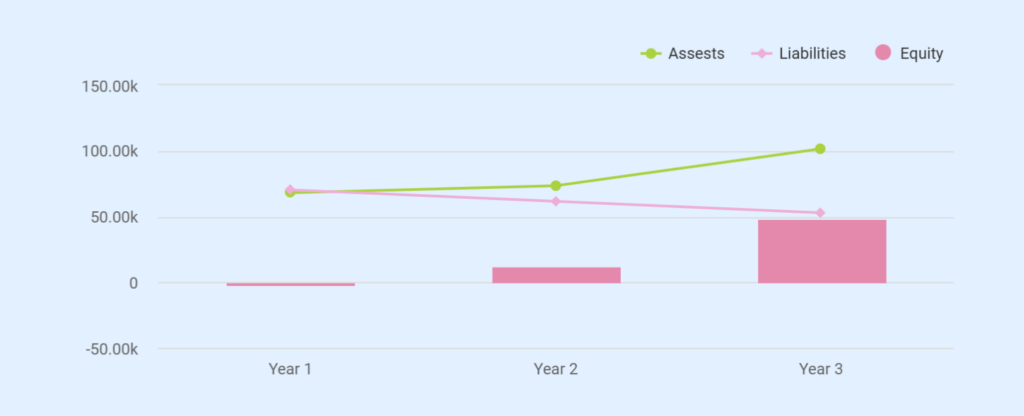
| Balance Sheet | Year 1 ($) | Year 2 ($) | Year 3 ($) |
|---|---|---|---|
| Assets | |||
| Cash | 18,100 | 38,300 | 76,700 |
| Accounts receivable | 2,500 | 4,000 | 5,000 |
| Inventory | 2,000 | 3,000 | 4,000 |
| Prepaid expenses | 3,000 | 3,200 | 400 |
| Total Current Assets | 25,600 | 48,500 | 86,100 |
| Property, equipment, buildout (cost) | 60,000 | 60,000 | 65,000 |
| Accumulated depreciation | (17,500) | (35,000) | (52,500) |
| Net Fixed Assets | 42,500 | 25,000 | 12,500 |
| Total Assets | 68,100 | 73,500 | 101,600 |
| Liabilities | |||
| Accounts payable and accruals | 6,000 | 8,000 | 10,000 |
| Current portion of term loan | 10,700 | 10,700 | 10,700 |
| Long-term term loan | 53,600 | 42,900 | 32,200 |
| Total Liabilities | 70,300 | 61,600 | 52,900 |
| Equity | |||
| Owner capital contribution | 20,000 | 20,000 | 20,000 |
| Retained earnings | (22,200) | (8,100) | 28,700 |
| Total Equity | (2,200) | 11,900 | 48,700 |
Break-Even Analysis
| Item | Amount |
|---|---|
| Average monthly fixed costs (OPEX) | $19,500 – $21,000 |
| Variable cost ratio (COGS + operational drag) | 26% – 29% |
| Contribution margin | 71% – 74% |
| Monthly break-even revenue (range) | $26,500 – $30,000 |
| Average monthly revenue – Year 1 | $30,200 |
| Average monthly revenue – Year 2 | $38,200 |
| Average monthly revenue – Year 3 | $42,700 |
Loan Repayment Plan
The business uses a term loan to fund startup costs and spread repayment over manageable annual payments. The structure supports cash flow stability while allowing the business to build operating reserves during the early years.
| Loan detail | Year 1 ($) | Year 2 ($) | Year 3 ($) | Year 4 ($) | Year 5 ($) | Year 6 ($) | Year 7 ($) |
|---|---|---|---|---|---|---|---|
| Opening loan balance ($) | 75,000 | 64,300 | 53,600 | 42,900 | 31,700 | 20,000 | 7,800 |
| Annual loan payment ($) | 13,700 | 13,700 | 13,700 | 13,700 | 13,700 | 13,700 | 7,800 |
| Principal repaid ($) | 10,700 | 10,700 | 10,700 | 11,200 | 11,700 | 12,200 | 7,800 |
| Closing loan balance ($) | 64,300 | 53,600 | 42,900 | 31,700 | 20,000 | 7,800 | 0 |
The Quickest Way to turn a Business Idea into a Business Plan
Fill-in-the-blanks and automatic financials make it easy.
