




Executive Summary
Greenville-based ArtisanWoven Crafts Studio, LLC, produces artisan décor, pottery, and woven fabrics. The studio was founded and is entirely owned by Maya Ellison, who creates all of the pieces in-house and conducts practical workshops that teach traditional craft methods. She has been producing genuine, superior handcrafted goods for more than 12 years.
At 1198 River Walk Boulevard in Greenville, our studio functions as a small shop space in addition to a functional production area. In-studio, at Greenville craft fairs, online via Etsy and Shopify, and through a few boutique partners, we sell our products.
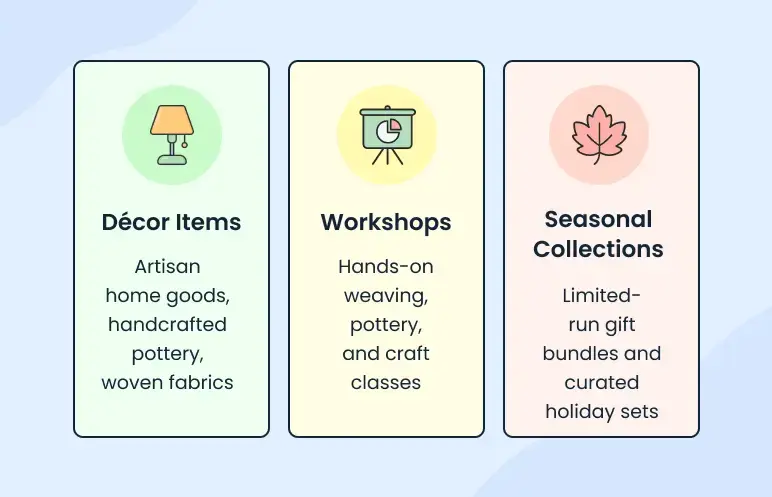
Serving bowls, planters, braided table runners, hand-dyed cotton blankets, seasonal gift sets, and more are among the items we provide. Additionally, we provide in-studio seminars where individuals can learn weaving and pottery in a welcoming, artistic setting.
We seek $38,000 in funding from the South Carolina Arts Commission and pair it with $52,000 in owner financing to support studio build-out, equipment, raw materials, e-commerce development, and first-year operating capital. No bank loan requested.
Our studio serves a strong local buyer base of women 25–65, tourists, home décor shoppers, and eco-conscious consumers. Greenville’s artisan markets draw thousands of visitors per weekend, and our location near Parkins Mill sits within a high craft-purchasing demographic.
Our mission is to create authentic, sustainably crafted home goods that preserve and share traditional craft skills in South Carolina.
Key Offerings
ArtisanWoven produces artisan décor, pottery, and handwoven fabrics built to last. Customers can order personalized gift sets or join workshops to learn traditional craft techniques firsthand. The studio also supplies small-batch collections to select boutiques and launches seasonal assortments inspired by cultural and design trends.
In addition to producing small-batch, environmentally sourced goods, the studio holds craft classes that promote traditional artistic skills and community involvement.
Market
In 2024, the U.S. handicrafts market reached about USD 319.4 billion, and we’ve been seeing a steady shift toward products that feel real, personal, and handmade. Greenville brings in thousands of weekend craft-market visitors, and they don’t browse casually—they stop, ask questions, and want to know who made the piece and how. These are the people who care about natural materials, visible craftsmanship, and local origin, which fits perfectly with what we create at ArtisanWoven. The growing interest in learning craft skills also supports our workshops, helping us connect with customers in a way that turns buyers into long-term supporters.
Finances
ArtisanWoven will begin operations with $90,000 in capital, including $38,000 requested from the South Carolina Arts Commission and $52,000 contributed by the owner. From this initial funding, the business will invest $65,000 in studio renovations, equipment, inventory, and launch-related costs. The remaining funds are used as working capital, and they can last six months to settle the rent, utilities, materials, and marketing as sales accumulate.
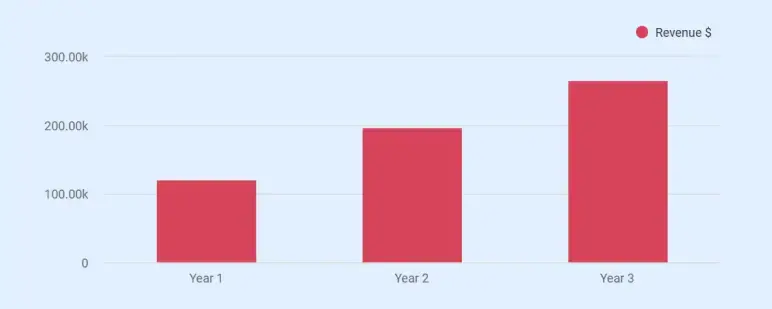
Year 1 ArtisanWoven project is expected to generate a revenue of $120,400, which will be a result of in-studio sales, online orders, craft markets, and workshops. The net profit after material and operating expenses will be recorded at 9,500 dollars after taking into consideration the realistic ramp-up period of the business, as opposed to instant scale.
In Year 2, revenue goes up to $196,400 due to the number of repeat customers, workshops being fully booked, and the online sales stabilizing. This is the first full year of the company, as it has been profitable. In Year 3, the revenue is projected to be at $266,000 with the aid of wholesale partnerships, seasonal gift purchases, and the product bundle of higher revenue. Better production efficiency and constant overhead at that point will result in a projected net margin of about 18%.
This monetary trend is a sign of a very conservative strategy, or rather a focus on product quality, a steady expansion and profitability in the long term, rather than the tendency to growth.
Tired of overthinking every part of your business plan?
Stop. Upmetrics AI guides you step-by-step to get it done effortlessly.

Business Goals
What We Aim to Achieve (Objectives)
- Expand sales through in-studio retail, online platforms, and boutique partnerships.
- Increase workshop attendance and grow a repeat participant community.
- Build a recognizable craft brand known for quality, sustainability, and local artistry.
- Achieve consistent year-over-year revenue growth while maintaining healthy profit margins.
- Strengthen operational efficiency by controlling material costs and minimizing excess inventory.
Keys to Success
ArtisanWoven will secure long-term success by focusing on core practices that directly support growth and profitability:
- Deliver superior craftsmanship with natural materials.
- Cultivate a craft community through workshops and personal engagement.
- Align product offerings with seasonal aesthetics and buyer preferences.
- Expand direct sales channels by reaching 1,000 online orders
- Manage inventory efficiently by turning inventory four times per year
Vision
We are also planning to become a well-known handmade craft studio in South Carolina, creating meaningful and heirloom-quality handmade items. We develop a vibrant society of students and entrepreneurs who preserve the usefulness and dynamism of conventional skills. Our vision is to become a recognized regional brand in the long run, a brand that promotes sustainability, craftsmanship, and the local creative economy.
Company Overview
ArtisanWoven Crafts Studio, LLC operates as a South Carolina–registered limited liability company. Founder Maya Ellison owns 100% of the business. The studio runs at 1198 River Walk Boulevard, Suite 104, Greenville, SC 29607. The team consists of one full-time owner-artisan and one part-time studio assistant. The company serves local craft buyers, boutique retailers, tourists, and online customers by producing and selling handmade woven textiles, pottery, and artisan décor.
Start-up Summary
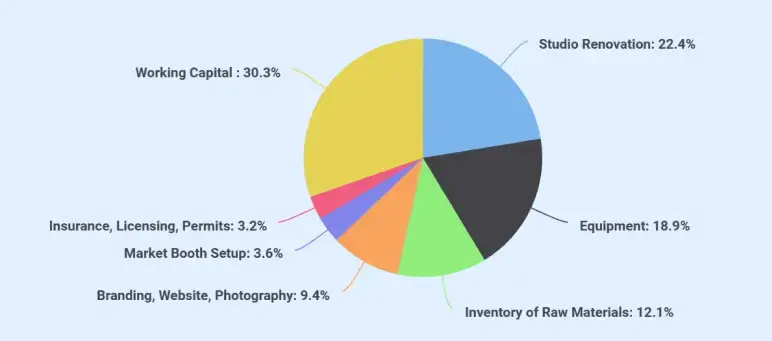
Funded by a combination of owner investment and state arts grant support, ArtisanWoven begins with an initial capital of $90,000. The money includes studio setup, production equipment, supplies, operations, and working capital for the first six months. The goal is to create a useful, secure, and visitor-friendly area that facilitates workshop and retail operations right away.
| Category | Cost | Description |
|---|---|---|
| Studio Renovation & Display Buildout | $14,800 | Shelving, product displays, lighting, counters |
| Equipment (kiln, loom, wheels) | $12,500 | Core production tools for pottery and textiles |
| Inventory of Raw Materials | $8,000 | Clay, fibers, dyes, fabric stock |
| Branding, Website, Photography | $6,200 | Brand identity, online storefront, product media |
| Market Booth Setup | $2,400 | Tent, tables, and signage for local markets |
| Insurance, Licensing, Permits | $2,100 | Legal compliance and artisan liability coverage |
| Working Capital (6 months) | $44,000 | Rent, utilities, materials, wages, and marketing during ramp-up |
| Total Startup Capital | $90,000 | $38,000 grant + $52,000 owner investment |
Ownership
ArtisanWoven operates under single-owner leadership with full creative and managerial control held by the founder.
| Owner | % Ownership | Role | Background & Expertise |
|---|---|---|---|
| Maya Ellison | 100% | Founder & Lead Artisan | 12 years in pottery and textile arts, former artisan with The Makers Collective, past instructor at Greenville Center for Creative Arts |
Regulatory Requirements
ArtisanWoven operates within South Carolina’s small-scale artisan and retail framework and will maintain full compliance from launch. The business is registered as a South Carolina LLC, files annual state reports, and complies with all applicable local and state tax requirements, including sales and use tax collection for in-studio, market, and online sales.
The Greenville studio holds a local artisan vendor license and meets retail zoning approvals for limited on-site sales and workshops. Because the studio operates a kiln, ArtisanWoven secures a kiln permit, completes fire safety and ventilation inspections, and follows all safety standards for electrical load, air quality, and material handling.
For public markets and workshops, the business carries artisan liability insurance and provides proof of coverage as required by market organizers and venue partners. All workshops follow basic safety protocols for tools, equipment, and materials, particularly for youth sessions.
By addressing regulatory requirements early and maintaining clear documentation, ArtisanWoven avoids operational disruptions, protects customers and staff, and builds credibility with grant agencies, partners, and buyers.
Market Analysis
Industry Overview
The global handicrafts market shows strong and steady expansion. It reached $739.95 billion in 2024 and is projected to grow to $983.12 billion by 2030, backed by an annual growth rate of 4.9% from 2025–2030.
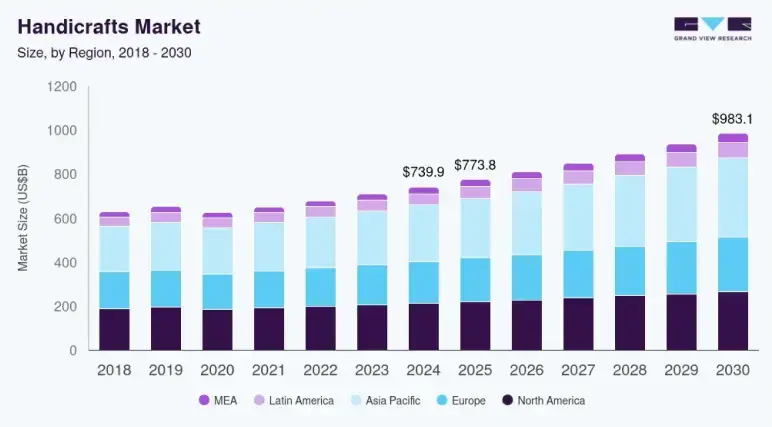
Particularly in the United States, the market reached $319.4 billion in 2024, indicating the nation’s robust demand for handcrafted and artisan goods.
This rise is fuelled by a number of fundamental consumer shifts: People are embracing things with cultural authenticity and narrative value, supporting locally manufactured and handmade goods, and choosing ethically produced goods over mass-produced ones. Customers are becoming more and more interested in things that are meaningful, personal, and related to the manufacturer rather than being impersonal and machine-generated.
Sustainability plays a major role. Buyers prefer natural materials, small-batch production, low-waste processes, and environmentally conscious sourcing. ArtisanWoven directly benefits from these trends because the company already positions itself with authentic craftsmanship, ethically sourced materials, and visible maker-driven storytelling. Such rising demand strengthens our brand’s pricing power, customer loyalty, and competitive advantage in both online and in-person retail channels.
Market Segmentation
We categorize our customers into defined segments and allocate priority based on expected revenue contribution and buying frequency. This helps ArtisanWoven direct marketing spend and production efforts where demand and profitability are strongest.
Home Décor Buyers & Interior Shoppers – 40%
We prioritize this segment because home décor purchases represent the most consistent and high-value sales.
Interior Designers & Boutique Retailers – 25%
This group drives bulk orders, higher margins, and repeat purchases for ongoing design projects.
Gift Buyers & Occasion-Driven Customers – 15%
Seasonal, holiday-driven, and personalized gifting creates predictable spikes throughout the year.
Ethical & Sustainability-Focused Consumers – 10%
These shoppers actively seek eco-responsible handcrafted products and strengthen our brand positioning.
Online Marketplace Shoppers (Etsy, Instagram, etc.) – 10%
These buyers discover us digitally and support organic online growth and referral-based sales.

Barriers to Entry
We operate in a space where newcomers face real, tangible challenges, which include:
1) Time-consuming Craftsmanship
Producing quality ceramics and woven products requires years of practical work and not weeks of installation. Every work must be carefully shaped, dried, smoked, polished, or woven, so that the rate of production can hardly be increased. New competitors tend to scale up more quickly, and this compromises quality and damages customer loyalty.
2) Supplier Relationships
ArtisanWoven has suppliers who provide high-quality and stable clay bodies, fibers, and dyes. Such relationships are built with time by repetitive orders, trust, and quality. New makers are also likely to have unpredictable resources and less purchasing power, and also incur increased costs until they can develop the same credibility level.
3) Brand Credibility and Genuineness
The handcrafted buyers would desire to know why and who made the product. It takes a long time to establish that trust, show up at markets, frequent narrative, and good customer experiences. The new entrants have to gain attention and trust until the customers are willing to pay high prices.
4) Market positioning of alternatives to mass-produced decor
The mass-produced decor is a strong competitor in terms of pricing, and handmade brands are forced to clarify their prices to maintain their position. It takes more than aesthetics to make makers successful because they have to communicate craftsmanship, materials, and process. There are a lot of new entrants who cannot justify the price and tell customers why their work is more expensive.
5) Artistry and quality control consistency
The ability to maintain the look, feel, and longevity throughout the pieces made by hand demands systems, norms, and experience. Firing schedules of the clay, behavior of the glaze, as well as tension of the fibers, all influence the end result. New producers have higher defect rates and poor product quality without tested processes.
These challenges naturally protect our business and offer ArtisanWoven a strong place in the handcrafted industry.
Market Trends
The demand for ArtisanWoven’s handcrafted goods and brand positioning are strengthened because:
- Genuine, handmade goods are becoming more in demand.
- Consumers favour goods made ethically and from sustainable sources.
- Digital platforms continue to grow the online sales.
- Premium-value customers are drawn to personalized and limited-edition products.
- Maker-led events and craft classes are becoming more popular as lifestyle purchases.
Stop searching the internet for industry & market data
Get AI to bring curated insights to your workspace
Products
ArtisanWoven crafts functional, high–quality home décor pieces designed for customers who value handmade authenticity, tactile beauty, and sustainable sourcing. Each product category reflects our mission to blend heritage craft with modern home style.
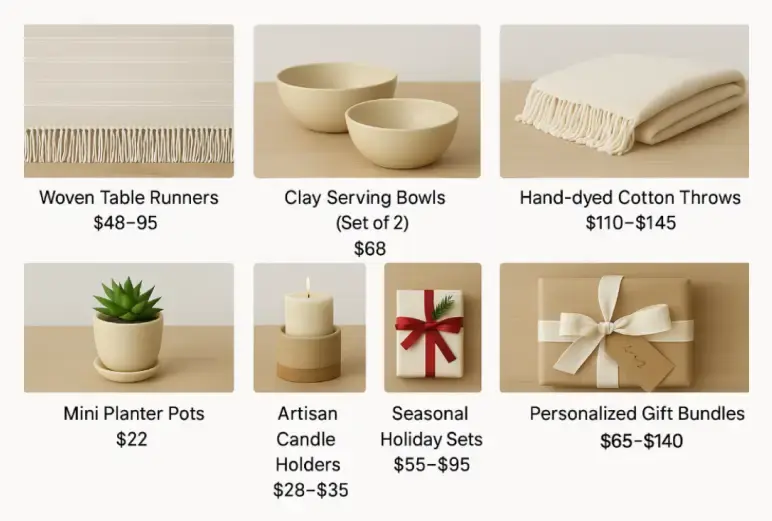
These products are offered by ArtisanWoven because consumers prefer handcrafted goods over mass-produced ones. Buyers don’t just purchase décor, they purchase meaning, craftsmanship, and originality. High-demand items like throws, table runners, and bowls anchor larger sales, while lower-ticket goods such as planters and candle holders increase accessibility and impulse purchases.
Seasonal products and personalized bundles create limited-edition urgency, improve repeat buying, and support strong holiday-driven revenue spikes.
Additional Offerings
ArtisanWoven hosts hands-on learning sessions that help the community engage with craftmaking, build creative skills, and form a deeper appreciation for handmade goods.
| Workshop | Price | Format & Focus |
|---|---|---|
| Beginner Pottery (2-hour session) | $65/person | Attendees shape basic clay forms and learn wheel fundamentals |
| Weaving 101 (4-hour workshop) | $95/person | Participants practice loom techniques and create a small woven sample |
| Kids’ Craft Saturdays | $25/child | Children explore clay, fiber, and basic handcraft activities in a guided setting |
These programs enhance appreciation for handmade goods, foster client loyalty, and expand community involvement.
Raw Materials Suppliers
ArtisanWoven maintains reliable sourcing through trusted suppliers who deliver consistent, high-quality materials aligned with our sustainability and craftsmanship standards.
| Supplier | Location | Materials Provided | Reason for Selection |
|---|---|---|---|
| Clay King | Spartanburg, SC | Clay, glazes | High-quality clay, fast local delivery |
| The Woolery | Frankfort, KY | Fibers, weaving tools | Premium weaving supplies and equipment |
| Dharma Trading Co. | USA | Dyes, natural fabrics | Wide range of dyeing materials and fabric bases |
| Carolina Craft Fibers Cooperative | South Carolina | Organic cotton | Local, ethically produced, and sustainably grown cotton |
This supplier mix allows ArtisanWoven to control quality, reduce sourcing risk, and maintain authentic handcrafted standards.
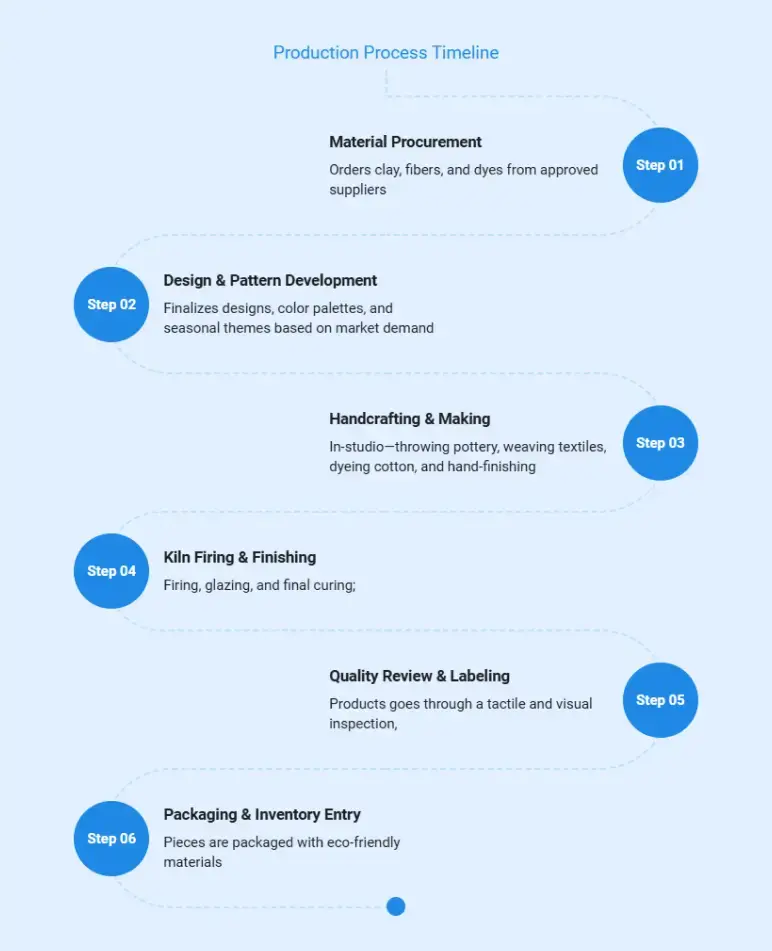
Production Process Timeline
Competitive Analysis
Direct Competitors
| Competitor | Address | Target Audience | Known Strength |
|---|---|---|---|
| Makers Collective Shop | 2901 Mill St | Local craft buyers and interior-style shoppers | Wide variety of local makers and curated artisan goods |
| Swamp Rabbit Pottery | 205 Cedar Lane Rd | Pottery collectors and workshop participants | Specializes in ceramics and hands-on pottery instruction |
| Indigo & Clay Studios | Travelers Rest | Home décor customers and artistic buyers | Artistic clay pieces with creative studio-driven designs |
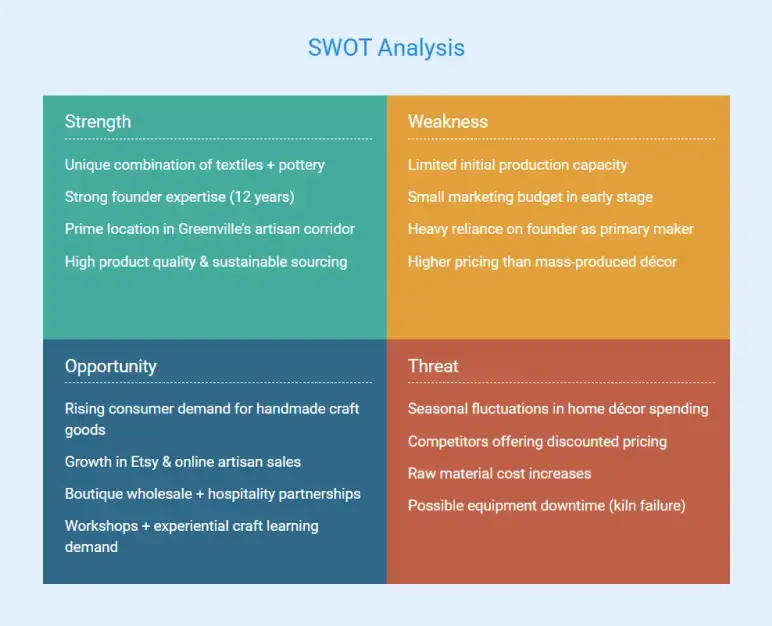
This competitive landscape shows a strong pottery and artisan market presence. ArtisanWoven stands out by combining textiles + pottery into cohesive collections—positioning the brand uniquely within the Greenville craft ecosystem.
SWOT Analysis
Marketing and Sales Strategy
ArtisanWoven uses a targeted approach to reach craft-focused buyers, drive repeat purchases, and build long-term customer relationships through local presence and online visibility.
Target Customer Profile
ArtisanWoven will sell to those consumers who appreciate authenticity, craftsmanship, and natural components. We have the following core customer groups:
- Females between 25 and 65 years who will invest in high-quality home decoration and want products of artisans.
- Tourists and visitors of the market on the weekend want local, handmade, and meaningful souvenirs.
- Buyers of online crafts on Etsy/Shopify are seeking unique and limited-edition items.
- Interior decor and home decor lovers who incorporate handmade products in the design visual warmth and touch.
- Gift customers who purchase them to give at weddings, housewarming parties, holidays, and custom-made presents.
- Ecologically mind conscious consumer who would want to use sustainable, locally produced materials rather than imported ones, which are produced in secluded areas.
It is a perfect match to our price range, handcrafted quality, and our brand name, so there will be a high correlation between the product values and customer motivation.
Marketing Channels
ArtisanWoven uses a balanced mix of digital and in-person marketing to reach and convert high-value customers.
| Channel | Use | Purpose |
|---|---|---|
| Instagram & Pinterest | Product photos, behind-the-scenes, artisan storytelling | Build awareness and brand identity |
| Etsy & Shopify | Online storefronts | Capture high-intent craft buyers |
| Greenville Saturday Market Booth | In-person selling & sampling | Drive local sales and workshop sign-ups |
| Boutique Collaborations | Retail placements | Expand reach through trusted environments |
| Email List & Newsletters | Targeted updates & offers | Increase customer retention and repeat purchases |
This channel mix creates multiple entry points for buyers while strengthening brand presence both locally and online.
Sales Strategy
1) Customer Acquisition Plan
ArtisanWoven attracts customers by meeting them where they already discover and buy handcrafted goods—local markets, visual social platforms, and in-person studio experiences. The focus remains on building trust through direct interaction, consistent quality, and repeat engagement rather than relying solely on one-time transactions.
| Year | Strategy | Goal |
|---|---|---|
| Year 1 | Local buyers + Etsy sales | 1,000 online orders + repeat local customers |
| Year 2 | Wholesale partnership expansion | Supply 8–10 boutiques |
| Year 3 | Subscription product launch | Seasonal “artisan home décor box” |
2) Promotions
- Founding Month: Buy 2, get 10% off the third item
- Workshop Loyalty: Attend 4 workshops, get the 5th at 50% off
- Seasonal Collaborations: Limited-edition “Artist-in-Residence” releases
3) Sales Process
ArtisanWoven has a clear route to purchase:
- Reveal: Our products are initially viewed by customers on Instagram/Pinterest, Etsy search, or in Greenville craft markets.
- Story Connection: They interact with our backstage of operation, green sourcing and handcrafted story.
- Product Assessment: The customers review the quality of materials, cost, and handcrafted exclusivity, either online or directly.
- Purchase: The buyer closes the deal using Etsy/Shopify, in-studio retail, or on booths at the market.
- Post-Purchase Engagement: The customers will be provided with a thank-you message, care, and a mild invitation to workshops or the email list.
- Keep-on-buying and Re-buying: Repeat customers buy more, give gifts, or attend workshops- getting to know the brand better.
Operation
ArtisanWoven runs with a streamlined, craft-focused operational model that supports consistent production, customer engagement, and retail execution.
Business Location
The studio operates from 1198 River Walk Boulevard, Suite 104, Greenville, SC 29607, situated in the Parkins Mill / Woodruff Road corridor—an area with strong foot traffic, boutique shoppers, and active artisan market proximity.
Working Hours
- Tue–Fri: 10:00 AM – 6:00 PM
- Sat: 9:00 AM – 5:00 PM
- Sunday: Workshops only
These hours align with peak buyer engagement times and local market rhythms.
Customer Service
ArtisanWoven delivers personalized education on products, teaching customers how to use them, and responsiveness to customer instructions. The customers will be able to view the production processes of products in the studio, inquire, and have a clear explanation of how to use and maintain the handcrafted products to last.
Customer service does not end in the studio but is provided by means of immediate feedback by email, Etsy, and Shopify messages. The business has a quick reaction to order inquiries, customization orders, and after-sales services.
Reaching out to the customers through several channels makes sure that each buyer feels informed, supported, and confident in his/her purchase, which will enhance the level of trust and invite them to the repetitive business.
Sourcing Practices
ArtisanWoven has purposeful sources. The company chooses clay, fibers, and natural dyes from thoroughly trusted suppliers that uphold high quality, ethical, and sustainability. ArtisanWoven is trying to establish direct contacts with particular local artisan manufacturers where possible in order to help small-scale makers and provide the quality of materials that remains consistent and authentic. All the material brought into the studio is subjected to some sort of practical quality check before being integrated into a completed object.

Risk Mitigation Strategy
ArtisanWoven actively reduces operational and market risks to protect production continuity and financial stability:
1) Seasonal sales fluctuations
Handmade product sales often rise and fall with gifting seasons and tourism. To balance this, ArtisanWoven combines product sales with workshops, personalized gift bundles, and limited seasonal releases. Workshops provide steady off-season income and help stabilize cash flow when retail demand slows.
2) Kiln or equipment failure
Kilns and studio equipment face wear over time and occasional breakdowns. ArtisanWoven maintains a regular service and maintenance schedule and keeps a backup firing arrangement with Swamp Rabbit Pottery. This ensures production continues without long delays or missed customer orders.
3) Material cost increases
The costs of raw materials may vary with changes in the supply and shipping expenses. ArtisanWoven deals with a variety of suppliers and makes bulk purchases where feasible in order to manage price. This strategy minimizes the reliance on a particular vendor and minimizes the abrupt rise in costs.
4) Underperforming Etsy conversions
Marketplaces may undergo a change in appearance and competition online. ArtisanWoven aims at minimizing paid advertising by using organic Pinterest traffic, creating effective product descriptions, behind-the-scenes stories, and frequent reviews by customers. Such initiatives enhance credibility, transparency, and conversion in the long run.
This will help maintain a robust operations team, secure the margins, and maintain the continuous availability of products.
Investors hate amateur writing errors
Instantly improve your plan w/ our AI writing assistant

Milestone & Timeline
Our operational and growth milestones can be seen with a clear picture, as we will employ and expand within the next two years, as shown in the timeline below.
| Milestone | Target Date |
|---|---|
| Business Structure Formation | March 2026 |
| Grant Application Submitted | April 2026 |
| Studio Lease Signed | May 2026 |
| Renovation Completed | June 2026 |
| Equipment Setup | July 2026 |
| Soft Opening | August 2026 |
| First Workshop Launch | September 2026 |
| Online Store Launch | October 2026 |
| Break-even Target | Q3 2027 |
| First Boutique Wholesale Partnership | Q2 2028 |
Management and Staffing
The foundational figure of the business is the founder, Maya Ellison, a seasoned entrepreneur who owns a business and has worked as a consultant in the field of business for more than 20 years. She also has experience in working with handicrafts firms and is therefore well-informed on the issue of positioning products, customer expectations, and market forces.
Maya supervises day-to-day activities, chooses and maintains suppliers, establishes marketing strategy, develops alliances, and has full financial control. The team will be increased progressively as the business expands to safeguard the quality of products, consistent standards of production, and a high level of customer satisfaction.
Staffing Plan
ArtisanWoven maintains a lean, efficient team to manage production, workshops, and administrative tasks while keeping costs controlled.
| Position | Name / Role | Compensation | Notes |
|---|---|---|---|
| Founder / Artisan | Maya Ellison | $55,000/year | Leads production, design, and overall operations |
| Part-time Studio Assistant | TBD | $18/hour (~$10,000/year) | Supports daily studio operations and inventory |
| Workshop Assistants | Contract | $25/hour | Assist with workshops and special events |
| Accountant | Contract (quarterly) | $1,200/year | Manages bookkeeping, tax filings, and financial compliance |
Financial Plan
Our financial plan outlines how we’ll manage revenue, pricing, operating costs, and profitability to ensure a healthy, sustainable growth path from launch through expansion.
Revenue Forecast
ArtisanWoven expects revenue to scale across both product and workshop streams, with woven goods and workshop bookings becoming the strongest revenue drivers by Year 2.
| Category | Year 1 (2026) | Year 2 (2027) | Year 3 (2028) |
|---|---|---|---|
| Product Sales | $84,300 | 137,500 | 185,000 |
| Workshops & Classes | $28,100 | 42,900 | 55,000 |
| Online / Wholesale | $8,000 | 16,000 | 26,000 |
| Total Revenue | $120,400 | $196,400 | $266,000 |
Monthly Revenue (Year 1)
| Month | Revenue | COGS | Gross Profit | Operating Expenses | Net Income |
|---|---|---|---|---|---|
| Jan | $6,800 | $1,300 | $5,500 | $10,800 | -5,300 |
| Feb | $7,200 | $1,350 | $5,850 | $11,000 | -5,150 |
| Mar | $8,300 | $1,500 | 6,800 | $11,200 | -4,400 |
| Apr | $9,100 | $1,650 | $7,450 | $11,300 | -3,850 |
| May | $9,800 | $1,800 | 8,000 | $11,400 | -3,400 |
| Jun | $10,200 | $1,900 | 8,300 | $11,500 | -3,200 |
| Jul | $10,500 | $2,000 | 8,500 | $11,600 | -3,100 |
| Aug | $10,600 | $2,000 | $8,600 | $11,600 | -3,000 |
| Sep | $10,900 | $2,100 | 8,800 | $11,700 | -2,900 |
| Oct | $11,200 | $2,150 | $9,050 | $11,900 | -2,850 |
| Nov | $12,000 | $2,200 | $9,800 | $12,000 | -2,200 |
| Dec | $13,800 | $2,550 | $11,250 | $12,000 | -750 |
| Total | $120,400 | $22,500 | $97,900 | $137,000 | $-39,100 |
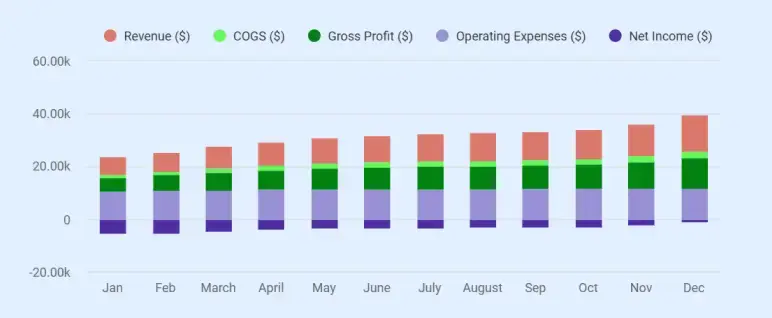
Profit & Loss Statement
ArtisanWoven projects steady revenue growth and healthy gross margins as product sales and workshops scale, leading to profitability within the first 18–20 months of operation.
| Category | Year 1 | Year 2 | Year 3 |
|---|---|---|---|
| Revenue | $120,400 | $196,400 | 266,000 |
| Cost of Goods Sold | $22,500 | $38,000 | 52,000 |
| Gross Profit | $97,900 | $158,400 | 214,000 |
| Gross Margin | 81.30% | 80.70% | 80.50% |
| Operating Expenses | |||
| Category | Year 1 | Year 2 | Year 3 |
| Staffing & Contract Help | $77,000 | 87,000 | $102,000 |
| Owner Draw | $55,000 | $55,000 | $55,000 |
| Assistant / Contract | $22,000 | $32,000 | $47,000 |
| Rent & Utilities | $24,000 | $26,000 | $30,000 |
| Supplies, Marketing & Admin | $36,000 | $42,000 | $58,000 |
| Total Operating Expenses | $137,000 | $155,000 | $190,000 |
| Metric | Year 1 | Year 2 | Year 3 |
| Net Profit (Loss) | -$39,100 | $3,400 | $24,000 |
Projected Cash Flow (Year 1–2)
ArtisanWoven projects are increasing monthly inflows from product sales, workshops, and online channels while maintaining cost discipline. This projection shows positive movement toward profitability and healthy liquidity as operations scale.
| Period | Cash Inflow ($) | Cash Outflow ($) | Net Cash Flow ($) |
|---|---|---|---|
| Q1 2026 | 12,700 | 18,900 | -6,200 |
| Q2 2026 | 23,400 | 19,450 | 3,950 |
| Q3 2026 | 32,300 | 19,950 | 12,350 |
| Q4 2026 | 38,800 | 19,700 | 19,100 |
| Q1 2027 | 45,200 | 22,500 | 22,700 |
| Q2 2027 | 51,800 | 23,500 | 28,300 |
| Q3 2027 | 56,400 | 24,500 | 31,900 |
| Q4 2027 | 61,500 | 24,500 | 37,000 |
| Q1 2028 | 66,800 | 31,000 | 35,800 |
| Q2 2028 | 72,400 | 33,000 | 39,400 |
| Q3 2028 | 77,900 | 34,000 | 43,900 |
| Q4 2028 | 83,600 | 34,000 | 49,600 |
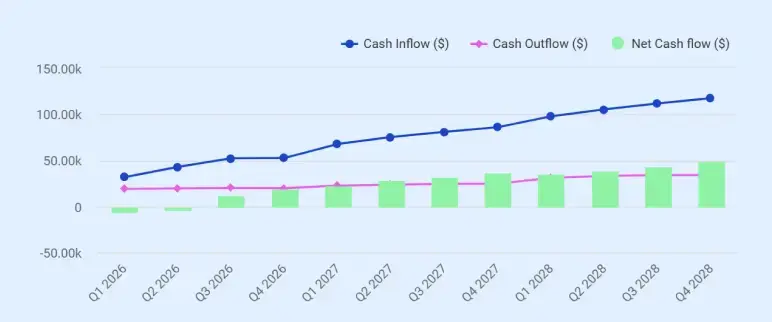
Balance Sheet
| Category | Year 1 | Year 2 | Year 3 |
|---|---|---|---|
| Assets | |||
| Cash & Cash Equivalents | 63,900 | 183,800 | 352,500 |
| Accounts Receivable | 4,000 | 6,500 | 9,200 |
| Inventory | 9,200 | 13,500 | 18,000 |
| Prepaid Expenses | 2,800 | 3,200 | 3,800 |
| Total Current Assets | 79,900 | 207,000 | 383,500 |
| Equipment & Studio Fixtures (gross) | 27,300 | 27,300 | 27,300 |
| Less: Accumulated Depreciation | -2,300 | -4,600 | -6,900 |
| Net Fixed Assets | 25,000 | 22,700 | 20,400 |
| Total Assets | 104,900 | 229,700 | 403,900 |
| Liabilities | |||
| Accounts Payable | 4,500 | 6,800 | 9,500 |
| Accrued Expenses | 2,200 | 3,500 | 4,800 |
| Taxes Payable | 0 | 8,200 | 14,000 |
| Total Current Liabilities | 6,700 | 18,500 | 28,300 |
| Equity | |||
| Owner Capital Contribution | 52,000 | 52,000 | 52,000 |
| Grant Funding (SC Arts Commission) | 38,000 | 38,000 | 38,000 |
| Retained Earnings | 8,200 | 46,700 | 103,400 |
| Total Equity | 98,200 | 136,700 | 193,400 |
| Total Liabilities + Equity | 104,900 | 229,700 | 403,900 |
Break-even Analysis
| Item | Amount |
|---|---|
| Average Monthly Fixed Costs | $6,500 |
| Average Gross Margin | 81% |
| Monthly Break-even Revenue | $8,025 |
Financial Strength & Debt Position
ArtisanWoven operates with a healthy financial base and zero outstanding debt. Initial capital is secured through owner equity and grant funding, eliminating repayment obligations and interest exposure. This strengthens liquidity, protects cash flow during growth, and allows more capital to be reinvested into production, marketing, and customer acquisition.
The Quickest Way to turn a Business Idea into a Business Plan
Fill-in-the-blanks and automatic financials make it easy.
