




No one ever says, “I wish I had to drive farther for ice.” When people need ice, they need it fresh and in an instant.
And that’s exactly what an ice vending machine delivers!
But launching a machine and turning it into a profitable business isn’t simple. Location, startup costs, local demand, operating expenses, and pricing all play a role.
That’s where you need a solid business plan that helps you understand your market, pick the right locations, and manage your costs.
Wondering how to write one?
This ice vending business plan template will guide you through every step!
Why do you need an ice vending machine business plan?
An ice vending machine business plan provides structure, direction, and clarity. Without the right one, it’s easy to underestimate costs, choose poor locations, or overlook key operational needs.
Here are a few key reasons why it matters:
It turns ideas into actionable strategy
You might see the growing demand for ice vending machines as a great opportunity. But without clear financial projections, site plans, and marketing strategies, it’s just a rough concept. A business plan breaks it all down into clear steps—startup costs, machine placements, revenue models, and growth timelines.
It wins trust and funding
Whether you’re approaching lenders, potential partners, or investors, a solid business plan shows that you’ve done your homework. It proves your business is viable, thought-through, and worth financial investing.
It prevents costly mistakes
Starting without a plan can lead to poor site selection, underestimating expenses, or ignoring local regulations. A business plan helps you plan, anticipate risks, and build a safety net for unexpected costs so you don’t run into avoidable setbacks later.
A well-structured plan gives you confidence, direction, and a higher chance of long-term success.
How to write an effective ice vending machine business plan?
Follow the steps given below to write an effective ice vending business plan:
1. Executive Summary
An executive summary is the first section that offers an overview of the entire ice vending business plan. However, it’s usually written last once all the key sections are written. This will help you highlight the most essential aspects of your ice vending business.
The purpose of this section is to give readers a quick yet comprehensive understanding of what your business is about, how it plans to operate, and why it will succeed.
Here are the steps you need to follow to write your executive summary:
- Briefly introduce your business to your readers
- Summarize your market research and highlight the gaps
- Describe the services your vending machine offers
- Outline your ice sales and marketing approach
- Include your financial projections for the first few years
- End your executive summary with a clear call to action
In short, try to keep your executive summary clear, concise, easy to understand, and jargon-free, otherwise, the readers may feel too bored to read ahead.
Say goodbye to boring templates
Build your business plan faster and easier with AI
Plans starting from $14/month

2. Business Overview
The business overview section dives deep into what kind of business you’re building, its legal structure, what products you offer, who you serve, and how your business is positioned in the market.
While planning, start by describing whether it’s a single-unit launch, a multi-location rollout, or part of a passive income investment portfolio.
To ensure you do not miss out on any information, try answering the following questions:
- Who owns the ice vending business? What’s their background in vending operations or small business management?
- What’s the legal structure of the business? (sole proprietorship, partnership, LLC, etc.)
- Where is the business based? Are your vending machines located locally, regionally, or as part of a broader expansion strategy?
- What’s your core business model—self-service vending only, ice and water combo machines, or franchise development?
- What are your short-term priorities and long-term plans for growth?
As you write this section, aim for a tone that’s practical and confident. You want to sound like someone who understands the vending space, the local market, and the operational demands of running a machine-based business.
3. Industry and Market Research
A thorough market analysis section is crucial to understand the field you’re getting into. It provides valuable insights into your target audience, market trends, as well as key competitors.
To make this section more impactful, dive deep into the data—don’t just assume you know the market. Here’s how to approach this section:
Analyze your market size and growth potential
Start by researching the packaged ice market size and its demand in your locality. Narrow it down to your target area and define how much of that market you can realistically capture.
Support your claims with numbers, trends, and growth forecasts to show investors there’s room to scale.
Start by identifying your target audience
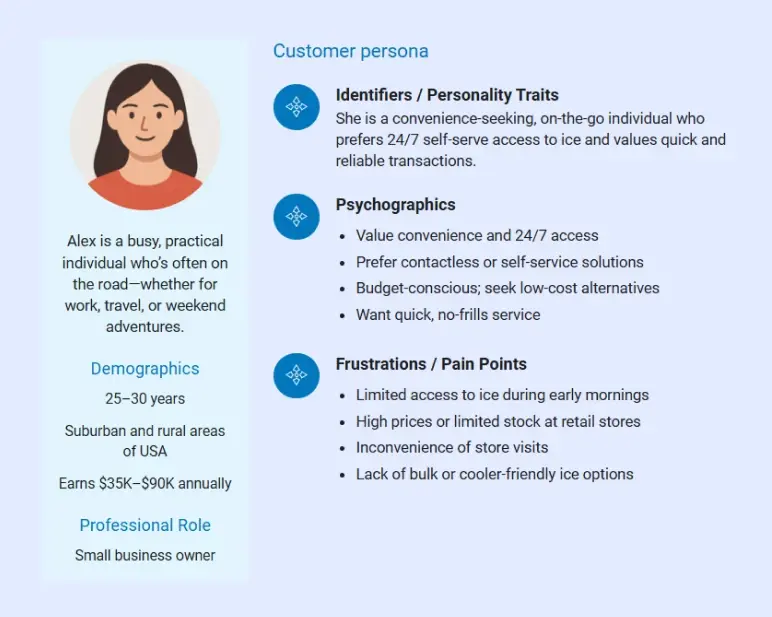
In the ice vending space, potential customers often include RV travelers, campers, boaters, construction workers, outdoor event organizers, and even everyday consumers looking for affordable, convenient ice.
Consider what matters to them—24/7 access, low prices, bulk ice, and locations close to where they live, work, or play.
Explore a few current market trends
The demand for contactless, self-serve options has increased post-pandemic. Outdoor recreation is also on the rise, leading to a greater need for quick and easy access to ice.
Customers also expect convenience, reliability, and low-cost alternatives to store-bought bagged ice. These trends support the shift toward automated ice vending.
A strong market analysis not only helps you understand your position but also equips you to make smarter decisions as your business grows.
4. Competitive Analysis
Now, this competitive analysis section is all about your competition and how you’ll differentiate your services. It actually helps you position your business smarter from day one and figure out how it’ll stand out in the local market.
To plan this section effectively, ask yourself a few key questions:
- How many other ice vending machines or bagged ice sellers are there in your area?
- Who are your direct competitors—local convenience stores, gas stations, or other vending operators?
- What do they offer, and what do they charge for a standard bag or bulk ice?
- What are their strengths—high traffic locations, brand recognition, or customer loyalty?
- Where do they fall short—limited hours, higher prices, inconsistent ice quality, or lack of contactless payment?
- What are customers saying about them online—are there recurring complaints or praises?
Use these insights to define your competitive advantages. Maybe you’re offering better locations, lower prices, filtered water add-ons, or 24/7 service. Perhaps it’s the convenience of contactless payments or the superior uptime of your machines.
5. Sales and Marketing Strategies
Writing the sales and marketing strategies section means outlining the list of strategies you’ll use to attract and retain your customers. Here are some key elements to include in your sales & marketing plan:
Unique Selling Proposition (USP)
Define your business’s USPs based on the market you serve, the type of vending machines you use, and the added conveniences you offer. Identifying USPs will help guide your marketing messages and appeal to your ideal customers.
For example, your ice vending business might offer 24/7 self-service availability, contactless payment options, filtered water dispensing, or energy-efficient machines—making it a more convenient and cost-effective alternative to traditional store-bought ice.
Pricing Strategy
Describe your pricing strategy—how you plan to keep prices competitive while maintaining strong margins. Your pricing may be lower than convenience stores due to lower overheads, and you might offer better value through bulk pricing or combo deals.
You can also mention any introductory discounts, seasonal offers, or loyalty perks you plan to offer to attract new users and build customer loyalty.
Marketing Strategies
List the marketing strategies you’ll use to promote your ice vending services. Some strategies you may include in your plan are being active and posting on your Google My Business profile, local advertising, social media marketing, and more.
Sales Strategies
Outline the sales strategies that will help you grow usage and increase revenue per machine. These may include partnering with the local existing businesses, referral programs, and seasonal campaigns.
Customer Retention
Describe the strategies you’ll implement to keep customers coming back. For example, loyalty programs, text or app-based notifications, exceptional machine uptime, and more.
Overall, this section of your ice vending business plan should focus on how you’ll bring in customers, keep them satisfied, and build long-term brand loyalty.
6. Management Team
The management team section is about the people behind your ice vending business—even if it’s just you right now.
Start by introducing yourself. Share your roles and responsibilities, your background in small business management, operations, or vending (if any), and the expertise you’re bringing to the table.
If you have a small team helping you—say, a maintenance technician, someone managing accounting, or a part-time marketing assistant—mention them too. Highlight what they’re responsible for and any relevant experience they bring.
You can also include a simple, easy-to-follow org chart showing how responsibilities are divided. For example:
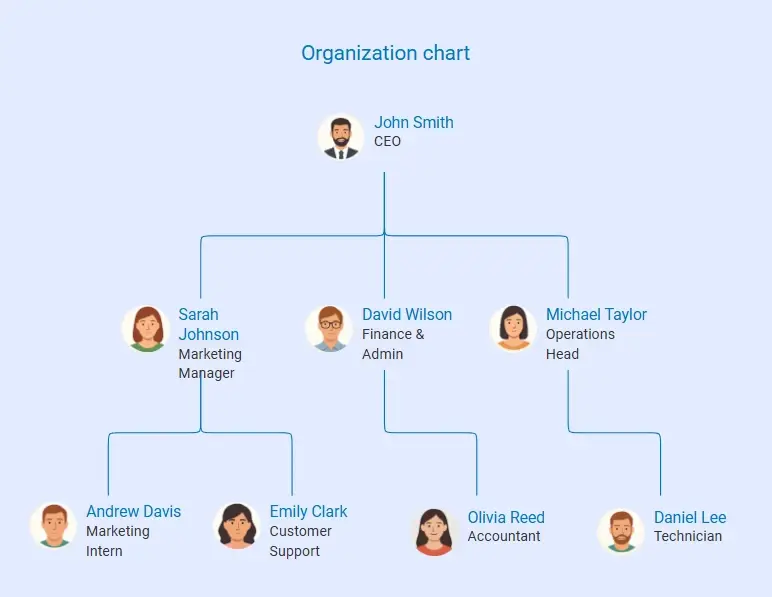
This helps clarify how decisions are made, especially if you’re planning to expand and hire more ice machines or staff.
Lastly, if you have any mentors, advisors, or industry experts guiding your strategy—maybe someone experienced in franchising or vending tech—mention them. It adds credibility and shows that you’re not doing this entirely on your own.
7. Operations Plan
In this section, walk the reader through how your ice vending business operates behind the scenes.
It should reflect how your ice machines are maintained, how sales and inventory management are tackled, and how customer issues are handled. Your readers need to get the idea that everything runs smoothly in your business with minimal downtime.
These are the few key elements you must include in your operations plan:
- Team setup: Will you run the business solo or with support? Define who will handle machine maintenance, restocking (if needed), and customer service.
- Daily operations: Outline how the machines will be monitored—through remote software, scheduled checks, or service alerts. Mention how often you’ll clean, inspect, and refill the ice machines (if applicable).
- Tools and systems: List any tools you’ll use for payment tracking, machine diagnostics, and accounting.
- Maintenance & quality control: Explain how you’ll handle breakdowns and routine servicing. Highlight any customer feedback options—like a QR code or contact number on the machine.
Overall, keep it simple, efficient, and scalable—that’s the goal of a strong operations plan for a vending business.
8. Financial Plan
Developing a strong, in-depth financial plan, along with realistic and well-researched financial projections, is the most essential yet demanding element of any business plan.
In fact, it’s one of the deciding factors for potential investors, lenders, or partners to invest in or support your ice vending business.
You should consider including monthly financial projections for at least the first year, along with annual projections for the next 3–5 years. This gives a clear picture of your growth trajectory and how quickly the business can become profitable.
Here are a few critical statements and reports to include:
- Sales & revenue forecasts
- Income statement
- Cash flow estimates
- Balance sheet
- Initial startup costs
- Funding requirements
- Break-even analysis
You can also include a summary of key financial assumptions, such as average monthly machine revenue, maintenance costs, or expected seasonal spikes in demand.
For instance, you can create financial projections as shown below to give more clarity to your readers:
Income Statement
| Category | Year 1 | Year 2 | Year 3 |
|---|---|---|---|
| Revenue | $54,000 | $86,400 | $126,800 |
| COGS (ice bags, water) | $10,800 | $17,280 | $23,040 |
| Gross Profit | $43,200 | $69,120 | $103,760 |
| Operating Expenses | |||
| – Machine Maintenance | $3,600 | $6,000 | $7,200 |
| – Utilities (Power/Water) | $2,400 | $3,000 | $4,800 |
| – Location Lease | $7,200 | $12,000 | $14,400 |
| – Insurance | $1,200 | $1,500 | $1,800 |
| – Marketing | $1,800 | $2,500 | $3,000 |
| – Miscellaneous | $1,000 | $1,200 | $1,500 |
| Total Operating Expenses | $17,200 | $28,200 | $32,700 |
| Operating Income | $26,000 | $40,920 | $71,060 |
| – Taxes (20%) | $5,200 | $8,184 | $14,212 |
| Net Income | $20,800 | $32,736 | $56,848 |
Cash Flow Statement
| Category | Year 1 | Year 2 | Year 3 |
|---|---|---|---|
| Cash Inflows | |||
| Revenue from Ice Sales | $54,000 | $86,400 | $126,800 |
| Other Income | $0 | $0 | $0 |
| Total Cash Inflows | $54,000 | $86,400 | $126,800 |
| Cash Outflows | |||
| Cost of Goods Sold (COGS) | $10,800 | $17,280 | $23,040 |
| Operating Expenses | $17,200 | $28,200 | $35,100 |
| Equipment Purchase | $25,000 | $0 | $0 |
| Loan Repayment | $0 | $5,000 | $5,000 |
| Total Cash Outflows | $53,000 | $50,480 | $63,140 |
| Net Cash Flow | $1,000 | $35,920 | $63,660 |
| Opening Cash Balance | $10,000 | $11,000 | $46,820 |
| Closing Cash Balance | $11,000 | $46,820 | $113,280 |
Balance Sheet
| Category | Year 1 | Year 2 | Year 3 |
|---|---|---|---|
| Assets | |||
| Cash | $11,000 | $46,820 | $113,280 |
| Vending Equipment (net) | $25,000 | $22,500 | $20,000 |
| Other Assets | $1,000 | $1,500 | $2,000 |
| Total Assets | $37,000 | $70,820 | $135,280 |
| Liabilities | |||
| Loan Payable | $10,000 | $5,000 | $0 |
| Accrued Expenses | $2,000 | $2,500 | $3,000 |
| Total Liabilities | $12,000 | $7,500 | $3,000 |
| Equity | |||
| Owner’s Equity | $5,000 | $5,000 | $5,000 |
| Retained Earnings | $20,000 | $58,320 | $127,280 |
| Total Equity | $25,000 | $63,320 | $132,280 |
| Total Liabilities & Equity | $37,000 | $70,820 | $135,280 |
If possible, add a sensitivity analysis showing best-case and worst-case scenarios. This shows you’ve thought through potential risks and have strategies in place to adapt.
A well-crafted financial plan not only builds confidence with investors—it gives you a clear roadmap to follow as your business grows and scales profitably.
9. Appendix
The appendix of your ice vending machine business plan includes supporting documents and attachments that increase your plan’s credibility and authority.
It may include:
- Market research data and location analysis
- Copies of permits, licenses, and insurance documents
- Equipment details such as machine specs, supplier contracts, or warranties
- Financial documents like credit reports or past tax returns (if applicable)
- Resumes or bios of the business owner and key team members
- Sample marketing materials (flyers, signage designs, social media posts)
- Maintenance schedules and operational checklists
You may also add any other relevant information your readers might use as a reference—especially if you’re applying for funding or forming partnerships.
Download a free ice vending machine business plan template
Ready to start writing your ice vending machine business plan from scratch? But need a little guidance to get it right? You’re in the right place. Download our free ice vending machine business plan PDF to get started today.
This free, investor-ready template is designed to walk you through every key section of your plan—from defining your services and market to outlining your operations and financial strategy. You can also customize it to fit your business goals.
The Quickest Way to turn a Business Idea into a Business Plan
Fill-in-the-blanks and automatic financials make it easy.

Takeaway
Now that you know how to map out your operations, highlight your services, understand your market, and plan your finances, drafting your own plan should feel a lot more manageable.
But if writing the whole plan still feels overwhelming or time-consuming, Upmetrics can be your go-to tool.
It’s an AI-powered business planning software that helps you build a clear, compelling business plan—complete with realistic financial forecasts. Plus, it helps you create professional, investor-ready pitch decks without the stress.
So, why wait? Start planning your ice vending business today!


