




Language School Business Plan Example (Meridian Language Academy LLC)
Starting a language school requires clarity on how the school will operate. Which programs generate revenue, how classes are structured, how instructors are managed, and how student progress is tracked. A business plan organizes these decisions before launch and reduces execution risk.
The financial side adds complexity. Setting up a school involves costs for space, equipment, instructors, and initial marketing. Revenue builds gradually, not all at once, so the plan must show how enrollments grow over time, how pricing supports costs, and how the business reaches stability.
The market must also be assessed carefully. Who are the target learners? What options do they currently use, and where do those options fall short? A workable model depends on identifying a gap that can translate into consistent enrollments.
This business plan presents Meridian Language Academy, focused on structured instruction and measurable outcomes, with a clear approach to operations and long-term student retention.
Executive Summary
Meridian Language Academy is a Portland, Oregon-based private language school opening in April 2026. Founded by Elena Vasquez and Marcus Chen, the school offers structured, instructor-led language instruction for adult learners and local employers across Portland’s inner southeast corridor.
Meridian operates across three revenue streams:
- Group language courses in Spanish, Mandarin, French, and ESL
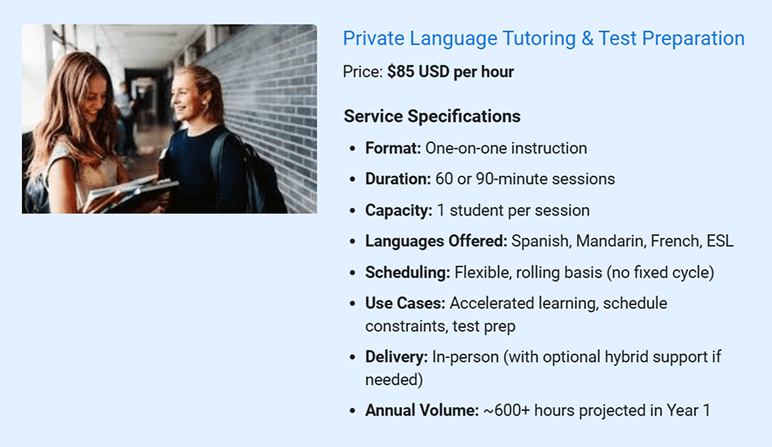
- Private one-on-one tutoring
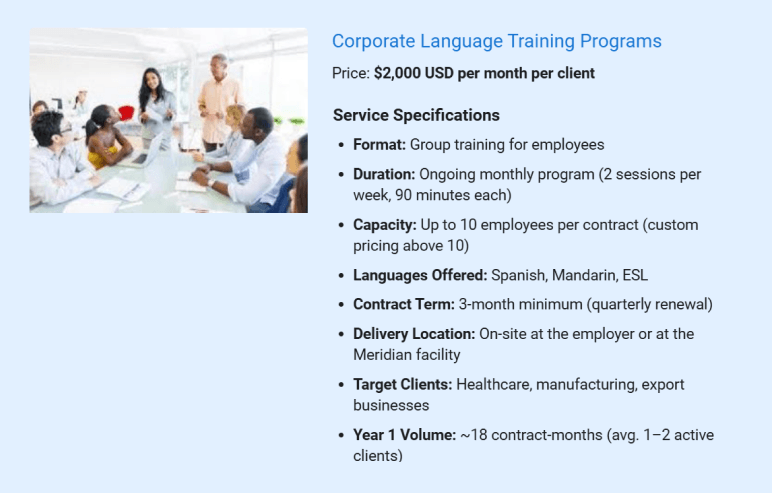
- Monthly corporate training contracts for local employers
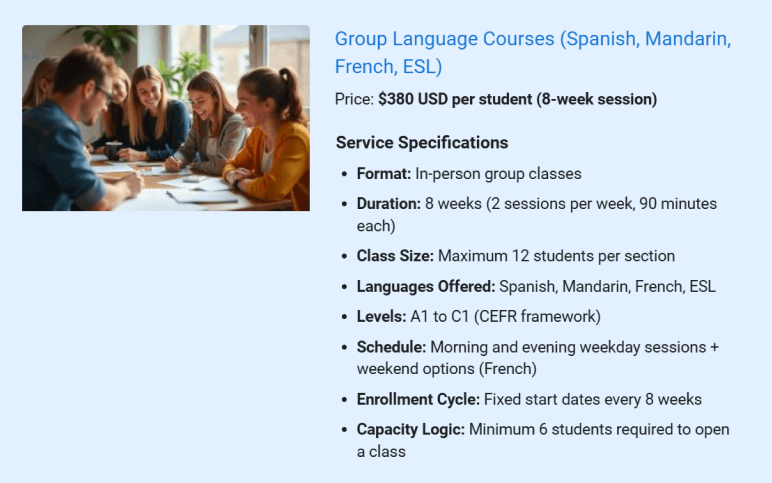
Each stream serves a different customer and generates revenue on a different schedule. Group courses run in 8-week enrollment cycles at $380 per student. Private tutoring is available on a rolling basis at $85 per hour. Meridian charges business contracts at $2,000 a month per client. The streams cater to different clientele and bring in revenue at different times.
This model identifies a definite gap in the local market. In Portland, the instructor-led language education continues to be in high demand, especially among the working population and those who do not speak English as a mother tongue and need to achieve a level of proficiency.
According to U.S. Census data, 19.4% of Portland residents speak a language other than English at home, and over 49,000 people are people with limited English proficiency.
At the same time, Portland Community College’s ESL program operates with a persistent waitlist, and no provider in the SE Division Street corridor currently offers structured, multi-language group instruction combined with corporate training.
The school is applying for an SBA 7(a) loan of up to $90,000 with Pacific Northwest Business Bank to start operations, plus owner equity of $35,000, resulting in a total of $125,000 as the startup capital. The funds will be used to cover leasehold improvements, classroom equipment, technology, and six months of working capital.
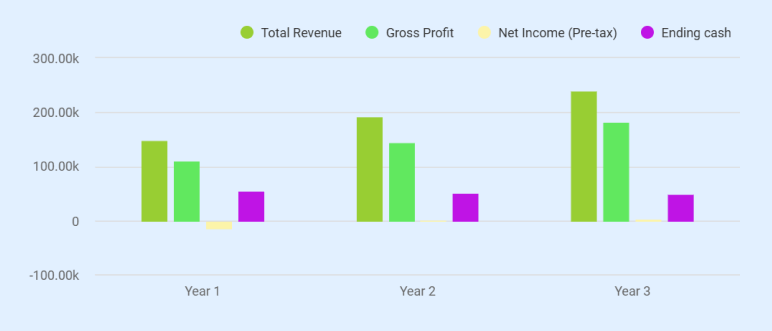
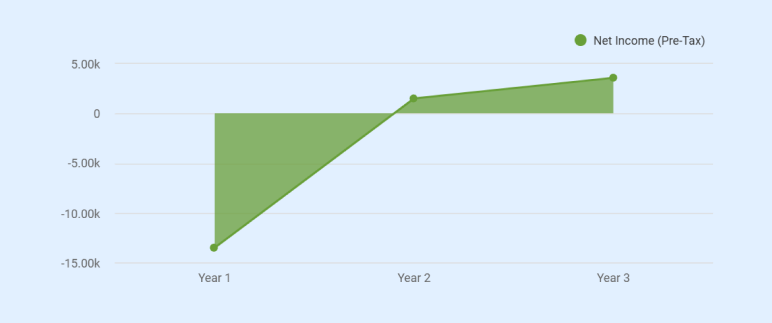
Meridian projects a pre-tax net loss of $13,508 in Year 1, due to one-time startup expenses and a 9-month ramp to enroll, then profitability in Year 2 (net income of $1,517) and further profitability in Year 3.
| Category | Year 1 (in $) | Year 2 (in $) | Year 3 (in $) |
| Annual Group Course Enrollments | 160 | 260 | 320 |
| Total Revenue | 148,000 | 192,400 | 240,500 |
| Gross Profit | 111,922 | 145,499 | 181,873 |
| Net Income (Pre-Tax) | (13,508) | 1,517 | 3,585 |
| Ending Cash | 54,395 | 51,681 | 50,101 |
Business Overview
Business Structure and Location
Meridian Language Academy operates as a Limited Liability Company, a structure chosen deliberately for this venture. The LLC provides a separation of personal assets and business liabilities, which is important when a school hires instructors, has a commercial lease, and signs corporate training agreements.
The school is based in a rented building at 1210 SE Division Street, Suite 210, Portland, Oregon 97202, in the inner southeast neighborhood. Prior to launch, this site was acquired on a commercial lease that lasts 3 years. It’s within walking distance of Portland Community College and the active transit lines that serve the working adult population in Portland.
Ownership and Management Roles
The organization is in a 50/50 partnership where the roles are well defined. Elena Vasquez is the Academic Director in charge of curriculum development, instructor management, and student life. She has 15 years of ESL teaching and program management experience, the latest 3 years being spent creating and developing the ESL program at Portland Community College. ‘
Marcus Chen is the Managing Director, in charge of business, financial management, and acquisition of corporate clients. He comes with 8 years of experience in running multi-location education and tutoring businesses throughout the Pacific Northwest, which can be directly applied to scheduling discipline, staffing structure, and revenue planning of Meridian.
The two founders have a combined experience of 23 years in the domain in the sphere of instruction and operations.
Mission and Vision
Meridian has a mission that aims to offer structured, instructor-based language training that assists adults in developing the language proficiency that they require in their careers, their communities, and their lives. The school is placed as a formal learning experience where there are set curriculum levels, scheduled classes, and progress trackable.
The long-term vision is to be the most trusted language school in Portland, with a record of high quality in the instruction of language, clear student results, and a good rapport with the local employers who look to train their employees in language.
Three-Year Business Goals
The company has defined measurable goals across its first three years of operation.
Meridian has defined measurable goals across its first three years, covering both revenue targets and operational milestones.
Year 1 (2026)
- Launch two classrooms and reach 160 group course enrollments
- Secure at least two corporate training contracts before opening
- Deploy learning management system (LMS) and scheduling software by April 2026
- Hire two part-time instructors prior to launch
- Establish the Google Business Profile and the school website at opening
Year 2 (2027)
- Scale to 260 enrollments and expand to three active corporate clients
- Add a third part-time instructor by Q1 2027
- Pursue ACCET accreditation to strengthen corporate client credibility
- Launch paid Google Search campaigns and expand corporate outreach to five target employers
- Achieve the first full year of profitability
Year 3 (2028)
- Reach 320 enrollments with combined owner salaries of $100,000
- Complete ACCET accreditation
- Evaluate the feasibility of a second location or online program expansion
- Assess staffing needs for a fourth part-time instructor based on enrollment volume
Organizational Structure
Meridian operates with a lean and clearly defined structure that separates academic leadership from operational management while maintaining flexibility for growth.
| Role | Name |
| Academic Director | Elena Vasquez |
| Managing Director | Marcus Chen |
| Part-Time Instructors (×2) | To be hired |
This structure supports consistent service delivery while allowing the business to scale instructor capacity as enrollment grows.
For readers building a similar venture, this level of structure is expected in a lender-ready school business plan.
Market Analysis
Industry Overview
The US private language instruction industry generated approximately $1.7 billion in annual revenue across more than 13,700 operators in 2025, according to IBISWorld. Overall industry revenue has declined at a 2.7% compound annual growth rate (CAGR) over the past five years, driven largely by the rise of self-paced language apps capturing casual learners.
That contraction, however, is not uniform. Tutor-led live instruction is the fastest-growing delivery format within the broader language learning market, advancing at a 21.25% CAGR through 2031, according to Mordor Intelligence, as learners who stall on self-paced platforms migrate toward structured programs with instructor accountability and measurable outcomes. Meridian operates in this growth segment, not the declining one.
Local Market Context
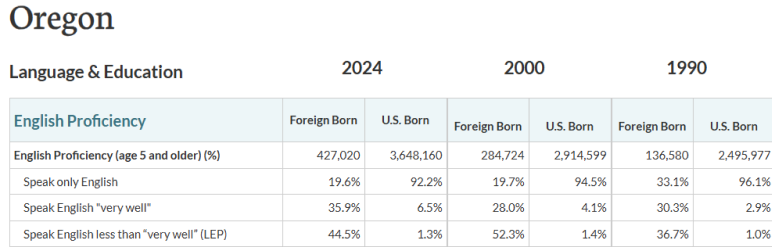
The Migration Policy Institute states that 44.5% of foreign-born Oregon residents indicate limited English proficiency, which is a significant number of people in need of organized ESL assistance to be able to join the labor force.
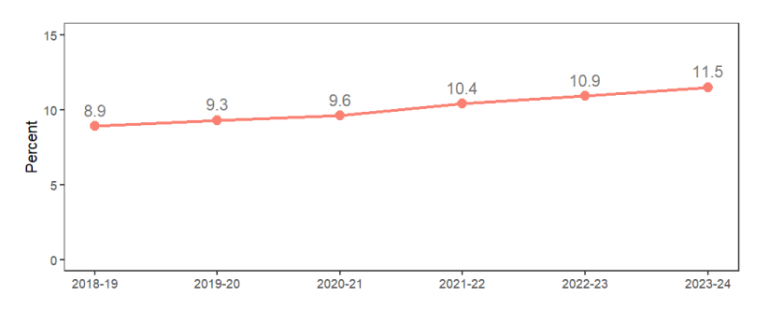
This is also required in the education system. According to 2024-2025 education data, Oregon has almost 62,000 students, 11.5% of the total enrolled, as current English learners, and almost 102,000 students are multilingual learners.
This pipeline leads into adulthood, where most of the learners would look into non-academic alternatives that are flexible and not part of the school system.
The table below indicates that the percentage of English learners in Oregon schools is increasing steadily.
This pipeline extends to adulthood, where most of the learners pursue non-academic and flexible alternatives outside the school system.
On the employer side, the pressure is equally measurable. According to a 2025 Preply study analyzing over 9,000 US job postings, bilingual employees earn an average of 19% more than their monolingual counterparts, with Spanish appearing in 86% of all bilingual job listings. Portland’s concentration of healthcare, manufacturing, and export businesses means this dynamic is local, not abstract.
Market Trends
Three current trends support Meridian’s positioning.
- Language skills have shifted from a preference to a workforce requirement. Bilingual employees earn measurable wage premiums, and employers are increasingly willing to fund structured training rather than absorb the cost of communication gaps.
- ESL demand continues to expand alongside population shifts. Oregon’s multilingual population has grown steadily over the past decade, creating sustained demand that public programs cannot fully absorb. Portland Community College’s ESL program operates with a persistent waitlist. That waitlist is Meridian’s most direct enrollment pipeline.
- Learner behavior is changing in Meridian’s favor. The majority of adults start learning languages with the help of apps and lose interest before achieving a functional level of proficiency. The resulting decrease in demand increases the need of programs with timed instruction, teacher feedback, and a clear progression tied to established standards such as the Common European Framework of Reference (CEFR) of Languages.
Target Customer Profile
Primary and Secondary Segments
Meridian serves two clearly defined segments.
1) Primary
These are adults between 25 and 50 who are full or part-time workers, and who are in the downtown Portland area (within 15 miles). These are purpose-driven learners who have usually experimented with self-paced tools and realized that they are not suitable for professional use.
They desire CEFR-monitored progress, a structured timetable, and a teacher who understands their position in the curriculum. Most enroll following a specific trigger like a job promotion requiring Spanish, a family member needing ESL support, or an employer covering training costs.
2) Secondary
This segment is local employers purchasing language training for teams. Healthcare providers, manufacturers, and export businesses in Portland face real communication gaps affecting operations and compliance. This segment generates predictable, recurring monthly revenue through corporate contracts.
Of Portland’s adult population, approximately 117,000 residents speak a language other than English at home. Meridian targets a conservative 0.3% penetration in Year 1, approximately 90 unique students, well within reach given Elena Vasquez’s existing professional network at Portland Community College.
Market Gap
No provider in Portland’s inner southeast corridor currently combines structured group instruction, private tutoring, and corporate training within a single school model. Portland Community College’s ESL program has a waitlist and a limited language range.
Language apps serve casual learners but cannot deliver the accountability or CEFR-assessed outcomes that working adults and employers require. National chains such as Berlitz operate out of downtown Portland at price points significantly above Meridian’s.
For readers comparing education business models, this vocational school business plan offers a useful adjacent reference.
Competitive Analysis
Meridian enters the Portland market with no direct equivalent. No local competitor currently offers Spanish, Mandarin, French, and ESL instruction in a structured group format alongside private tutoring and corporate training programs under one roof.
The business competes across four distinct competitor categories:
- Community colleges
- Language-learning apps
- Online tutoring platforms
- National language school chains
Each covers part of the market, but has gaps in its structure, consistency, or local accessibility.
Portland Community College offers affordable, accredited ESL courses but has set academic schedules, limited space, and a waitlist. Duolingo and Babbel are language apps that are more flexible and affordable, but cannot provide instructor feedback and measurable results.
Online tutoring programs such as iTalki and Preply match students with tutors, although lacking the standardized curriculum and ordered advancement. National chains such as Berlitz carry brand recognition and corporate training experience but operate out of locations well outside Portland’s inner southeast corridor at significantly higher price points.
Competitor Comparison
| Competitor Type | Example | Strengths | Weaknesses | Meridian’s Edge |
| Community College ESL | Portland Community College | Low-cost, accredited | Waitlists, semester-bound, limited languages | Flexible enrollment cycles, multiple languages, no waitlist |
| Language Apps | Duolingo, Babbel | Free or low-cost, self-paced | No instructor feedback, weak for professional fluency | Structured curriculum, CEFR-tracked progress, instructor accountability |
| Online Tutoring Platforms | iTalki, Preply | On-demand, wide instructor pool | No standard curriculum, inconsistent quality, no corporate offering | Consistent curriculum, in-person option, corporate training capability |
| National Language Schools | Berlitz | Brand recognition, corporate contracts | Distant locations, high pricing, no local relationships | Local presence, competitive pricing, and existing Portland employer relationships |
Competitive Positioning
Meridian will be the only structured, multi-language, instructor-led school within its immediate market. It is between the community colleges and national chains in terms of pricing, and it has a wider service mix than the two. Group courses, one-on-one tutoring, and corporate training in one school provide a model that is not yet replicated by any competitor in the region.
Competitive Advantages
The strength of Meridian lies in its implementation and current relations, as opposed to marketing investment. Elena Vasquez has direct access to the ESL students who are already on the waitlist of Portland Community College, which will provide an immediate pipeline of enrollment in the school before opening. Marcus Chen’s operational background managing multi-location education businesses means Meridian is built to scale from day one, not retrofitted later.
CEFR-based placement and progress tracking give students measurable proof of improvement. That is something apps cannot provide, and most tutoring platforms do not offer consistently. On the corporate side, Meridian’s local presence and employer outreach give it an advantage that a distant national chain simply cannot replicate.
Course Catalog & Instructional Services
Meridian Language Academy has three modes of training, which include group language classes, one-on-one training, and corporate training.
They each serve a different customer base, and they generate a diversified and recurring revenue base. Group courses are structured courses that are available to learners who want consistency. Private tutoring supports accelerated or flexible learning needs. Corporate programs address employer-sponsored training demand.
1) Group Language
Small-group-based, instructor-led language classes, aimed at adult learners who need a quantifiable improvement. Courses are based on CEFR levels of proficiency and have regular 8-week cycles.
2) Private Tutoring
Individual language training based on personal learning objectives, such as fluency in conversation and test preparation (IELTS, TOEFL, DELE). Catering to the needs of learners with a need to flex or accelerate.
3) Corporate Language Training Programs
Employer-based structured language training programs to enhance communication with the workforce. Offered on-premise or at the location of Meridian, and based on a curriculum relevant to workplace applications.
Enrollment and Payment
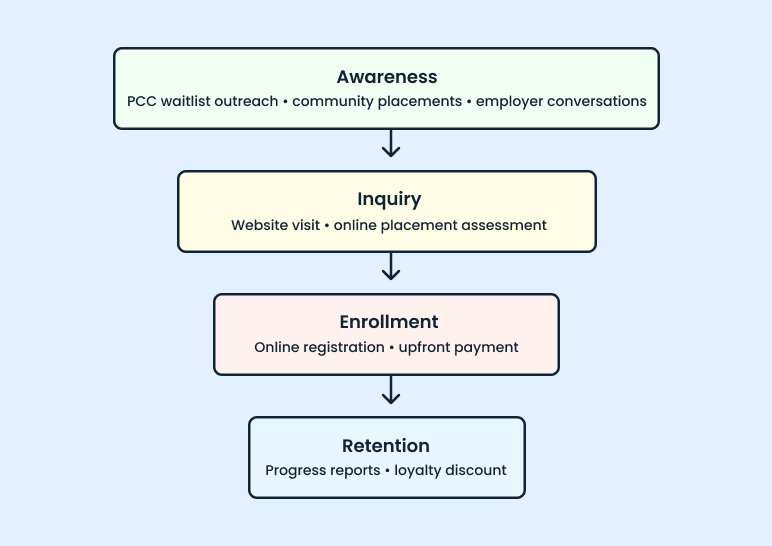
The registration of individual groups is three weeks prior to every 8-week cycle on the Meridian site. The 20-minute online placement test is conducted to identify the level of the student in terms of CEFR before any registration is made. The full payment is to be made at enrolment. Year 1 does not offer any installment plans.
Corporate clients are billed on net-7 payment terms monthly. The third consecutive enrollment of returning students is offered a 5% loyalty discount to aid in cycle retention.
Marketing & Sales Strategy
Meridian Language Academy will be a part of the Portland market with an in-built enrolment pipeline. The professional affiliations of Elena Vasquez at Portland Community College help with direct access to students who tried to enroll in ESL programs but were not able to get a place. This transforms the existing demand instead of creating demand out of thin air.
Brand Positioning
Meridian is poised to be a structured, instructor-based platform for adult learners who have outgrown apps and informal tutoring. The brand is positioned as a school, rather than a platform.
Teaching is based on a specific curriculum, lessons take place according to a set schedule, and student development is evaluated based on CEFR standards. Its central message is quite straightforward: fluency that is applicable in real-life contexts, such as workplaces, healthcare settings, and daily communication.
Individual Enrollment Acquisition (Year 1)
Pre-opening outreach (March 2026):
- Direct contact with PCC ESL waitlist students, offering early enrollment for the first session cycle
- Partnership with Portland Immigrant Support Network for ESL student referrals
- Printed enrollment flyers and course schedule cards were distributed at Portland Public Library, community centers, and healthcare facility bulletin boards across the inner southeast corridor
- Google Business Profile activated at launch to capture local search queries
If PCC outreach yields fewer than 40 confirmed enrollments by March 15, 2026, Meridian will activate two contingency channels:
- Outreach to the Oregon network of refugee resettlement organizations.
- Direct collaboration with immigrant services nonprofits in the Portland area, including Immigrant and Refugee Community Organization (IRCO).
Both channels require no paid spend and can be initiated within two weeks.
Corporate Sales Acquisition (Year 1)
Marcus Chen leads all corporate outreach, starting January 2026.
| Activity | Detail |
| Target employers | Healthcare, manufacturing, and export sectors |
| Outreach method | In-person meetings with HR managers and department heads |
| Goal | 2 signed contracts before April 2026 opening |
| Entry offer | One-month pilot at $1,500 (vs. standard $2,000/month) |
| Contract structure | Quarterly renewal after pilot |
Digital Marketing (Year 2 Expansion)
Meridian will introduce paid digital marketing only after validating demand and conversion channels in Year 1. This approach will limit early-stage spend and ensure that marketing investment targets channels that already demonstrate consistent enrollment conversion.
The approach in Year 2 will be high-intent search traffic. Meridian will also initiate Google search campaigns, including queries like Spanish classes Portland and ESL school Oregon, which will lead to special landing pages containing course schedules, rates, and a placement test. The measurement of performance will be cost per lead, cost per enrollment, and inquiry-to-enrollment conversion rates.
The content will facilitate acquisition as opposed to being a growth driver on its own. Instagram and Facebook will also enhance trust and minimise reluctance to enroll by showing student progress, brief testimonials, and classroom images.

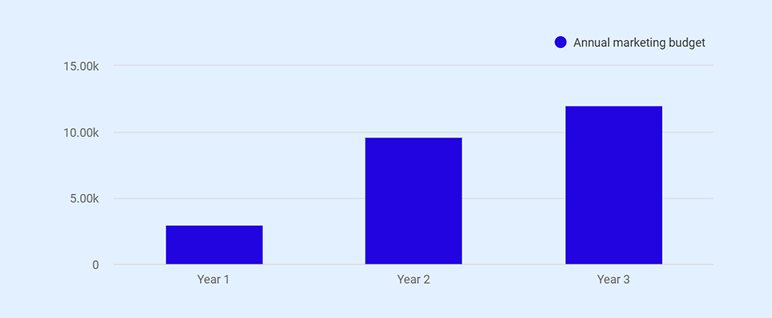
The budget for marketing will be performance-based. In Year 2, Meridian will set aside funds to cover the monthly acquisition expenses, allocating the funds as $800 per month, and in Year 3, the allocation will be $1,000 per month, as the acquisition costs will be predictable and the conversion data more stable.
Sales Strategy
Meridian’s sales approach differs by segment. Individual enrollments are self-serve and transactional. Corporate contracts require a direct, relationship-driven close.
For individual students, the placement assessment completes the conversion. A learner who completes the assessment is given their CEFR level and referred straight to registration.
Meridian will provide prospective students who have low English proficiency with registration assistance in Spanish and Mandarin, either over the phone or in-person in the facility. Elena Vasquez will handle Spanish-language inquiries directly. Mandarin support will be provided by the part-time Mandarin instructor from opening day. No third-party translation services are required in Year 1.
For corporate clients, the pilot contract at $1,500 covers one full month of instruction: two 90-minute sessions per week for up to 10 employees, identical in scope to the standard contract.
The $500 discount lowers the budget approval barrier for HR managers committing to a new provider. At the end of the pilot, Marcus presents an outcomes summary covering attendance, session completion, and instructor feedback. Employers who renew move to the standard $2,000 per month quarterly rate with no change in scope or delivery.
Year 1 Sales Targets
| Segment | Target |
| Group course enrollments | 160 across all cycles |
| Private tutoring hours | ~600 hours |
| Corporate contracts signed | 2 by April 2026 opening |
| Corporate contract-months | 18 across Year 1 |
Student Retention
Meridian will use three mechanisms to convert one-time enrollments into repeat participation:
- Loyalty discount: 5% off for a student’s third consecutive enrollment
- Monthly CEFR progress reports: Tangible proof of improvement sent to each student
- End-of-session gatherings: Build peer connection and reduce drop-off between cycles
Enrollment Funnel
Meridian structures acquisition and retention as a four-stage funnel, moving prospective learners from awareness to long-term participation rather than relying solely on continuous new customer acquisition.
Operations Plan
Meridian Language Academy is based in a rented 1,800 sq. ft. of a commercial space in 1210 SE Division Street, Suite 210, Portland, Oregon 97202. The school is designed to support small group teaching and effective time management.
Facility layout:
- Two classrooms (400 sq. ft., 12 students in each classroom) with an interactive white board, instructor desk, 12 student desks, and audio support.
- Shared staff and admin area
- Reception and waiting space
- Storage room
- Restroom
The facility will be leased at 2100 per month over 3 years with a 5% increase in year 3.
Every classroom has an interactive whiteboard, the instructor’s desk, 12 student desks, and audio. The 3-year lease agreement of the facility is at a rate of 2,100 per month, with an increase of 5 percent in Year 3. The facility operates on a 3-year lease at $2,100 per month, with a 5% escalation in Year 3.

Operating Days and Hours
| Day | Hours | Activities |
| Monday–Thursday | 9:00 AM–8:30 PM | Morning classes, afternoon tutoring, evening classes |
| Friday | 9:00 AM–6:00 PM | Morning classes, afternoon tutoring, and admin |
| Saturday | 9:00 AM–1:00 PM | French sessions, tutoring, makeup classes |
| Sunday | Closed | — |
Morning classes cater to ESL students, retirees, and students with flexible classes. Afternoon is dedicated to tutoring and corporate on-site. Evening slots are aimed at working professionals: the largest enrollment group at Meridian.
Class Scheduling Logic
Every classroom has one session that lasts 90 minutes. The sessions will be provided in four blocks of the day, Monday-Thursday:
- 9:00 AM
- 12:00 PM
- 6:00 PM
- 7:30 PM
Courses run in fixed 8-week cycles with six entry points per year:
| Cycle | Start Month |
| Cycle 1 | January |
| Cycle 2 | March |
| Cycle 3 | May |
| Cycle 4 | July |
| Cycle 5 | September |
| Cycle 6 | November |
A class will then open when a minimum of six students are registered at least five days prior to the opening date. In case the minimum number of enrolled students is not achieved, the school will move to the following cycle or refund in full. This eliminates unused sessions and safeguards the time of instructors.
Typical Operating Day
Marcus comes to the office at 8.30 AM to approve enrollments, corporate invoices, and answer questions. Classes in the morning will be conducted between 9:00 and 10:30 AM, where Elena will be teaching Spanish Intermediate and Marcus will be teaching ESL Beginner in separate classrooms.
Midday shifts to administrative tasks, placement assessments, and private tutoring. Elena does back-to-back tutoring, and Marcus does corporate outreach or travels to take on-site training.
Part-time teachers come at 5.30 PM. Evening classes start at 6:00 PM and last until 9:00 PM, with beginner, intermediate, and advanced classes in both classrooms.
Staffing Plan
| Role | Person | Schedule | Hours/Week | Compensation |
| Academic Director / Lead Instructor | Elena Vasquez | Mon–Fri 9 AM–7 PM, Sat 9 AM–1 PM | 45 hrs | $24,000/year |
| Managing Director / Instructor | Marcus Chen | Mon–Fri 9 AM–6 PM | 40 hrs | $24,000/year |
| PT Instructor (Spanish) | To be decided | Mon–Thu evenings, Sat | 18 hrs | $28/hour |
| PT Instructor (Mandarin) | To be decided | Tue–Thu evenings | 12 hrs | $28/hour |
Elena and Marcus handle core instruction and operations in Year 1, supported by part-time instructors for evening demand. Instructors should have a minimum of two years of teaching experience and a minimum bachelor’s degree in language, linguistics, or education.
Elena’s professional network provides a direct recruitment pipeline. Standardized lesson plans developed by Elena reduce onboarding time and maintain instructional consistency across sections.
Licensing and Compliance
Meridian is licensed under the City of Portland. Oregon does not mandate state accreditation of the operation of the private language schools. It will pursue Accrediting Council for Continuing Education and Training (ACCET) accreditation in Year 2 to strengthen credibility with corporate clients and support future grant eligibility.
ACCET accreditation is generally a fee to apply, preparation of documents, and a site visit, and all costs about $3,000 to $5,000. This is an expense that is going to be budgeted as a separate expense in the Year 2 operational budget, and not included in the current three-year projections.
The company has general and professional liability insurance of around 3800 a year. Both founders hold current CPR and first aid certifications.
Financial Plan
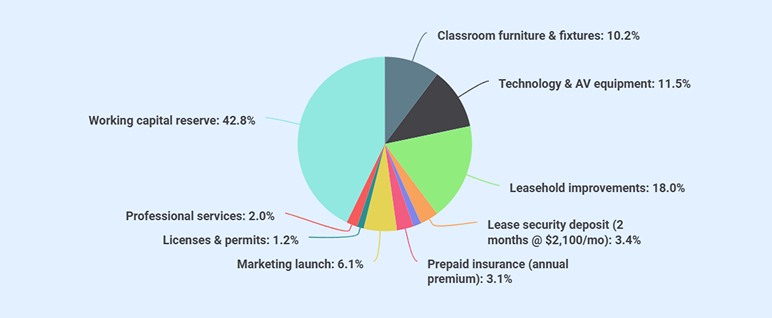
Meridian Language Academy will need a total of $125,000 start-up capital to cover facility setup, equipment, and start-up operations. The school is requesting an SBA 7(a) loan of $90,000 with Pacific Northwest Business Bank, plus $35,000 of its own capital. The capital enables a planned start with adequate working capital to continue operations during the initial nine months of enrollment ramp.
The investment covers four categories:
- Capitalized assets
- Lease deposits and prepaid insurance
- One-time launch costs
- Working capital
Startup Costs
| Expense | Amount |
| Classroom furniture & fixtures | $12,500 |
| Technology & AV equipment (computers, projectors, sound system) | $14,000 |
| Leasehold improvements (partition walls, paint, signage, lighting) | $22,000 |
| Lease security deposit (2 months @ $2,100/mo) | $4,200 |
| Prepaid rent (1st month) | $1,800 |
| Prepaid insurance (annual premium) | $3,800 |
| Marketing launch (website, branding, photography, launch ads) | $7,500 |
| Licenses & permits (business license, occupancy permit) | $1,500 |
| Professional services (LLC formation, lease review, accountant setup) | $2,500 |
| Working capital reserve | $55,200 |
| Total Startup Costs | $125,000 |
Entrepreneurs building a similar plan can estimate their startup requirements using a startup cost calculator.
Source of Funds
| Source | Amount |
| SBA 7(a) Term Loan (Pacific Northwest Business Bank) | $90,000 |
| Owner equity contribution (Elena Vasquez & Marcus Chen, combined) | $35,000 |
| Total Startup Capital | $125,000 |
Founders evaluating financing options can compare providers through this list of the best SBA lenders.
Key Financial Assumptions
| Item | Assumption |
| Group course price per enrollment | $380 per 8-week session (fixed all 3 years) |
| Annual group enrollments | Year 1: 160; Year 2: 260; Year 3: 320 |
| Max class size | 12 students per class section |
| Group course revenue | Year 1: $60,800; Year 2: $98,800; Year 3: $121,600 |
| Private tutoring rate | $85/hour (fixed all 3 years) |
| Annual tutoring hours | Year 1: ~602 hrs; Year 2: ~395 hrs; Year 3: ~411 hrs |
| Tutoring revenue | Year 1: $51,200; Year 2: $33,600; Year 3: $34,900 |
| Corporate training rate | $2,000/month per client contract |
| Annual corporate contract-months | Year 1: 18 (avg 1.5 clients); Year 2: 30 (avg 2.5); Year 3: 42 (avg 3.5) |
| Corporate revenue | Year 1: $36,000; Year 2: $60,000; Year 3: $84,000 |
| Total revenue | Year 1: $148,000; Year 2: $192,400; Year 3: $240,500 |
| Year-over-year revenue growth | Year 1→2: +30.0%; Year 2→3: +25.0% |
| Direct materials (textbooks, printed materials) | 5.0% of revenue all years |
| Part-time instructor wages (direct labor) | 18.0% of revenue all years |
| Payroll taxes on direct labor | 7.65% of instructor wages |
| Gross margin | 75.6% all years |
| Combined owner salaries | Year 1: $48,000; Year 2: $72,000; Year 3: $100,000 |
| Payroll taxes on owner salaries | 7.65% of owner salaries |
| Monthly rent | Year 1–2: $2,100/mo ($25,200/yr); Year 3: $2,205/mo ($26,460/yr — 5% escalation per lease) |
| Lender | Pacific Northwest Business Bank |
| Loan amount | $90,000 |
| Loan term | 7 years (84 monthly payments) |
| Annual interest rate | 8.5% |
| Monthly payment | $1,425 |
| Annual payment | $17,100 |
| Year 1: Interest / Principal / Ending Balance | $7,272 / $9,828 / $80,172 |
| Year 2: Interest / Principal / Ending Balance | $6,488 / $10,612 / $69,560 |
| Year 3: Interest / Principal / Ending Balance | $5,592 / $11,508 / $58,052 |
| Accounts receivable (DSO) | 7 days — Year 1: $2,838; Year 2: $3,688; Year 3: $4,612 |
| Accounts payable (DPO) | 15 days — Year 1: $1,483; Year 2: $1,928; Year 3: $2,409 |
| Inventory | $0 — pure service business |
| Depreciation: Classroom furniture & fixtures | $12,500 cost ÷ 7 years = $1,786/year |
| Depreciation: Technology & AV equipment | $14,000 cost ÷ 5 years = $2,800/year |
| Depreciation: Leasehold improvements | $22,000 cost ÷ 10 years = $2,200/year |
| Total annual depreciation | $6,786/year — Net PP&E: Y1 $41,714 / Y2 $34,928 / Y3 $28,142 |
Income Statement (Profit & Loss)
| Year 1 ($) | Year 2 ($) | Year 3 ($) | |
| Group course enrollments | 160 | 260 | 320 |
| Total Revenue | $148,000 | $192,400 | $240,500 |
| COGS | |||
| Direct materials/textbooks (5%) | $7,400 | $9,620 | $12,025 |
| Part-time instructor wages (18%) | $26,640 | $34,632 | $43,290 |
| Payroll taxes on instructor wages (7.65%) | $2,038 | $2,649 | $3,312 |
| Total COGS | $36,078 | $46,901 | $58,627 |
| Gross Profit | $111,922 | $145,499 | $181,873 |
| Gross Margin | 75.6% | 75.6% | 75.6% |
| Operating Expenses | |||
| Owner salaries | $48,000 | $72,000 | $100,000 |
| Owner payroll taxes (7.65%) | $3,672 | $5,508 | $7,650 |
| Rent | $25,200 | $25,200 | $26,460 |
| Insurance | $3,800 | $4,000 | $4,200 |
| Accounting & bookkeeping | $3,600 | $3,600 | $3,600 |
| Phone & internet | $2,400 | $2,400 | $2,400 |
| Ongoing marketing | $6,000 | $9,600 | $12,000 |
| Classroom supplies (consumables) | $3,600 | $4,200 | $4,800 |
| Equipment maintenance | $1,200 | $1,800 | $2,400 |
| Technology subsc.riptions (LMS, scheduling, video) | $2,400 | $2,400 | $2,400 |
| Marketing launch — one-time (Year 1 only) | $7,500 | — | — |
| Licenses & permits — one-time (Year 1 only) | $1,500 | — | — |
| Professional services setup — one-time (Year 1 only) | $2,500 | — | — |
| Total Operating Expenses | $111,372 | $130,708 | $165,910 |
| EBITDA | $550 | $14,791 | $15,963 |
| Depreciation | $6,786 | $6,786 | $6,786 |
| EBIT | ($6,236) | $8,005 | $9,177 |
| Interest expense | $7,272 | $6,488 | $5,592 |
| Net Income (Pre-Tax) | ($13,508) | $1,517 | $3,585 |
Cash Flow Statement
| Year 1 ($) | Year 2 ($) | Year 3 ($) | |
| Beginning Cash | $66,700 | $54,395 | $51,681 |
| Operating Activities | |||
| Net income (pre-tax) | ($13,508) | $1,517 | $3,585 |
| Add: Depreciation (non-cash) | $6,786 | $6,786 | $6,786 |
| Change in accounts receivable | ($2,838) | ($850) | ($924) |
| Change in prepaid expenses | $5,600 | $0 | $0 |
| Change in accounts payable | $1,483 | $445 | $481 |
| Net Cash from Operations | ($2,477) | $7,898 | $9,928 |
| Investing Activities | |||
| Capital expenditures | $0 | $0 | $0 |
| Net Cash from Investing | $0 | $0 | $0 |
| Financing Activities | |||
| SBA loan principal repayment | ($9,828) | ($10,612) | ($11,508) |
| Net Cash from Financing | ($9,828) | ($10,612) | ($11,508) |
| Net Change in Cash | ($12,305) | ($2,714) | ($1,580) |
| Ending Cash | $54,395 | $51,681 | $50,101 |
Opening Balance Sheet (at Launch)
| Line Item | Amount ($) |
| ASSETS | |
| Cash (working capital + one-time expense float) | $66,700 |
| Security deposit (2 months rent) | $4,200 |
| Prepaid rent (1st month) | $1,800 |
| Prepaid insurance (annual premium) | $3,800 |
| Gross PP&E (furniture, technology, leasehold improvements) | $48,500 |
| Total Assets | $125,000 |
| LIABILITIES & EQUITY | |
| SBA 7(a) term loan | $90,000 |
| Owner’s paid-in capital | $35,000 |
| Total Liabilities + Equity | $125,000 |
Balance Sheet (Years 1-3)
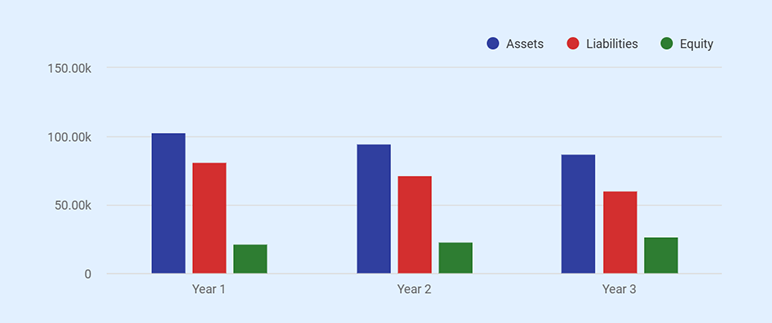
| Year 1 ($) | Year 2 ($) | Year 3 ($) | |
| ASSETS | |||
| Cash | $54,395 | $51,681 | $50,101 |
| Accounts receivable | $2,838 | $3,688 | $4,612 |
| Prepaid expenses | $0 | $0 | $0 |
| Security deposit | $4,200 | $4,200 | $4,200 |
| Net PP&E | $41,714 | $34,928 | $28,142 |
| Total Assets | $103,147 | $94,497 | $87,055 |
| LIABILITIES | |||
| Accounts payable | $1,483 | $1,928 | $2,409 |
| SBA term loan | $80,172 | $69,560 | $58,052 |
| Total Liabilities | $81,655 | $71,488 | $60,461 |
| EQUITY | |||
| Paid-in capital | $35,000 | $35,000 | $35,000 |
| Retained earnings (cumulative net income) | ($13,508) | ($11,991) | ($8,406) |
| Members’ Capital | $21,492 | $23,009 | $26,594 |
| Total Liabilities + Equity | $103,147 | $94,497 | $87,055 |
Break-Even Analysis
| Item | Value |
| Revenue per course enrollment | $380 |
| Direct materials per enrollment (5%) | $19.00 |
| Instructor wages per enrollment (18%) | $68.40 |
| Payroll taxes on wages per enrollment (7.65%) | $5.23 |
| Total variable cost per enrollment | $92.63 |
| Contribution margin per enrollment | $287.37 |
| Contribution margin (%) | 75.6% |
| Annual fixed operating costs (Year 2 steady state, excl. depreciation) | $130,708 |
| Break-even enrollments per year | 455 enrollments |
| Break-even enrollments per month | 38 enrollments |
| Break-even revenue per year | $172,900 |
Key Risks and Mitigation
| Risk | Likelihood | Mitigation |
| Enrollment ramp is slower than projected | Medium | $55,200 working capital reserve covers a slower ramp. Minimum six-student threshold prevents unviable sessions. Contingency channels (IRCO, refugee resettlement networks) activated if the first two cycles fall below 60% of the projection. |
| Corporate contract delays | Medium | Marcus begins outreach in January 2026, three months before opening. The initial low price of 1,500 pilots reduces HR approval. If no contracts signed by June 2026, outreach hours redirect toward individual enrollment. |
| Founder departure or incapacity | Low | Standardized lesson plans reduce instructor dependency. Part-time instructor pipeline sourced from Elena’s PCC network. Corporate client processes documented independently of verbal relationship knowledge. |
The Quickest Way to turn a Business Idea into a Business Plan
Fill-in-the-blanks and automatic financials make it easy.
