




Looking to hang your own shingle and start a law practice? Great!
But writing a law firm business plan is the first step to turning your legal expertise into a real business.
Whether you’re going solo or launching a firm with others, a clear plan will give you structure, direction, and confidence from day one. Need help getting your plan in order?
Worry not! This Law firm business plan template walks you through every section, with practical tips to help you write a plan that works.
What is a law firm business plan?
A law firm business plan outlines your goals, services, target clients, and how you’ll run and grow your practice. It also covers your mission, marketing plan, client acquisition strategy, operations, and finances as well.
Think of it as both a roadmap to guide your firm and a tool to show investors or lenders why your law business is set up to succeed.
Why do you require a business plan for a law firm?
Even if you’re a brilliant attorney, running a successful law firm requires more than legal knowledge—you need a business plan.
A business plan forces you to think through important facets of your practice in advance. It even helps you:
- Define your direction: Clarify your firm’s niche, goals, and the services you’ll focus on.
- Stay organized: Plan out how you’ll handle day-to-day operations and case management so nothing critical is overlooked.
- Identify strengths & gaps: Assess what sets you apart from competing firms and what weaknesses you need to address.
- Set financial targets: Budget for expenses like office rent, staffing, and malpractice insurance, and project your revenue from client fees.
- Attract partners or funding: If you need a bank loan or want to bring on partners, a polished business plan shows you’re serious and have a clear strategy.
Simply put, a law firm business plan is your blueprint to build a sustainable, thriving practice. It’s easier to navigate the competitive legal industry when you have a map in hand.
→ Download Now: Free Law Firm Business Plan
How to draft an effective law firm business plan?
Drafting a business plan might sound daunting, but it doesn’t have to be. Let’s break it into the key sections:
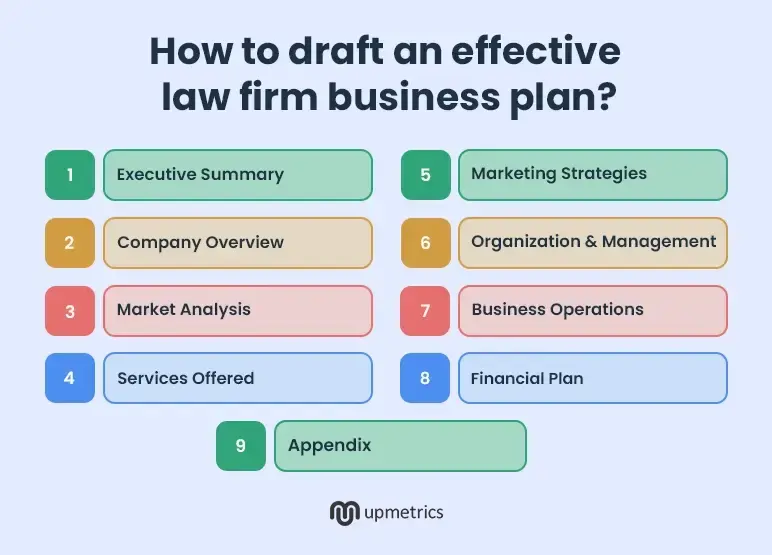
1. Executive Summary
The executive summary is the elevator pitch for your law firm. It’s a concise overview of your entire business plan, distilled down to a page or two.
Even though this section appears first, it’s typically written last – once you have fleshed out all the details in the rest of your plan. So, you can pull the highlights effectively into this summary.
The goal here is to give the reader a quick snapshot of your firm and convince them it’s poised for success.
Your executive summary should cover the most important aspects of your plan, including:
- Firm overview: A brief introduction to your law firm—your firm’s name, location, and legal structure, and a bit of your firm’s background if relevant.
- Services & practice areas: What legal services will you offer? Highlight your main practice areas or specialties. This tells the reader what revenue streams you’ll have.
- Target market: Who are your ideal clients? Identify your target market based on practice areas, location, and client type, such as individuals, small businesses, startups, or nonprofits.
- Unique value proposition: What sets your law firm apart from other firms? Summarize your competitive edge or USP.
- Financial highlights: Provide a topline look at your firm’s financial outlook. You might mention your expected revenue in the first year, your growth targets, and profit goals.
- Funding needs (if applicable): If you’re seeking funding or investment, state how much you need and what you’ll use it for. This is important to include if your plan’s reader is a lender or investor.
Keep the tone confident and optimistic, but also realistic. In a few quick paragraphs, the reader should grasp what your firm does, who it serves, why it will be successful, and what you’re asking for.
Say goodbye to boring templates
Build your business plan faster and easier with AI
Plans starting from $14/month

2. Company Overview
Now, it’s time to describe your law firm in more detail!
The company overview section provides foundational information about your firm, including who you are, what you do, and why you’re in this business. Think of it as the introduction to your firm’s story.
Here are the key elements to include in this section:
- Your law firm’s name, location, and contact info. Where is your office headquartered? Do you serve any specific geographic area?
- Business legal structure: Are you operating as a sole proprietorship, partnership, professional corporation, or LLC?
- Vision statement—your long-term ambition or ideal future position in the legal market.
- An inspiring mission statement that captures the purpose of your firm.
- Short-term goals and long-term objectives for your law firm
If your firm is already operating or you have key milestones leading up to its founding, include a brief history. For a startup law firm, you might instead mention the inspiration or reason you decided to start this practice.
Overall, the company overview gives a snapshot of your law firm’s identity and strategy.
By the end of this section, the reader should have a solid understanding of what your firm is all about and what it aims to achieve. Keep it concise but impactful—you’re essentially setting the stage for the rest of the plan.
3. Market Analysis
Before launching your law firm, you need to understand the market you’re entering. The market analysis section shows your knowledge of the legal industry, your target clients, and your competition. It answers: “What is the demand for my legal services, and how does my firm fit in?”
Start with a brief overview of your practice area. Is demand growing? Mention trends like the rise in virtual consultations, elder law demand, or legal tech tools. Note any regulations or changes that impact how you’ll operate.
Then, define your target clients. Describe who they are: individuals, families, startups, or businesses, and the problems they need solved.
If you serve multiple client types, break them into clear segments like estate planning for individuals and contracts for small businesses. This shows you understand your audience and how to serve them effectively.
If applicable, support your plan with local data. This helps justify the demand for your services.
Next, cover your competition. List nearby firms offering similar services, and explain how you’re different by niche, pricing, or approach.
Furthermore, you can add a quick SWOT analysis to show your strengths, weaknesses, opportunities, and threats. Something like this:
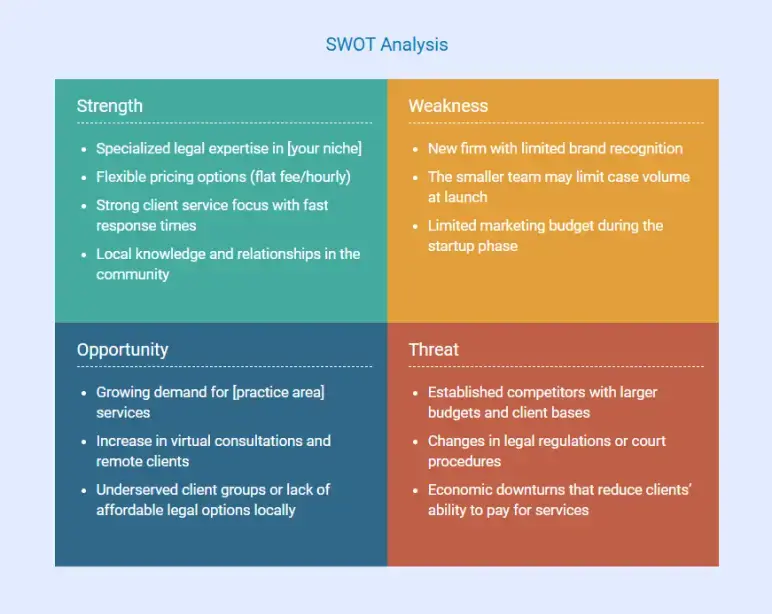
This will help you fill a real need and even evaluate how to position your law firm in a competitive marketplace.
4. Services Offered
In this section, describe the legal services your firm will offer. What clients will pay for. A clear breakdown helps show how you’ll generate revenue and meet client needs.
List your key practice areas. For example:
- Business formation and contracts
- Family law
- Estate planning
- Litigation
- Real estate law
Tailor this to your focus. A niche firm might only cover one area (like patents), while a multi-specialty firm can group services into categories.
Add short descriptions where needed for clarity. Then, explain your pricing model.
Do you charge hourly, flat fees, or contingency? If you offer flexible models, include them; these help show how your pricing stays competitive.
Also, mention any value-added features: free consultations, online case dashboards, 24/7 availability, or anything that adds convenience.
5. Marketing Strategies
This section explains how you plan to attract and retain clients using a mix of digital and traditional strategies that align with legal advertising ethics.
Let’s break down the key strategies that will help position your firm and bring in consistent, qualified clients.
- Branding: Define your firm’s name, logo, tagline, and overall image.
- Online presence: Plan for a professional website with SEO so local clients can find you. Include online legal directories and profiles on LinkedIn or similar platforms. Consider content marketing, like legal blogs or guides.
- Social media & digital ads: Use LinkedIn, Facebook, or YouTube to reach clients. If running ads, explain your targeting approach. Stay compliant with legal advertising rules.
- Networking & referrals: Leverage local networking events, bar associations, and referral sources like accountants or real estate agents. Encourage word-of-mouth through testimonials and reviews.
- Advertising & promotions: Include any traditional marketing. You may offer promotions like free consultations or discounts to bring in early clients.
- Client experience & retention: Focus on client satisfaction through follow-ups, appreciation gestures, and quick communication. Happy clients often lead to repeat business and strong referrals.
This section should show that you have a practical, multi-channel approach to bring in new clients and build long-term trust.
6. Organization and Management
The organization and management team section outlines who runs the firm and how it’s structured. It gives readers confidence that the right people are in place to manage the business and deliver legal services.
Start with your ownership structure. Are you the sole owner, or do you share equity with partners? Note any outside investors, if applicable.
If you’re running a solo practice, highlight your credentials and experience clearly. If you have a larger team, include partners, associate attorneys, paralegals, and admin staff.
Next, introduce your key team members. Share brief bios for each, covering their education, years of practice, and areas of legal focus.
Further, describe your organizational setup. If it’s a solo practice, it may just be you with a virtual assistant or paralegal. If you’re running a multi-partner firm, describe how the team is divided. For instance:
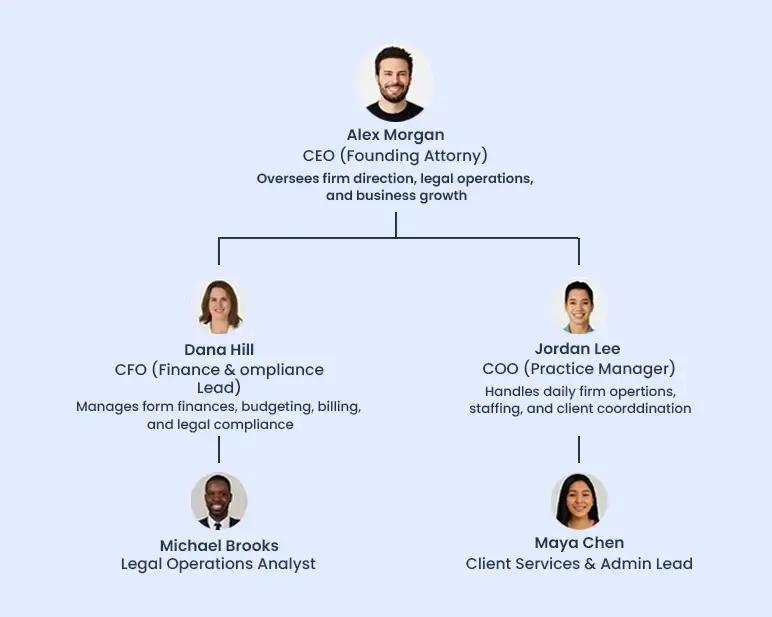
If applicable, mention any advisors or consultants, such as financial or legal practice consultants, that support your firm.
7. Business Operations
The operations plan section explains the day-to-day workflow and logistics of running your law firm. Essentially, how will you deliver your legal services efficiently and effectively? While the earlier sections covered the “what” and “who,” this part covers the “how.”
Consider the following points for your operations plan:
- Office & facilities: Describe your office setup, whether it’s a physical office, virtual model, or home-based practice.
- Equipment & technology: Mention essential tools—law practice software, cloud storage, legal research tools, or e-signature platforms.
- Workflow & processes: Explain how a client matter moves through the firm, from intake to resolution.
- Client management: Outline how you’ll handle communication, updates, and service.
- Suppliers & outsourcing: List services you’ll rely on court filing, process servers, IT, or virtual reception.
- Hours & risk management: State your business hours and quality measures. Mention tools for deadline tracking, licensing, and insurance.
In short, this section proves you’re not just offering legal services—you’ve planned how to deliver them reliably every day.
8. Financial Plan
The financial plan is one of the most critical sections of your law firm business plan, especially if you’re seeking funding or want to ensure the venture is financially viable. This section will detail your firm’s financial projections, funding requirements, and key assumptions.
Here’s what to include in your financial plan:
Startup Costs and Use of Funds
List what you need to launch: Office rent, furniture, software, legal fees, insurance, marketing, and a cash reserve. If seeking funding, state the total and break it down.
You can also include a simple pie chart to visually show how the funds will be used.
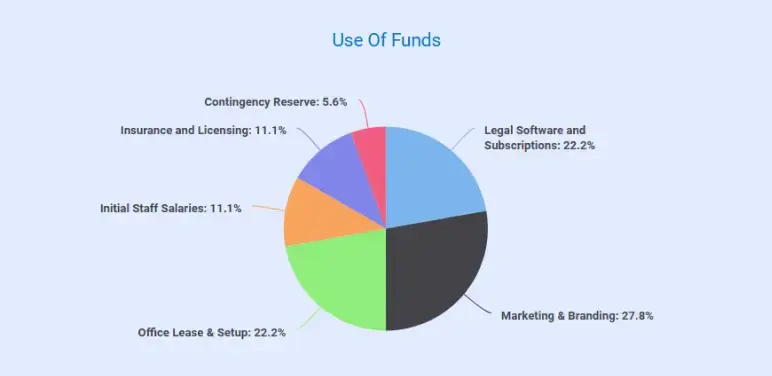
Revenue Model
Explain how your firm earns, usually client fees. Break it down if needed. Include your pricing model: flat fees or hourly. Estimate volume and average fees to project revenue.
Expenses and Profit
Summarize monthly/annual costs—salaries, rent, software, marketing, insurance, supplies, and loan payments. Forecast your profit/loss for 3–5 years.
Cash Flow and Break-Even
Mention cash flow timing—clients may take time to pay. Show that you’ve planned reserves. Share your break-even point.
When writing this section, clarity and realism are key. Use straightforward language – you don’t need to be an accountant, just explain the figures in a logical way.
If you have used a tool to generate your financial projections, you can rely on those calculations and then describe the highlights.
9. Appendix
The appendix is the final section of your business plan. It includes supporting documents that back up the main content. While not part of your pitch, it’s useful for anyone reviewing details more closely.
For a law firm, this might include full resumes of attorneys and key staff, copies of legal documents like your business registration, or partnership agreements.
You can also include detailed financial projections—multi-year income statements, cash flow, balance sheets, and assumption tables. This keeps the main plan clear but offers transparency.
Add any market research data that supports your analysis, like charts on industry growth or local demand. Sample marketing materials—like website mockups or brochures—can help visualize your brand.
Label each item clearly. Only include what adds value. A clean, relevant appendix strengthens your business plan and builds trust.
Download a free law firm business plan template
Ready to create your own law firm business plan but need a bit of guidance? We’ve got you covered. Download our free law firm business plan template (PDF) to help you get started with confidence.
This template includes a complete outline and sample content for each key section. It’s easy to customize for your legal practice, whether you’re launching a boutique firm, solo practice, or growing a team. It saves time and ensures you don’t miss anything important, giving you a solid foundation to build on.
The Quickest Way to turn a Business Idea into a Business Plan
Fill-in-the-blanks and automatic financials make it easy.

Summary
That’s a wrap! We’ve gone over all the essential parts of a law firm business plan and how to write each one. Plus, we’ve provided a ready-to-use sample plan to help you take the next step.
However, if you’re still feeling unsure or want to speed things up, business planning tools like Upmetrics can be your go-to solution.
With advanced AI capabilities, financial forecasting features, free templates, and additional resources, it streamlines the planning process, m. It lets you create a comprehensive, actionable plan quickly and easily.


