

Executive Summary
The PrimeCoat Painting offers residential and light commercial services in Raleigh, NC. The business is single-member-owned and operated by Andrew Collins.
The business focuses on standard, repeat-demand work rather than specialty or high-risk projects. PrimeCoat Painting operates with simple systems, limited overhead, and controlled risk. Growth comes from completing more jobs, not from raising prices or expanding services.
The business doesn’t seek large corporate contracts, specialty finishes, epoxy floor coating, or building repair. This restrictive service provider focus reduces exposure to liability, cost of equipment, and execution risk.
The owner, Andrew Collins, was a hands-on and trade-level employee who is now directly applicable to the operating requirements of PrimeCoat Painting. He has been involved in residential repaint jobs where correct estimation, surface preparation, and a clean finish are directly related to profitability and customer satisfaction.
Target Customers
Our primary customers include:
- Homeowners who need room repaints
- Landlords maintaining rental properties
- Property managers handling multiple units
- Small local businesses updating their offices or retail spaces
We target these customers because they want solid work at fair prices. They don’t need specialty finishes or high-end design services.
Opportunity
The Raleigh painting market leaves a clear gap between high-end contractors and low-cost operators. Many homeowners and property managers want reliable repainting work within 3-5 years in wood siding, 12-15 years in brick painting, and fiber cement siding in 7-10 years due to Raleigh’s climate at fair prices, but cannot find consistent service.
PrimeCoat Painting targets this underserved middle by delivering accurate quotes, dependable scheduling, and clean execution on standard repaint jobs.
Business Model
PrimeCoat generates revenue through three service lines:
- Interior residential repainting: The primary revenue driver. Includes single rooms, multiple rooms, and whole-home repaints. Covers walls, ceilings, trim, and doors. Minor drywall patching included as needed.
- Exterior residential repainting: Seasonal work focused on siding and trim. Weather-dependent, with stronger demand in spring and summer. Requires more setup time and material volume than interior jobs.
- Small commercial repaints: Office spaces, retail shops, small professional buildings. These jobs arrive irregularly but pay well when scheduled during business hours.
All services include surface prep, protection of fixtures and floors, paint application, and job site cleanup.
Financial Snapshot
Revenue is generated on a per-job basis. Interior residential repainting is the primary and most consistent revenue source. Exterior work is seasonal and weather-dependent. Small commercial jobs are incidental and irregular. Pricing is set at mid-market local rates with no premium positioning.
| Metric | Year 1 | Year 2 | Year 3 |
|---|---|---|---|
| Interior residential repaint revenue | $60,000 | $72,000 | $80,000 |
| Exterior residential repaint revenue | $42,000 | $52,000 | $62,000 |
| Small commercial repaint revenue | $6,000 | $8,000 | $10,000 |
| Total Revenue | $108,000 | $132,000 | $152,000 |
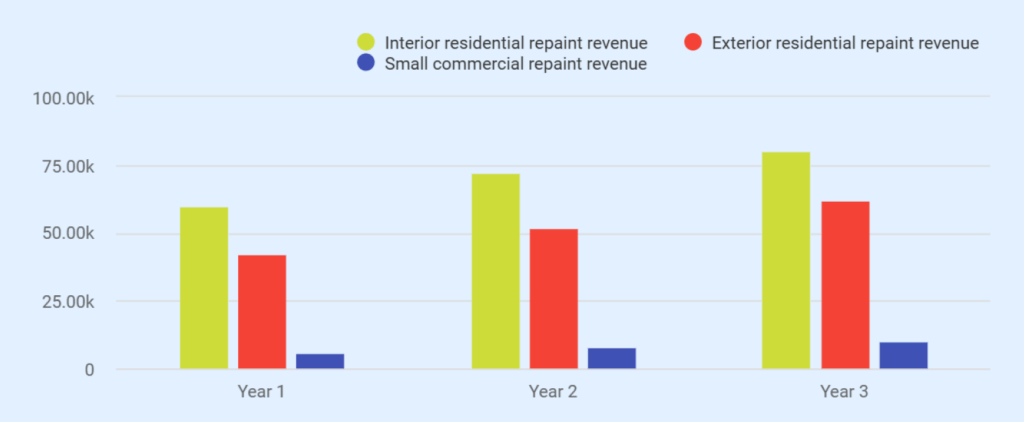
Monthly revenue is uneven, with weak periods expected due to weather, scheduling gaps, and customer decision delays.
The owner does not take a salary in Years 1 and 2. A modest $30,000 salary begins in Year 3 and is treated as an operating expense. Owner distributions are irregular and depend on available cash.
Funding Requirement
PrimeCoat Painting is seeking $28,000 in startup financing through a term loan from Truist Bank. The loan carries an estimated interest rate of 7.5% with a 5-year repayment term. The owner will also contribute $7,000 from his personal savings. This makes the total startup cost of $35,000.
The funds support business launch costs and provide sufficient working capital to operate through early volatility without additional borrowing.

Business Overview
PrimeCoat Painting focuses on well-defined repaint projects that fit into the practical, low-risk operating model and help to sustain the local demand.
It doesn’t deal with complicated forms of the projects that raise the costs, risk, and pressure of execution. This structure enables the business to operate in a clean, disciplined, and foreseeable environment.
Business Structure and Legal Setup
- Business name: PrimeCoat Painting
- Legal structure: Single-member LLC
- Business address: 1246 Commerce Lane, Unit 5, Raleigh, NC 27604
The LLC structure separates personal and business liability while keeping tax and compliance requirements simple.
Ownership and Management
PrimeCoat Painting is solely owned and operated by Andrew Collins. The company is a single-member LLC with a hands-on managerial form, where all the major decisions and day-to-day activities are under the direct management of the owner.
There are no partners, outside investors, or silent owners. This removes the complexity of governance, and accountability is held in a single decision-maker.
Andrew Collins is in charge of all activities of the core business. His responsibilities include:
- Job estimating and pricing
- Preparation and implementation of painting on the surface.
- Job scheduling and coordination at the site.
- Quality testing and inspection checks.
- Invoicing and collection of money.
- Coordination with vendors and suppliers.
- Minimal compliance and recordkeeping.
The owner hires helper labor hourly on a per-job basis when the workload exceeds individual capacity.
Service Delivery Model
PrimeCoat Painting follows a lean owner-operator model. Andrew Collins performs all estimating, surface prep, painting, scheduling, customer communication, and quality control.
An operational drag equal to 4% of revenue is built into the model to reflect rework, material waste, scheduling inefficiencies, and minor overruns. This is not optional or improvable; it represents normal execution friction for a first-time independent operator.
Startup Summary
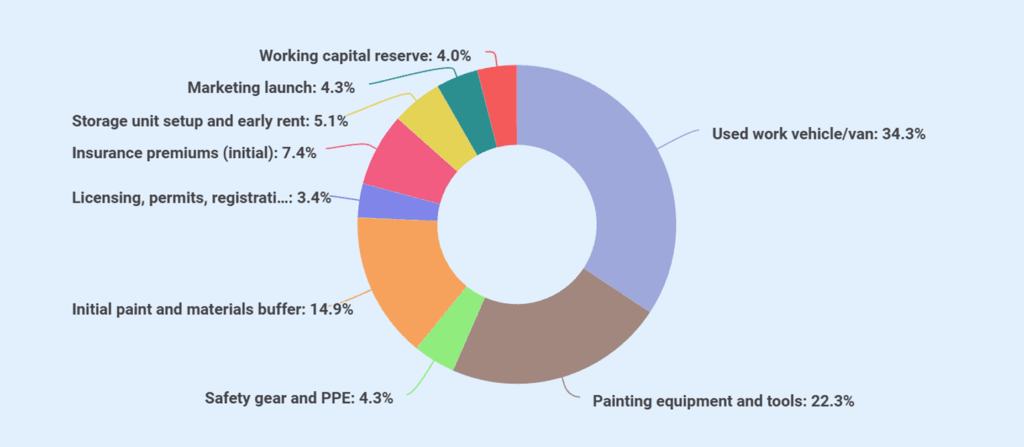
PrimeCoat Painting requires $35,000 funding to set up essential operating assets, meet compliance requirements, and support early working capital. Here’s how we’ll use the funds:
| Use of Funds | Amount |
|---|---|
| Used work vehicle/van | $12,000 |
| Painting equipment and tools | $7,800 |
| Safety gear and PPE | $1,500 |
| Initial paint and materials buffer | $5,200 |
| Licensing, permits, registrations | $1,200 |
| Insurance premiums (Initial) | $2,600 |
| Storage unit setup and early rent | $1,800 |
| Marketing launch | $1,500 |
| Working capital reserve | $1,400 |
| Total | $35,000 |
Services Offered
PrimeCoat Painting offers a focused set of painting services built around repeat-demand work. The company keeps services narrow to control costs, reduce errors, and deliver consistent results.
Our core services include:
1) Interior Residential Repainting
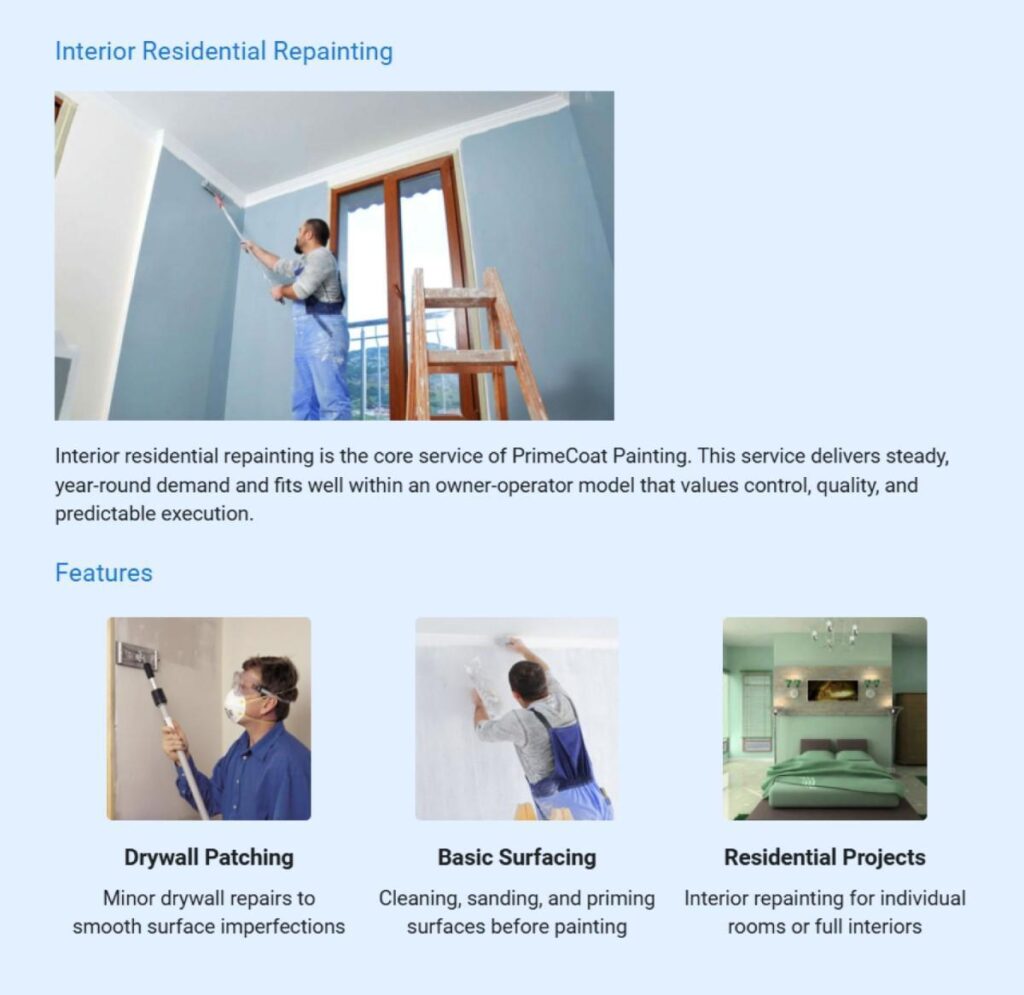
The process begins with an on-site evaluation. The owner reviews room size, ceiling height, surface condition, existing paint type, and customer expectations. Based on this assessment, the owner defines the exact scope of work and provides a clear written estimate.
2) Exterior Residential Repainting
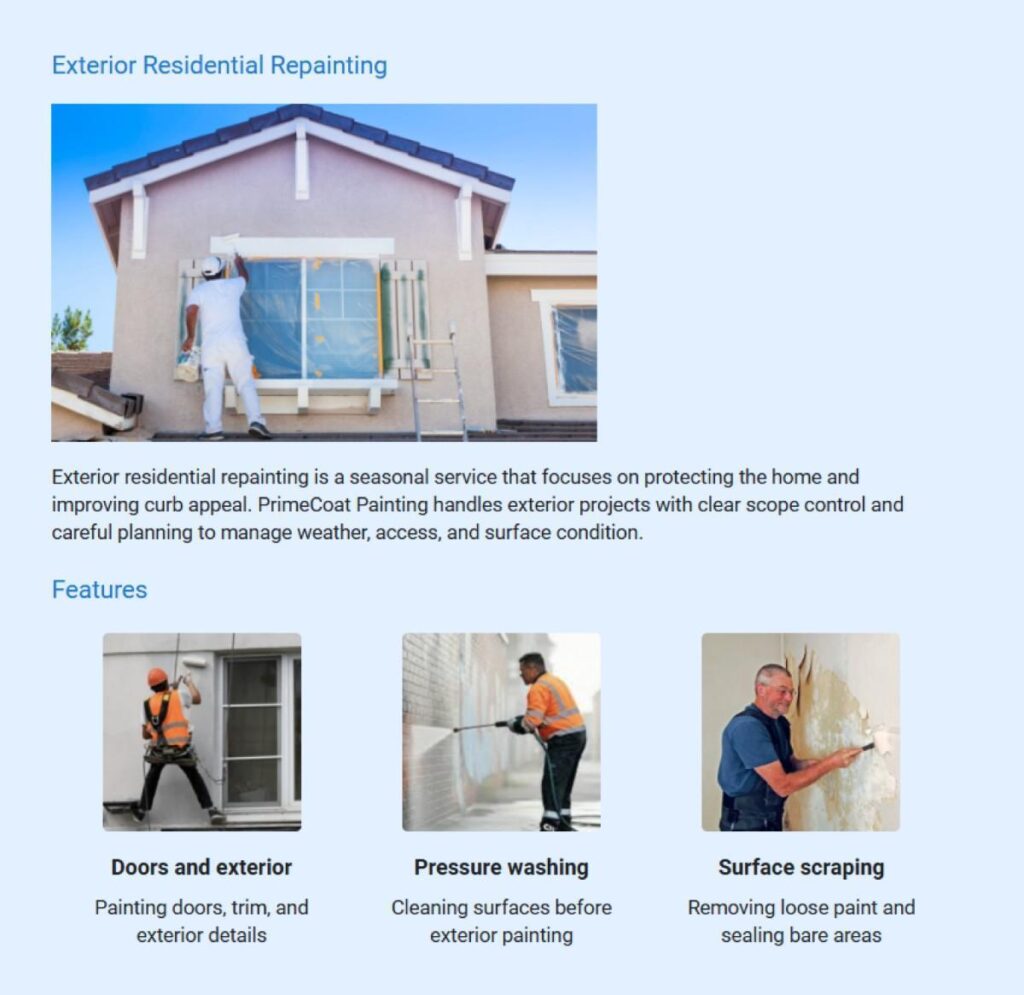
The process starts with an exterior inspection. The owner reviews siding type, trim condition, height, existing paint wear, and exposure to sun and moisture. Based on this review, the owner defines the project scope and provides a written estimate that reflects surface prep needs and access requirements.
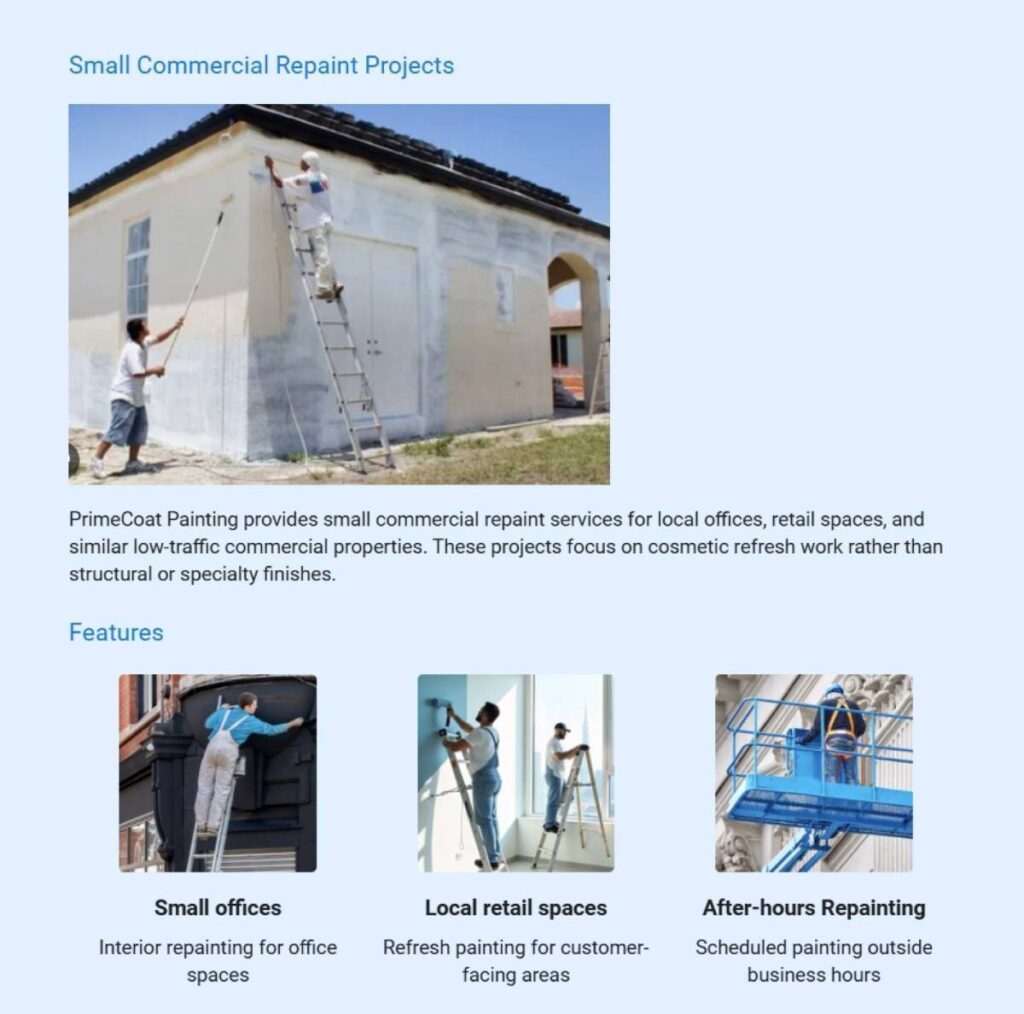
3) Small Commercial Repaint Projects
Painting work covers walls, ceilings, trim, and entry areas based on the approved scope. The owner defines a clear scope that limits disruption to daily business activity. Projects are often scheduled during off-hours, evenings, or weekends when required.
What We Exclude
PrimeCoat Painting excludes tasks that increase project risk, timeline uncertainty, or specialized labor requirements.
The removal of wallpaper wouldn’t be part of regular projects and would need a separate quote, as it would be an extra time, risk to the surface, and cleanup. Repairs of major defects of drywall, such as holes bigger than four inches, are out of the scope, as they need structural repair and take a long time to dry.
The company does not carry out popcorn ceiling removal, cabinet refinishing or staining, or decorative finishes, including faux painting, Venetian, or murals. Such services require special tools, methods, and increased project durations.
PrimeCoat Painting does not involve lead paint abatement and mold remediation since these procedures must be handled by certified personnel, and they must comply with the regulations and have extra liability insurance. With these services being excluded, the business will have its costs predictable, timelines under control, and uniform quality on repaint work, as long as this is core work.
Our Project Size
We focus on small-scale painting projects rather than large commercial jobs. Our work typically includes repainting small houses, individual rooms, and local retail spaces.
Due to this focus, our projects remain manageable in size and are planned to align with the scope and capacity of a small, owner-operated business. Here’s how our typical project scope is structured:
| Project Type | Estimated Timeline |
|---|---|
| Single room – standard bedroom (12×12 ft) | 1 day |
| Single room – large master bedroom (15×18 ft) | 1.5 days |
| Living room (15×20 ft) | 1.5–2 days |
| Kitchen (walls only) | 1–1.5 days |
| 3 bedrooms | 3–4 days |
| Common areas (living, dining, hallway) | 3–4 days |
| 3 bedrooms + common areas | 5–7 days |
| Whole home – small (1,200 sq ft) | 5–7 days |
| Whole home – medium (2,000 sq ft) | 7–10 days |
| Whole home – large (3,000+ sq ft) | 10–14 days |
| Retail space (1,000–1,500 sq ft) | 3–5 days |
A business plan shouldn’t take weeks
Market Research
The U.S. home painting services market was valued at $25.96 billion in 2024 and is projected to reach $36.67 billion by 2033. The market is expected to advance at a CAGR of 3.94% from 2026 to 2033.
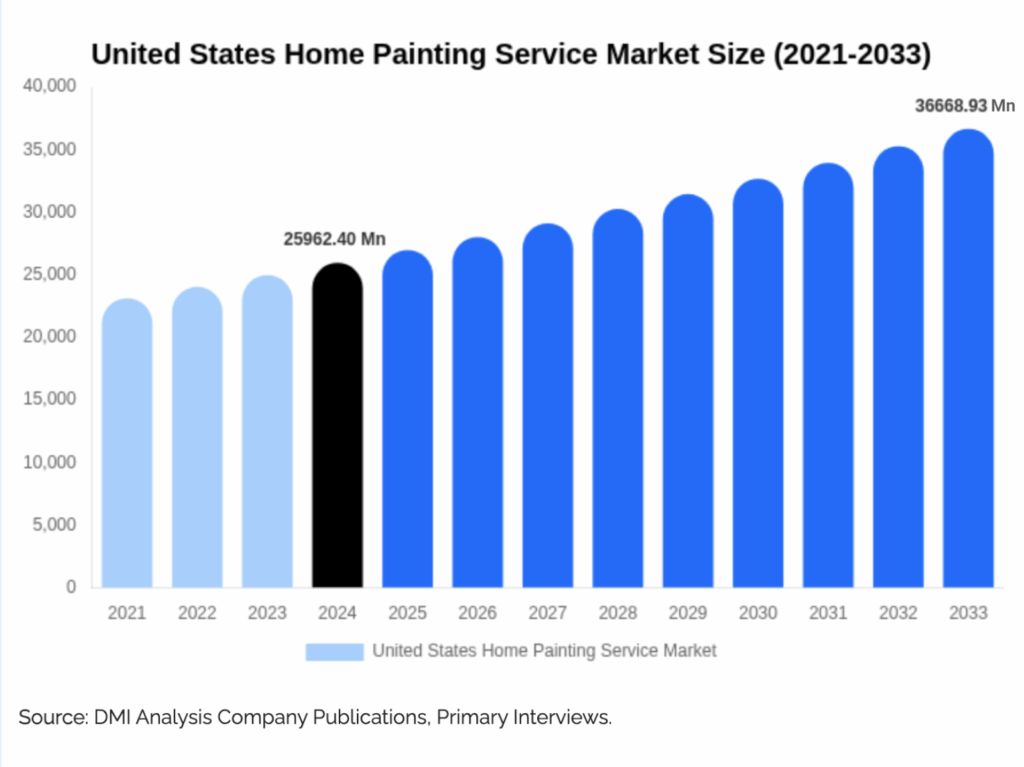
This growth favors small, local operators who focus on repeat-demand services rather than large-scale or specialty projects.
PrimeCoat Painting benefits from this trend by operating in a stable segment of the market where demand grows from:
- Housing stock
- Turnover
- Routine maintenance
Local Market Insights
Raleigh has good business prospects for a small painting company that specializes in conventional repaint jobs. This is what motivates the Raleigh painting market demand:
1) Large homes: Raleigh homes average over 2,140 sq ft, larger than the national average, which increases paintable surface area and raises per-job value, especially for exterior work.
2) Higher exterior repaint pricing: Exterior painting projects average around $3,000 to $8,500 per home, which is higher than typical ranges, supporting solid job revenue without premium pricing.
3) Strong renovation cycles: In the Raleigh climate, repainting follows clear, material-based timelines across common home surfaces, as outlined below.
| Home Type/Surface | Typical Repaint Cycle |
|---|---|
| Wood siding | Every 3–5 years |
| Fiber cement siding | Every 7–10 years |
| Painted brick | Every 12–15 years (touch-ups at 5–7 years) |
| Stucco | Every 5–7 years |
| Trim (wood) | Every 4–5 years |
4) Ongoing residential and commercial growth: New housing and mixed-use development in Raleigh, Cary, and surrounding suburbs continues to add properties that require initial and repeat repainting.
5) Skilled labor shortage: Painters in the Raleigh metro area earn approximately $17.86 per hour, indicating strong demand for skilled labor and service gaps that reliable owner-operators can fill.
These conditions support steady, repeat demand for standard repaint services, creating a clear opportunity for PrimeCoat Painting’s focused, owner-managed model.
Stop searching the internet for industry & market data
Get AI to bring curated insights to your workspace

Target Customer Segment
PrimeCoat Painting targets customers who need reliable, standard repaint services and value clear pricing. We target the following customers:
| Segment | What they buy | What they care about most | Best-fit PrimeCoat services |
|---|---|---|---|
| Homeowners | Single-room to multi-room repainting | Clean work, clear timeline, accurate quote | Interior repainting |
| Landlords | Turnover repaints and refreshes | Speed, consistency, cost control | Interior repaints, trim, touch-ups, fast resets |
| Property managers | Ongoing maintenance repaints across units | Reliable scheduling, repeatable results | Unit turns, common areas, recurring repaint needs |
| Small office and retail tenants | Small refresh projects | Minimal disruption, simple scope | After-hours or low-impact repaints, small commercial jobs |
Competitor Analysis
The Raleigh painting market is active and fragmented, with customers choosing between large contractors, low-cost independents, and general service providers. Each competitor type serves the same market with different trade-offs in price, quality, and reliability.
Direct Competitor Analysis
These competitors directly serve homeowners, landlords, and small businesses in the Raleigh area seeking repaint work.
- CertaPro Painters of Raleigh is a nationally recognized painting company with a strong local presence and multiple crews serving various clients in the area. The company represents big residential and commercial projects effectively, but tends to impose higher prices and set up minimum project costs, which don’t accommodate small repaint and maintenance jobs.
- Five Star Painting of Raleigh is a franchise-based painting company that takes residential and light commercial works. It generally charges more and has lower flexibility in small or short turn repaint work.
- Local Independent Budget Painters are those who are single painters and have a small crew that operates all over Raleigh. These operators are able to offer low prices and prompt availability to customers, but in many cases, they fail to maintain quality and schedules and lack clear communication with the customer, thus resulting in customer frustration.
Indirect Competitors
These competitors offer painting services as a secondary or bundled offering.
- Mr. Handyman of Raleigh offers painting as part of a broader home repair service mix. The company provides convenience for small jobs but does not specialize in painting, which often results in lower finish quality and slower completion for repaint projects.
- Ace Handyman Services Triangle focuses on general home maintenance and minor repairs, with painting offered as a secondary service. This model suits small touch-ups but lacks the skill depth and efficiency needed for full interior or exterior repaints.
- Property Management Maintenance Crews handle basic painting tasks within rental portfolios, mainly between tenant turnovers. These teams prioritize speed and cost control over finish quality and rarely take on full repaint projects.
Differentiation
PrimeCoat Painting positions itself between premium contractors and budget operators.
Key points of differentiation:
- Focus on standard repaint work only
- Clear scope and accurate estimates
- Reliable scheduling and follow-through
- Owner-managed execution and quality control
- Fair mid-market pricing
Such positioning allows PrimeCoat Painting to serve customers who want dependable results without premium pricing or service risk.
Operational Plan
PrimeCoat Painting operates on standard weekday hours to maintain predictable scheduling and consistent job execution. Saturday work is used only when needed to complete projects or accommodate customer availability.
| Days | Working Hours |
|---|---|
| Monday to Friday | 8:00 AM – 5:00 PM |
| Saturday | By appointment only |
| Sunday | Closed |
Our Process
The process of our project starts when a customer makes a request by phone, DM, or referral. Andrew organizes a visit to the site within 48 hours to look at the space physically.
In the visit, he measures and evaluates surface conditions, which usually occupy 30 minutes to an hour. This is followed by a written estimate that is submitted within a day or 48 hours. All the estimates are valid within 30 days.
Before the work began:
- 20% deposit collected to confirm the project
- Start date scheduled with a 1–3 week lead time
- Schedule confirmed 48 hours before start
- Materials purchased and staged one day prior
During the project, Andrew arrives daily between 8:00 and 8:30 AM. Furniture is moved and protected at the start of each job, followed by surface preparation and painting.
The work area is cleaned at the end of each day to maintain a usable space. On the final day, Andrew completes a walkthrough with the customer and addresses any required touch-ups before closing the job.
After work completion:
- Final walkthrough conducted to confirm satisfaction
- Furniture returned to its original position
- Leftover paint labeled and provided to the customer
- Invoice submitted after customer approval
- Final payment due within 7 days
- Follow-up call made 2 weeks after completion
Staffing Plan
PrimeCoat Painting will follow a lean staffing model designed for an owner-operated trade business. The goal is to control labor costs while maintaining flexibility during busy periods.
The business avoids fixed payroll and adds labor only when job volume exceeds the owner’s capacity. The business operates with one full-time owner-operator and no permanent employees.
- Andrew Collins manages all estimating, painting, scheduling, and quality control
- Additional labor is added only when required
- All hired labor works on an hourly, per-job basis
This structure keeps fixed labor costs low and aligns labor expenses directly with revenue. Andrew Collins will not take a salary for the first 2 years. The labor wages will be $20–$25, depending on the workload.
Inventory Management
Inventory at PrimeCoat Painting is kept basic and managed. The business doesn’t carry high quantities of paint products and materials. It only purchases supplies upon the confirmation of jobs.
The paint and materials are bought from the local paint shops and building supply outlets. This will guarantee fast accessibility, uniform quality, and convenient returns in case of necessity. Local suppliers also offer better color matching and support after-sales services.
The company maintains a minimal inventory of standard products such as brushes, rollers, tape, and drop cloths. The storage unit is rented to store the tools and materials to be able to remain organized and job-ready.
This approach reduces waste, lowers cash tied up in inventory, and prevents overbuying. It also enables the business to adapt to change quickly in accordance with job demands and client preferences.
Insurance and Compliance
PrimeCoat Painting has the necessary insurance coverage and bare minimal compliance measures to safeguard the customers, the owner, and the business. The company has a policy of general liability insurance in place to cover damages to properties and job-related incidents. The work van used on a daily basis is covered with vehicle insurance.
The company also fulfills all the necessary local and state registrations, such as business licensing and tax returns. The safety measures are in accordance with the standard painting industry practice, such as wearing protective equipment and utilizing materials properly.
By maintaining insurance and compliance from day one, PrimeCoat Painting reduces risk, builds customer trust, and meets lender and landlord requirements.
Don’t spend weeks on your first draft
Complete your business plan in less than an hour
Marketing Plan
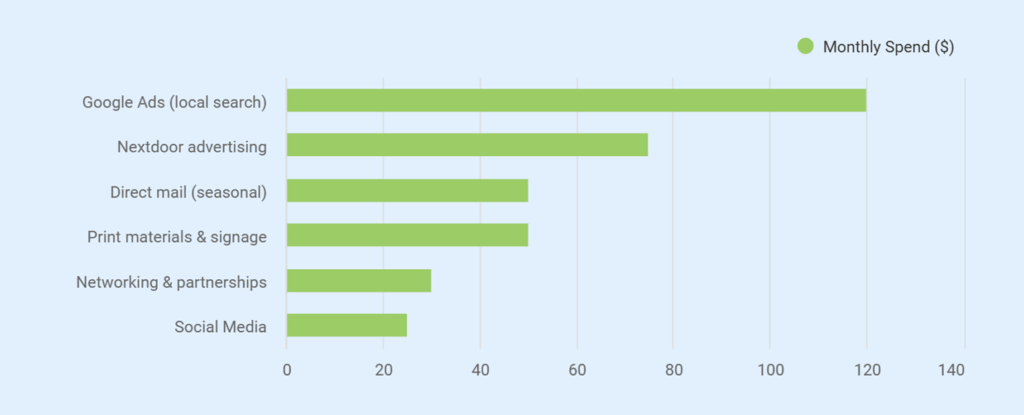
PrimeCoat allocates $350 per month to marketing activities, totaling $4,200 annually. This budget remains flat across all three years, reflecting a disciplined approach to customer acquisition focused on efficiency rather than aggressive growth.
| Channel | Monthly Spend | Purpose |
|---|---|---|
| Google Ads (local search) | $120 | Capture active searchers |
| Google Business Profile | $0 | Free local visibility |
| Nextdoor advertising | $75 | Neighborhood targeting |
| Direct mail (seasonal) | $50 | Targeted homeowner outreach |
| Print materials & signage | $50 | Business cards, yard signs |
| Networking & partnerships | $30 | Property manager relationships |
| Social media | $25 | Before/after photos, painting process, client testimonials |
| Total | $350 |
Customer Reviews and Referrals
The strategy of lead generation by PrimeCoat Painting is primarily through customer reviews and referrals. Painting involves trust-based service, and the majority of customers base their contact with a contractor on previous customer reviews. Positive reviews lower the buying hesitations as well as shorten the decision-making process.
The owner seeks a review of the customers’ satisfaction after each job that he does. The emphasis is on the Google reviews since they directly affect the local searchability and consumer trust. Regular review activity enhances credibility and can make the business look more credible than other competitors that are not reviewed or have a low rating.
Customers who are repeaters and referrals are given priority over the one-time promotional offers. This will reduce the cost of attracting customers and will appeal to current customers who cherish the quality of services. Good reviews boost close rates without needing low prices, which safeguard margins and maintain consistent employment.
Property Managers and Landlords
PrimeCoat Painting targets property managers and landlords through direct outreach because they generate repeat repaint demand. These customers require regular interior repainting between tenants and value reliability, speed, and clear pricing over decorative finishes.
The business focuses on:
- Local property managers
- Small landlord portfolios
- Real estate agents
- Real estate managers
These relationships lead to recurring work with a defined scope and faster approval cycles.
By serving the same properties over time, PrimeCoat Painting reduces estimating time, improves scheduling efficiency, and maintains steady interior repaint volume with lower marketing costs.
Launch Promotion
PrimeCoat Painting starts with a clear and limited launch offer. The first 100 customers receive a membership discount that includes 10% off labor on their first job and preferred pricing on future services. This offer is time- and quantity-limited to create early demand while keeping pricing controlled. Customers know exactly what they are getting, with no hidden conditions.
Customers are invited to leave a Google review after every job. Customers who leave a review or refer a new paying customer receive a service credit toward future work. Property managers and landlords are offered consistent pricing and priority scheduling instead of one-time discounts. Such a strategy assists PrimeCoat Painting in creating trust, creating repeat business, and rising through referrals instead of excessive advertising and huge discounts.
Investors hate amateur writing errors
Instantly improve your plan w/ our AI writing assistant

Financial Plan
The financial plan indicates a conservative, owner-operator, painting business with normal market conditions. It is projected that there will be uneven monthly revenues, seasonal demand, and realistic limits of execution. The strategy does not take into consideration aggressive growth, price rise, or expansion of margins. Every character is obsessed with cash security, expenditure, and sustainability rather than short-term profits.
Funding Source
| Source | Amount (USD) |
|---|---|
| Truist Bank term loan | $28,000 |
| Owner cash contribution | $7,000 |
| Total Sources | $35,000 |
Income Statement
| Line Item | Year 1 | Year 2 | Year 3 |
|---|---|---|---|
| Revenue | |||
| Interior residential repaint jobs | $60,000 | $72,000 | $80,000 |
| Exterior residential repaint jobs | $42,000 | $52,000 | $62,000 |
| Small commercial repaint jobs | $6,000 | $8,000 | $10,000 |
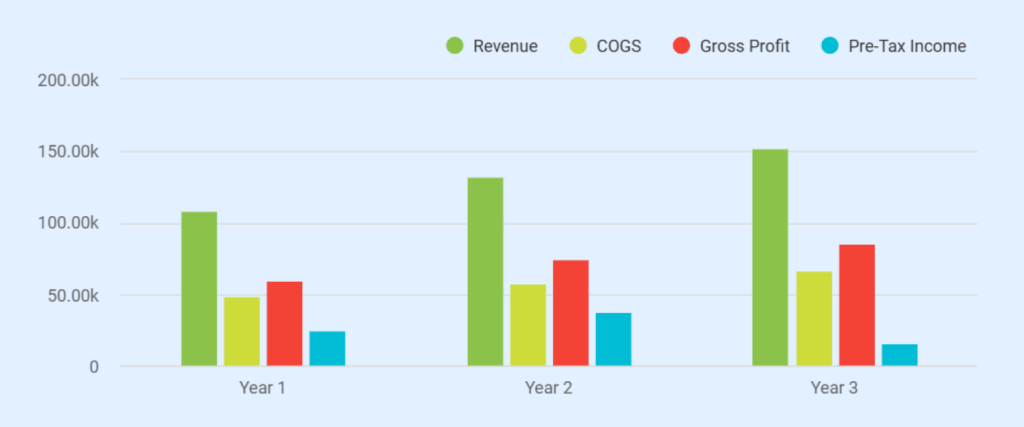
| Total Revenue | $108,000 | $132,000 | $152,000 |
| Cost of Goods Sold (COGS) | |||
| Paint and materials | $20,000 | $23,500 | $27,000 |
| Helper labor (hourly, per-job) | $22,000 | $26,500 | $31,000 |
| Disposal and job-specific rentals | $6,500 | $7,500 | $8,500 |
| Total COGS | $48,500 | $57,500 | $66,500 |
| Gross Profit | $59,500 | $74,500 | $85,500 |
| Gross Margin | 55% | 56% | 56% |
| Operating Expenses (OPEX) | |||
| Vehicle fuel and insurance | $9,000 | $9,600 | $10,200 |
| Storage unit rent | $3,600 | $3,600 | $3,600 |
| Insurance allocation | $2,640 | $2,800 | $2,960 |
| Phone and software | $1,080 | $1,140 | $1,200 |
| Marketing | $4,200 | $4,200 | $4,200 |
| Equipment maintenance | $2,000 | $2,600 | $3,200 |
| Admin and compliance misc. | $1,800 | $2,200 | $2,600 |
| Owner salary | $0 | $0 | $30,000 |
| Total OPEX (before drag) | $24,320 | $26,140 | $57,960 |
| Operational Drag (4% of revenue) | $4,320 | $5,280 | $6,080 |
| EBITDA | $30,860 | $43,080 | $21,460 |
| Depreciation (vehicle + equipment) | $3,800 | $3,800 | $3,800 |
| Operating Income (EBIT) | $27,060 | $39,280 | $17,660 |
| Interest expense | $2,100 | $1,750 | $1,350 |
| Pre-Tax Income | $24,960 | $37,530 | $16,310 |
Cash Flow Statement
| Line Item | Year 1 | Year 2 | Year 3 |
|---|---|---|---|
| Cash Flow from Operating Activities | |||
| Pre-tax income | $24,960 | $37,530 | $16,310 |
| Add: Depreciation (non-cash) | $3,800 | $3,800 | $3,800 |
| Change in working capital | ($4,500) | ($3,000) | ($2,000) |
| Net Cash from Operations | $24,260 | $38,330 | $18,110 |
| Cash Flow from Investing Activities | |||
| Capital expenditures | $0 | $0 | ($4,000) |
| Net Cash from Investing | $0 | $0 | ($4,000) |
| Cash Flow from Financing Activities | |||
| Loan principal repayment | ($6,600) | ($6,600) | ($6,600) |
| Owner contributions | 0 | 0 | 0 |
| Owner distributions | ($8,000) | ($18,000) | ($6,000) |
| Net Cash from Financing | ($14,600) | ($24,600) | ($12,600) |
| Net Change in Cash | $9,660 | $13,730 | $1,510 |
| Beginning cash balance | $0 | $9,660 | $23,390 |
| Ending Cash Balance | $9,660 | $23,390 | $24,900 |
Balance Sheet
- Startup is funded with $35,000 total: $28,000 Truist Bank term loan plus $7,000 owner cash contribution.
- Startup spending is allocated primarily to the work vehicle ($12,000), equipment and tools ($7,800), and an initial materials buffer ($5,200).
- Additional launch costs include safety gear, permits, insurance premiums, storage setup, and initial marketing, totaling $8,600 and expensed immediately at launch.
- Revenue is modeled conservatively at $108,000 in Year 1, growing to $132,000 in Year 2 and $152,000 in Year 3 through higher completed job volume only.
- Gross margin is held flat at approximately 55–56%, with no assumed pricing power or efficiency gains.
- Operating overhead is modest and includes vehicle fuel/insurance, storage rent, software, marketing, maintenance, and compliance costs.
- A mandatory operational drag equal to 4% of revenue is included to reflect typical trade-business overruns and inefficiencies.
- The owner does not take a salary in Years 1–2 and begins a $30,000 salary in Year 3 as the business stabilizes.
- Cash flow remains uneven, with working capital consumption modeled explicitly and excess cash used for debt service, owner draws, and a minor equipment refresh in Year 3.
- The Truist loan amortizes steadily with straight-line principal repayment of $6,600 per year and declining interest expense over time.
| Line Item | Opening (Y0) | Year 1 | Year 2 | Year 3 |
|---|---|---|---|---|
| Assets | ||||
| Cash | $0 | $9,660 | $23,390 | $24,900 |
| Working capital (materials buffer) | $5,200 | $6,100 | $9,100 | $11,100 |
| Total Current Assets | $5,200 | $15,760 | $32,490 | $36,000 |
| Vehicle (gross) | $12,000 | $12,000 | $12,000 | $12,000 |
| Equipment & tools (gross) | $7,800 | $7,800 | $7,800 | $11,800 |
| Accumulated depreciation | $0 | ($3,800) | ($7,600) | ($11,400) |
| Net Fixed Assets | $19,800 | $16,000 | $12,200 | $12,400 |
| Total Assets | $35,000 | $31,760 | $44,690 | $48,400 |
| Liabilities | ||||
| Loan payable (Truist Bank) | $28,000 | $21,400 | $14,800 | $8,200 |
| Accrued expenses & payables | $0 | $2,000 | $3,200 | $4,200 |
| Total Liabilities | $28,000 | $23,400 | $18,000 | $12,400 |
| Equity | ||||
| Owner capital contribution | $7,000 | $7,000 | $7,000 | $7,000 |
| Retained earnings | $0 | $1,360 | $19,690 | $29,000 |
| Total Equity | $7,000 | $8,360 | $26,690 | $36,000 |
Don’t waste time using spreadsheets
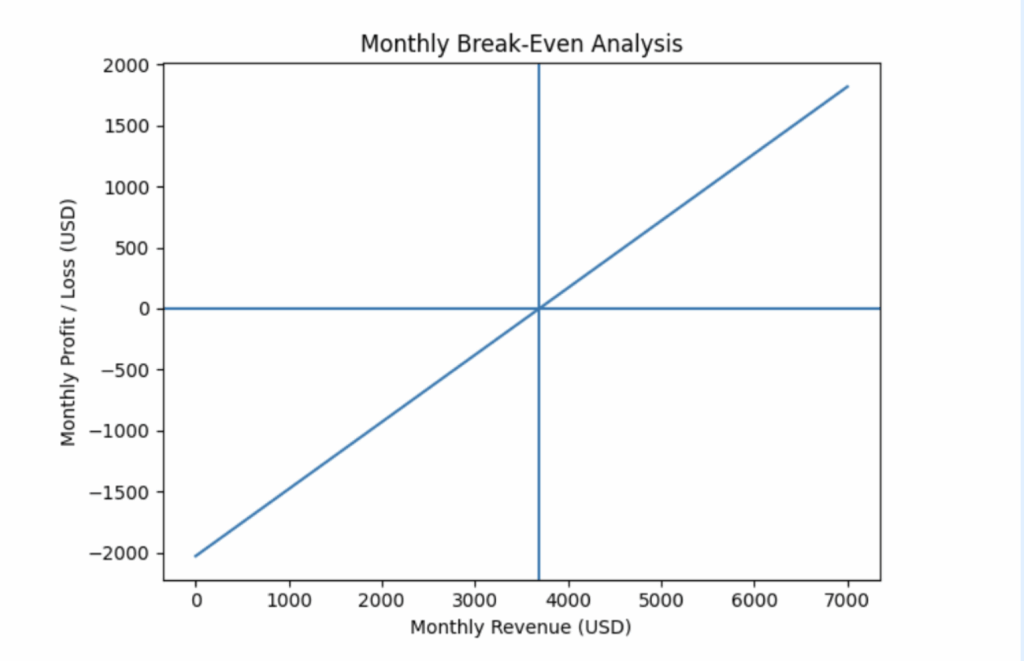
Break-Even Analysis
| Item | Monthly Amount |
|---|---|
| Fixed operating expenses (OPEX, excl. owner salary) | $2,030 |
| Marketing (included above, shown for clarity) | $350 |
| Vehicle fuel & insurance | $750 |
| Storage unit | $300 |
| Phone & software | $90 |
| Insurance allocation | $220 |
| Admin & compliance misc. | $150 |
| Equipment maintenance (baseline) | $170 |
| Total Fixed Monthly Costs (Year 1–2) | $2,030 |
Loan Repayment Plan
PrimeCoat Painting will repay the startup loan through steady monthly payments funded by operating cash flow. The business secured a $28,000 term loan from Truist Bank with a 5-year term at an estimated 7.5% interest rate.
The repayment plan prioritizes consistency and avoids refinancing or additional borrowing. Principal reduces evenly over time, while interest expense declines as the balance amortizes.
| Item | Year 1 | Year 2 | Year 3 | Year 4 | Year 5 |
|---|---|---|---|---|---|
| Beginning balance | $28,000 | $21,400 | $14,800 | $8,200 | $1,600 |
| Principal repaid | $6,600 | $6,600 | $6,600 | $6,600 | $1,600 |
| Interest paid | $2,100 | $1,750 | $1,350 | $750 | $150 |
| Total debt service | $8,700 | $8,350 | $7,950 | $7,350 | $1,750 |
| Ending balance | $21,400 | $14,800 | $8,200 | $1,600 | $0 |
This repayment structure steadily reduces debt exposure each year and fully retires the loan by the end of Year 5. The approach strengthens cash discipline, improves balance sheet health, and lowers financial risk as the business matures.
Spreadsheets are exhausting & time-consuming
Build accurate financial projections w/ AI-assisted features