




You might already know exactly how your recycling business will run. You know where you’ll collect plastic, how you’ll process it, and who you’ll sell to.
But knowing your business and writing a plan that convinces someone to fund it are two different things.
Lenders look for clear proof. They want to see feedstock reliability, realistic margins, equipment costs that match your loan ask, and financials that make sense. Putting all of that together in the right order and clear language is not always easy, especially for first-time business owners.
That’s exactly what this sample plan for GreenCycle Waste Solutions is here for. It’s a complete example you can read through, learn from, and use to build your own lender-ready plan from the ground up.
Recycling Business Plan Sample (GreenCycle Waste Solutions)
Executive Summary
Plastic use in everyday life keeps growing, and so does the pressure to recycle it properly. The problem is that large national waste companies tend to go after high-volume contracts only, while small-scale recyclers are set up mainly for individual households. There is no dedicated plastic-only recycling option built around the small and mid-sized local businesses’ needs.
GreenCycle Waste Solutions is built specifically for that gap. Operating out of Austin, Texas, the company provides plastic collection and processing services to local businesses, residential communities, and municipal programs at a mid-scale level that actually makes sense for these clients.
Because GreenCycle focuses on localized collection routes, fuel and operating costs stay lower, and mid-volume clients get the flexible services that bigger companies simply don’t offer them.
The business is run by co-owners Daniel Collins and Sarah Davis. Daniel handles operations, logistics, and facility management. Sarah takes care of finance, administration, and business development. Between the two of them, the operations and services are well covered.
The following are the core services and products offered:
- Regular plastic waste pickup from neighborhood residents, local businesses, and select municipal programs
- Processing collected plastic waste into reusable 2–5mm raw, pre-production plastic pellets
- Selling those pellets to local manufacturers for use in packaging, containers, consumer goods, and other plastic products
The Austin market consistently generates recyclable plastic waste and needs a dependable waste collection service. Around GreenCycle’s facility, there’s a dense mix of restaurants, retail stores, warehouses, manufacturing units, and apartment communities, all producing plastic waste daily. That concentration of sources creates a reliable, ongoing demand for what GreenCycle does.
Financial Outlook
To get GreenCycle fully operational, we require $350,000. From that, $250,000 is being requested from Wells Fargo Bank at an 8.25% interest rate, repaid over 5 years. Daniel and Sarah are contributing the remaining $100,000 from personal funds.
The business revenue comes from two main sources: selling recycled plastic pellets and charging fees for plastic collection. Below are the projections for the first three years.
| Revenue Source | Year 1 | Year 2 | Year 3 |
| Sales of Recycled Pellets | $135,200 | $374,010 | $443,040 |
| Collection Service Fees | $19,200 | $50,400 | $57,600 |
| Tipping Fees | $4,000 | $10,500 | $12,000 |
| Total Revenue | $158,400 | $434,910 | $512,640 |
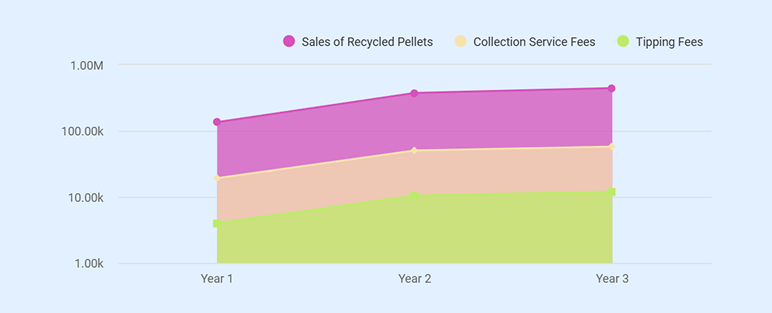
GreenCycle expects to reach break-even as operations grow and customer volume increases. With steady expansion of service contracts and improved route efficiency, the business is projected to achieve full break-even during Year 2 as operations stabilize and production capacity is better utilized.
Business Overview
GreenCycle is located at 1122 Industrial Parkway in Austin, Texas, 78744, USA. It’s registered as a Limited Liability Company (LLC), which separates the owners’ personal assets from company liabilities.
Our business operates from a 1,500 square foot warehouse space that is set up for small-scale plastic recycling operations. The space is arranged in a simple yet efficient manner. It includes separate areas for sorting, cleaning, shredding, pelletizing, storage of raw plastic, storage of finished pellets, and an area for loading & unloading the truck.
There is also a secure outdoor parking space where the truck is kept safe when it is not on collection routes.
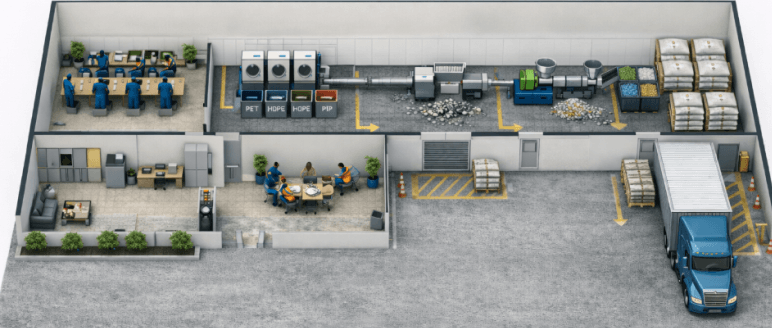
(Sorting Area → Cleaning Area → Shredding Area → Pelletizing Area → Storage Area → Employee Common Area → Truck Space for Loading and Unloading)
The 1,500 sq ft facility is sufficient for the projected processing volume during the first two years. It allows the team to handle materials safely and efficiently without needing immediate expansion.
GreenCycle serves clients within a 20-mile radius of the facility. Keeping operations local cuts down on fuel costs and lets us maintain dependable pickup schedules for contracted customers.
The property runs on a 3-year commercial lease with renewal options. This gives the business a stable foundation in its early stages while leaving room to scale up and move to a larger space down the road if needed.
Ownership Structure
Daniel Collins – Owner (60% of contribution in funds)
- Role: Operations & Collection Lead
- Experience: Daniel brings 8 years in waste management to the company, including 5 years running waste collection trucks firsthand. That background gives him everything needed to handle the day-to-day running of GreenCycle.
- Responsibilities: Daniel oversees the sorting and processing activities and makes other important decisions related to the operations of GreenCycle. He ensures equipment is properly maintained and monitors daily production. He also supervises staff workflow and makes sure operations comply with safety and environmental regulations.
Sarah Davis – Owner (40% of contribution in funds)
- Role: Administration & Business Development Lead
- Experience: Sarah has 6 years of experience in business administration management, customer service, and vendor relations.
- Responsibilities: Sarah takes care of customer relations, finances, compliance, and vendor management.
Both founders have personal guarantees for the loan and are actively involved in the day-to-day operations of the company.
Business Model
We provide regular plastic waste pickup for residential areas, local businesses, and local municipal programs. This plastic waste is then converted into reusable 2 to 5mm raw plastic pellets. And the material is then sold to local manufacturers to make packaging materials such as containers and other plastic products.
GreenCycle generates revenue through three primary streams, as outlined below:
| Revenue Stream | % of Total Revenue | Payment Terms | Description |
| Pellet Sales | ~80% | Net-30 | Sale of recycled plastic pellets to local manufacturers |
| Collection Service Fees | ~15% | Monthly / Net-15 | Scheduled pickup services for businesses and municipalities |
| Processing / Tipping Fees | ~5% | Upfront | Per-ton fee for customers delivering plastic waste to the facility |
Waste volume may increase during retail-heavy seasons, such as holidays, when packaging use rises. However, long-term service agreements with commercial clients help maintain a consistent baseline monthly volume throughout the year.
Approximately 20–25% of collected material may be contaminated or non-recyclable. This portion is separated during sorting and transported to approved disposal facilities. Disposal costs are included in the company’s operating expenses and factored into pricing.
This structure creates balanced cash flow by combining recurring service revenue with higher-margin product sales.
Future Goals
GreenCycle has some business goals to expand the business and make the community more sustainable in the 1122 Industrial Parkway region of Austin. Our goals include:
- We are committed to stepping up the recycling rate of plastic waste. We are targeting a 30% increase in the second year and a 20% increase in the third year.
- We aim to reduce contamination by 15% of the plastic waste we collect. This will let us improve the quality of our recycled pellets.
- We’re planning to share the right knowledge with residents, companies, and officials through different methods and organized learning sessions to lower plastic pollution.
- We’ll establish market presence by securing the first 25 contracted customers within 2–3 concentrated geographic zones through direct outreach and relationship building.
- Our long term goal is to reach 100 contracted customers by expanding into nearby service zones and targeting mid-sized commercial clients to increase volume and operational efficiency.
Market Analysis
Texas is known to produce a high amount of waste, so the need to improve the recycling services in the state is increasing. According to the Texas Commission on Environmental Quality, approximately 38.32 million tons of waste were disposed of in the state in 2021. This is equivalent to 7.09 pounds of waste per person every day.
A big portion of this trash consists of plastic that could be recycled rather than being thrown into a landfill. This indicates that Texas still has a need for plastic recycling facilities and provides a good business opportunity for local businesses like GreenCycle.
Local Market Overview
In 2026, Austin is home to roughly 1,007,435 people, ranking highest among rapidly expanding American cities.
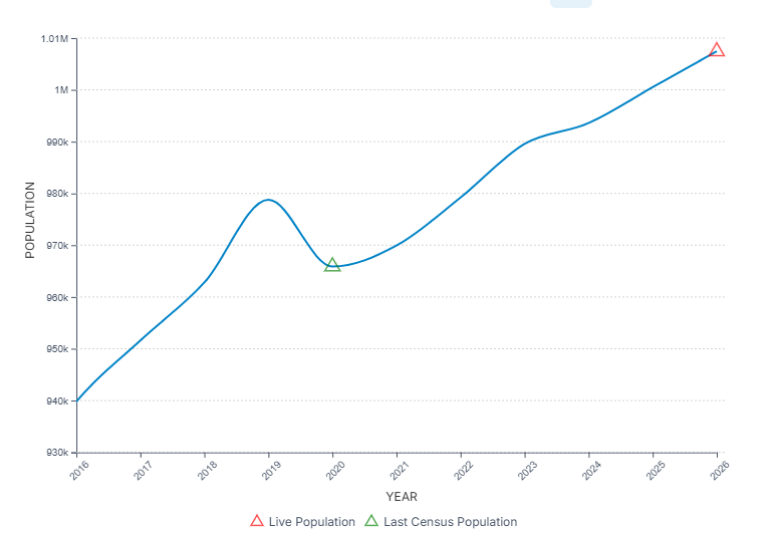
Population growth, along with strong commercial activity in technology, retail, hospitality, and manufacturing, contributes to consistent packaging and post-consumer plastic waste generation.
During 2024’s financial cycle, Austin Resource Recovery (ARR) reported hauling 52,924 tons of recyclable materials. This covers every category found in local bins. If plastics account for even 12–15% of this volume, the city may generate approximately 6,000 to 8,000 tons of recyclable plastic annually through formal collection channels alone.
Additionally, Austin hosts thousands of commercial establishments across key sectors such as tech, retail, services, and manufacturing, contributing to a robust local economy.
Commercial clients often generate cleaner and more consistent plastic waste streams than residential curbside programs. GreenCycle can achieve its required annual tonnage by securing long-term service agreements with a small percentage of these businesses.
And most importantly, improvements in polypropylene recovery at Austin-area sorting facilities have resulted in capture rates exceeding 30 tons per month in early 2025. This confirms that recoverable plastic streams are actively circulating within the region and that secondary processors can access consistent supply channels.
Target Clients
GreenCycle’s focus is on waste generators that produce plastic in steady, measurable volumes, not on individual households as the primary revenue base.
Local Municipalities
Municipalities are a natural fit. They move large amounts of plastic through public recycling programs and need dependable processing partners to keep those systems running.
Commercial Businesses
(1) Restaurants: There are approximately 4,669 restaurants in Austin. All of these restaurants produce a decent amount of plastic waste through food containers, packaging, and one-time-use materials.
(2) Manufacturing Plants: There are more than 1,600 manufacturing plants in Austin. All of these plants produce a large amount of plastic waste from packaging materials, pallet wrap, and rejected plastic components.
(3) Retail & Distribution Facilities: Austin has a large number of retail stores, grocery chains, and warehouses. These businesses generate plastic waste, such as packaging materials, shrink wrap, and containers.
(4) Multi-Unit Properties: Austin has many complexes and property management companies. These properties often have high turnover of plastic packaging, bottles, and disposable items used by residents.
Residents
Residential service is available. But it’s strategically limited to neighborhoods and residents within a 20-mile service radius. This ensures route efficiency and prevents low-margin, scattered pickups that increase fuel and labor costs.
Competitive Landscape
GreenCycle faces competition from both large and small recycling companies in Austin.
| Competitor | Type | Strengths | Weaknesses |
|---|---|---|---|
| Circular Services | Large MRF (Material Recovery Facility), high-volume processing | Strong infrastructure for high-volume recycling | Focuses on big city contracts; limited service for small businesses |
| Scrap Management Inc. | Industrial bulk plastic recycler | Focus on industrial sources, large material quantities | Works mainly with big factories; less support for local clients |
| Republic Services | National waste management company | Large-scale infrastructure, broad service network | Higher prices and less flexible service for small businesses |
| Waste Management Inc. | National waste management company | Extensive network and broad service offerings | Mixed recycling lowers plastic quality; slower service changes |
| West Polymer LLC | Local polymer recycler | Specialized in specific plastic types, local focus | Limited pickup services and a smaller service area |
Market Positioning
GreenCycle positions itself as a locally focused plastic recycling partner. It mainly serves small to mid-sized businesses in Austin that are often underserved by large national waste companies.
Custom Service for Local Clients
GreenCycle is not a large corporate entity like National Waste Management or Republic Services. But it’s a small-scale operator with enough facility space.
We focus on mid-sized commercial clients and multi-unit properties. The company offers scheduled pickups, defined service routes within a 20-mile radius, and contract-based agreements tailored to client volume levels.
This localized approach allows for faster response times, consistent scheduling, and more personalized service.
Specialized Plastic Recycling
Many recycling companies focus on various types of recyclables such as paper, cloth, metals, etc. However, at GreenCycle, we recycle only plastics from different categories, such as PET, HDPE, PVC, etc. This specialization allows:
- Better sorting efficiency
- Improved contamination control
- More consistent pellet quality
- Stronger relationships with plastic-focused manufacturers
Services & Product Offerings
GreenCycle Waste Solutions offers a variety of recycling services to help local businesses, government programs, and residents manage plastic waste easily and efficiently.
The following are our core waste collection services:
Residential Plastic Waste Collection
We offer plastic waste collection services for residential homes in Austin. The service includes regular pick-ups from the curb for recycling plastic waste such as bottles, containers, and packaging.
Pricing: $15 per month for regular pick-up
Commercial Plastic Recycling
GreenCycle uses a collaborative method to handle plastic waste collection from local restaurants and small retail businesses. We offer flexible services that suit the needs of different businesses, whether scheduled waste pickups or occasional removals, with pricing aligned to current market levels.
Pricing: $150 per ton for plastic waste collection
(Additional fees apply for special collections, like unscheduled pickups, depending on volume)
Collection Service for Large Waste Generators
For businesses or organizations that produce large amounts of plastic waste, we offer drop-off and collection services. This helps manufacturers, municipal programs, or large retailers manage their plastic waste more efficiently.
Pricing: $130 per ton for plastic waste collection
Product Offering
After collecting the plastic waste, we produce recycled plastic pellets. These pellets are then sold to companies that use them for packaging materials, plastic containers, bottles, consumer goods, industrial plastic components, etc.
Here is the range of pellet products we offer:
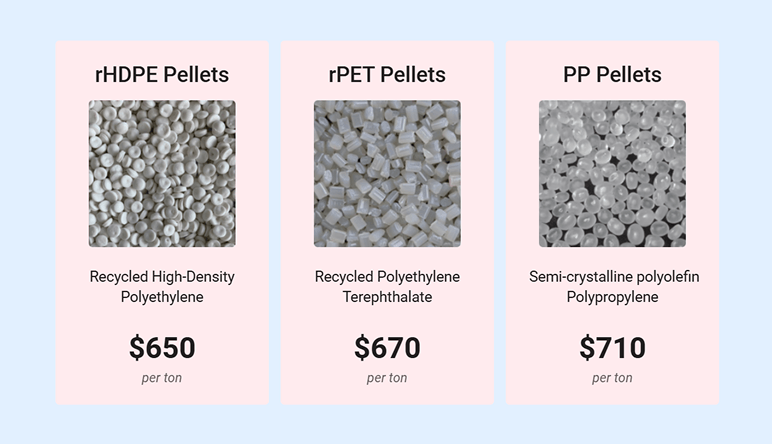
The price of our plastic pellets varies depending on the quality of the recycled plastic. Pellets made from industrial plastic waste are usually priced higher because they are cleaner and have less contamination than post-consumer plastic.
We keep contamination at low levels to meet buyer requirements. Pricing also varies based on the melt flow index, which affects how the plastic performs during manufacturing. The pellets are packed in bulk bags or palletized bags, depending on customer preference.
Operational Plan
We operate our business Monday to Friday, from 7:00 AM to 5:00 PM. This schedule ensures regular commercial pickups, material processing, and production.
While regular operations run on weekdays, limited weekend pickups are available for emergency or overflow situations, particularly for high-volume commercial clients. Emergency services may include additional collection fees.
Processing Capacity
Our facility is designed to handle around 3-4 tons of plastic materials every day. At full steady plant utilization, this equates to 70–80 tons per month. This is expected to increase gradually over the first year of operations, with the increase in customer contracts.
After sorting and contamination removal, the expected usable yield is approximately 65–75%, depending on material quality. This production level helps fulfill projected sales targets without requiring additional shifts.
Waste Collection Management
GreenCycle uses optimized scheduling to manage waste collection efficiently. We plan our truck routes to reduce fuel costs and increase overall pickup efficiency. By organizing pickups into specific routes based on location, we minimize travel time and fuel usage per ton collected. This helps reduce operating costs and ensures that we can offer affordable recycling services to businesses and residents.
Daily Workflow
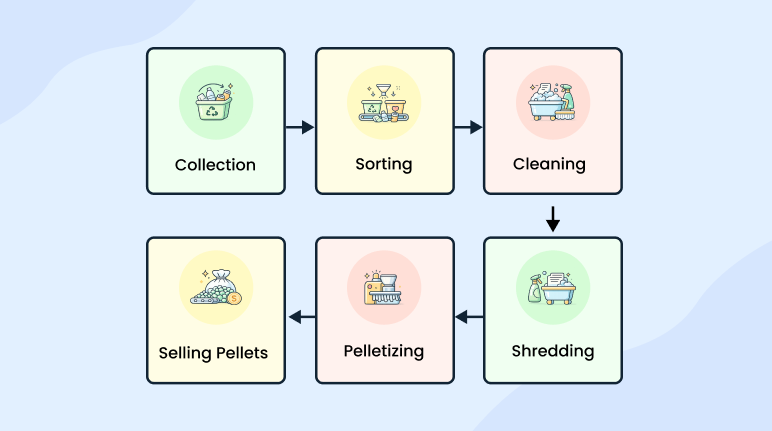
GreenCycle follows a simple and efficient workflow to manage plastic waste from collection through to pellet production and sale:
Collection
Plastic waste is collected from contracted commercial clients, municipalities, and selected multi-unit residential properties. This is done through scheduled pickups for local businesses and unscheduled pickups for larger clients with significant waste volumes.
Sorting
This area is provided to separate the collected materials by resin type, including PET, HDPE, PP, and PVC. Non-recyclable and contaminated materials (estimated 20–25%) are removed and transported to approved disposal facilities.
Cleaning
After sorting, the plastic is moved to the washing area. In this step, the material is cleaned using industrial washing systems. These machines remove dirt, food residue, labels, glue, and other impurities attached to the plastic.
Shredding
After cleaning, the plastic is fed into shredding machines. These machines cut the plastic into small, uniform pieces. Smaller pieces are easier to handle and process. This step prepares the material for melting and converting it into recycled pellets.
Pelletizing
In this stage, the shredded plastic is fed into the pelletizing machine. The machine melts the plastic and shapes it into small, uniform pellets. The pellets are then cooled and hardened. After cooling, they are packed and stored safely until they are ready to be sold to manufacturers.
Selling Pellets
The final product, recycled plastic pellets, is sold to regional manufacturers. These manufacturers use the pellets as raw material to produce packaging materials, plastic containers, household products, and automotive components.
Quality Control
In order to maintain the quality of the pellets, we implement the following controls:
- Monitoring contamination levels during sorting
- Testing the melt flow index (MFI) according to buyer requirements
- Batch-based tracking by resin type and production date
- Final inspection before packaging
Inventory & Storage Management
Finished pellets are packaged in labeled bulk bags (super sacks) and stored in the warehouse zones. Inventory is tracked by resin type, production date, batch number, and customer allocation.
Raw material intake and pellet output are monitored weekly to maintain balanced throughput and prevent excess accumulation.
Equipment & Maintenance
These are the basic pieces of equipment we require on a daily basis to run the business smoothly. The equipment includes:
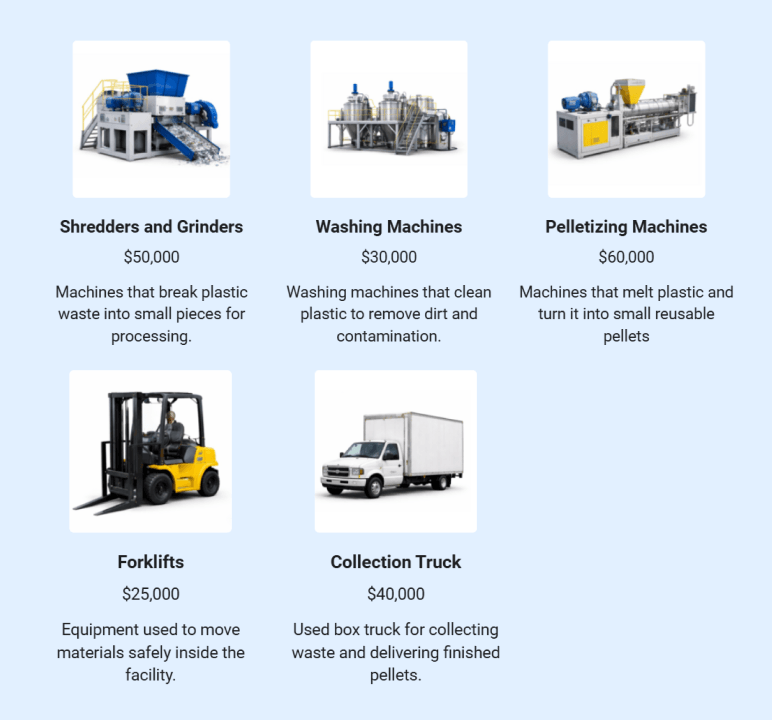
Preventive maintenance is conducted on shredders, washing systems, and the pelletizing machine on a scheduled basis to reduce downtime.
In case of equipment failure:
- Backup processing adjustments are made to prioritize sorting and storage.
- Service technicians are contacted under maintenance agreements.
- Temporary outsourcing of pelletizing may be considered if necessary to meet supply commitments.
Software and Technology
At GreenCycle, we use digital systems to manage route efficiency, scheduling, billing, and inventory control.
| System Area | Purpose |
|---|---|
| Route Management & GPS | Optimize pickup routes and monitor truck movement |
| Scheduling System | Manage recurring pickups and service contracts |
| Invoicing & Accounting | Generate invoices and track payments |
| Inventory Tracking | Monitor resin type, batch numbers, and production dates |
| Maintenance Log | Schedule and record equipment servicing |
Does your plan sound generic?
Refine your plan to adapt to investor/lender interests

Marketing & Sales Strategy
GreenCycle’s marketing strategy focuses on building long-term relationships with clients rather than relying on one-time pickup services.
Client Acquisition Channels
GreenCycle uses direct and structured outreach methods to gain new clients:
Direct Outreach to Businesses
We do direct outreach to businesses by contacting restaurants, retailers, manufacturing facilities, and resident property managers. Either through a professional network or a digital platform, to explain our service offerings and negotiate a pricing structure according to their volume of waste.
Municipal Partnerships
Our business approaches local government offices and waste departments to discuss supporting curbside programs or handling overflow plastic waste. Our goal is to secure service agreements for specific zones or business districts.
B2B Contracts with Manufacturers
Since we also offer recycled plastic pellets, we directly approach manufacturers that use plastic packaging or components. We offer steady supply agreements based on our projected output and quality standards.
Referral Program
We offer discounts to our existing clients who refer us to other businesses. This allows us to create a long-term business partnership with the clients we serve.
Online B2B Listings
We list GreenCycle on recycling platforms and local business directories, such as Google Business Profile, Yelp, RecycleNation, etc. This will make it easy for companies searching for recycling partners to find us.
Budget Allocation
GreenCycle has allocated a total of $3,000 for Year 1 marketing activities, focusing on practical channels that directly support client acquisition and brand visibility in local service areas. The marketing budget is distributed across four main categories, each supporting a specific growth objective.
| Category | % Allocation | Amount (Year 1) | Objective |
|---|---|---|---|
| Local Advertising & Branding | 30% | $900 | Build local awareness in service zones |
| Digital Presence (Website, SEO, LinkedIn) | 25% | $750 | Generate inbound business leads |
| Direct Sales & Outreach | 25% | $750 | Secure commercial contracts |
| Referral Incentives & Promotions | 20% | $600 | Increase word-of-mouth growth |
Sales Strategy
GreenCycle uses a direct B2B sales funnel focused on identifying businesses that produce consistent plastic waste and converting them into long-term collection clients. The process is designed to move potential clients through a clear sequence, from identification to contract agreement.
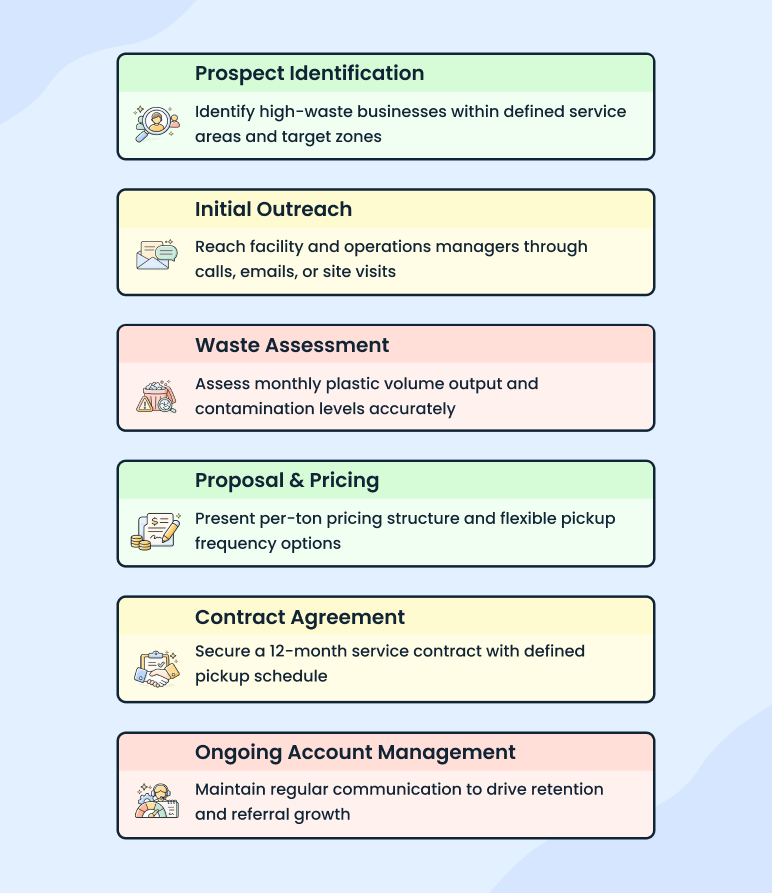
GreenCycle signs 12-month contract agreements with commercial clients that generate steady plastic waste. Contracts define pickup schedules, per-ton pricing, and contamination limits. This ensures a consistent monthly supply and stable revenue.
The buyer’s sales strategy involves that the recycled pellets directly to regional manufacturers under repeat purchase agreements. Resin type, quality standards, and payment terms are agreed in advance to maintain steady sales and avoid excess inventory.
Awareness and Lead Generation Strategy
GreenCycle uses simple, targeted marketing methods to build awareness and trust.
1. Clear Branding
All materials we use as branding clearly explain what plastics we accept and how our process works, who we serve, and how we are aligned with environmental initiatives.
2. SEO-Optimized Website
Our website provides detailed information about our services, pricing, and contact information. It is optimized to enable businesses searching for “plastic recycling in Austin” to find us easily.
3. LinkedIn Outreach
We utilize LinkedIn to connect with property managers, facility managers, and manufacturing business owners.
4. Content Marketing
We also add informative content on our website. This helps us to build authority and trust through short blog posts and newsletters that inform the community about the recycling process of plastics, how to minimize contaminant levels, and how businesses can improve recycling levels.
5. Local Promotions
To promote the brand among locals and raise awareness, we use branded truck signage and participation in relevant business events within the service area.
Staffing Structure
GreenCycle Waste Solutions maintains the recycling activities through a team of professional and efficient personnel. The company employs a careful selection process to choose staff members who will perform waste collection, waste sorting, administrative work, and other customer service duties.
Here is the list of the owner’s role & responsibilities:
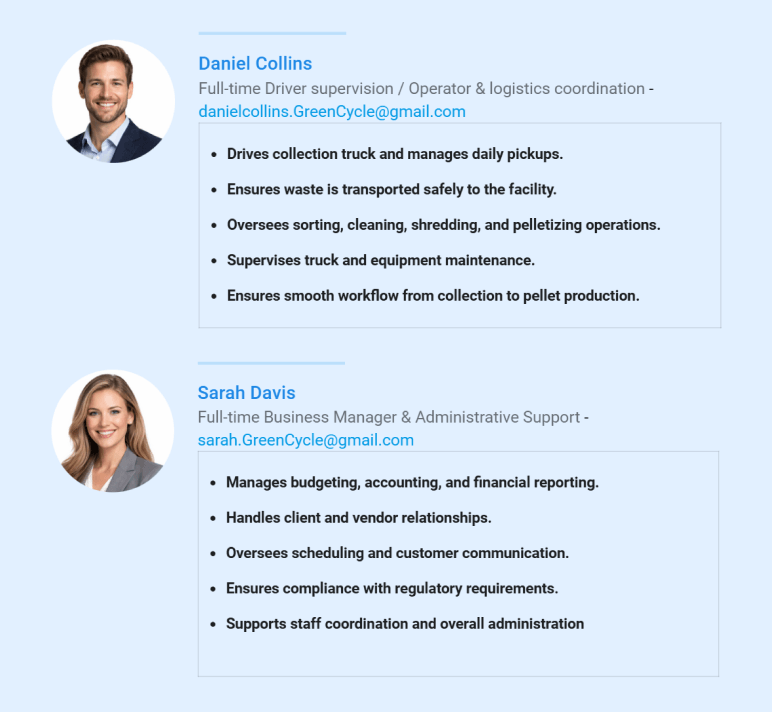
Full-time Truck Driver (CDL License)
We have a full-time truck driver for the daily collection of waste from local businesses, municipality programs, residential areas, and then transporting them to the facility.
His major responsibility is to drive the same route every day at the same hour to ensure timely delivery. Because clients count on him to show up at a particular time without delay.
The truck driver helps the facility staff with waste unloading and sometimes participates in basic material sorting as needed.
| Category | Details |
|---|---|
| Compliance | CDL-licensed driver operating under DOT regulations |
| Annual Compensation | ~$50,000 (Austin wage benchmark) |
| Hiring Timeline | Month 4, before launch |
| Backup Coverage | Daniel Collins is available for operational support |
Waste Sorting and Processing Staff
GreenCycle has two full-time workers in the sorting and processing areas of the facility. The sorting workers are responsible for sorting the plastic materials before they are cleaned, shredded, and pelletized.
The processing workers are responsible for cleaning, shredding, and pelletizing the plastic materials. They ensure that the plastic materials undergo an efficient process to produce high-quality recycled materials.
These employees are also responsible for maintaining the equipment to run the daily operations smoothly.
| Category | Details |
|---|---|
| Qualification | Machine operation and safety trained |
| Annual Compensation | ~$36,400 per employee |
| Hiring Timeline | Worker 1: Month 4; Worker 2: Year 2 |
| Backup Coverage | Cross-trained staff + Daniel support |
Business Licensing & Compliance
GreenCycle complies with all required municipal and state regulations governing waste handling and recycling operations in Austin. Because when running a recycling business, staying permitted isn’t optional; we make sure this is part of our work routine.
Business Permits
To run the business legally in Austin, we have:
- A City of Austin business registration
- A waste hauling permit that allows us to collect and transport plastic waste
These permits allow us to legally pick up plastic waste from local areas and bring it to our facility.
State Rules (TCEQ)
GreenCycle maintains all required state registrations to operate legally in Texas. The company is officially registered with TCEQ Recycling Facility Registration (30 TAC Chapter 328 – Recycling and Reuse).
This registration confirms that GreenCycle is officially recognized by the Texas Commission on Environmental Quality as a recycling facility authorized to process non-hazardous recyclable plastic materials in compliance with state regulations.
These rules explain how recyclable materials must be handled and stored. We make sure to:
- Store plastics properly
- Keep the facility clean
- Process only plastic waste
- Avoid handling hazardous waste or other restricted materials
Where applicable, operations align with EPA solid waste management guidelines for responsible recycling practices.
Workplace Safety & Fire Compliance
The facility follows OSHA workplace safety standards, including:
- Mandatory use of personal protective equipment (PPE)
- Machine safety training for employees
- Clearly marked processing and storage zones
- Emergency response procedures
The facility also meets local fire safety requirements, including proper material storage limits, fire extinguishers, emergency exits, and safe access for emergency services.
Zoning & Insurance
Our facility in Austin, TX, is settled in an industrial area where recycling operations are legally allowed. The space supports sorting, processing, storage, and truck parking.
In GreenCycle, we carry all the required insurance that covers accidents, injuries, and damage:
- Commercial auto insurance for the truck
- General liability insurance for the facility
- Workers’ compensation insurance for employees
Financial Plan
GreenCycle Waste Solutions requires a total startup investment of $350,000 to launch operations. These funds will cover equipment purchases, facility setup, and initial operating expenses.
To finance the business, the company is applying for a $250,000 loan from Wells Fargo Bank at an 8.25% interest rate with a 5-year repayment term.
The remaining $100,000 will be contributed by the owners. Daniel Collins will invest $60,000, and Sarah Davis will invest $40,000.
Financial Assumptions
| Item | Assumption |
| COGS (Variable) | |
| Fuel | Year 1: $18,000 / Year 2: $36,000 / Year 3: $39,600 |
| Waste disposal (35% residue × $50/ton) | Scales with raw tons collected |
| Processing utilities | Year 1: $9,600 / Year 2: $19,200 / Year 3: $21,600 |
| Packaging | $20/ton of pellets produced |
| FACILITY | |
| Rent + CAM (1,500 sq ft, Austin SE industrial) | Year 1: $27,750 / 3% annual escalation |
| OTHER OPEX | |
| Equipment maintenance | Year 1: $7,000 / Year 2: $14,000 / Year 3: $16,000 |
| Marketing (ongoing) | Year 1: $3,000 / Year 2: $8,000 / Year 3: $10,000 |
| Office supplies, software | $3,600/year |
| Phone, internet, misc | Year 1: $2,400 / Year 2–3: $3,600 |
| Professional services | $4,000/year |
| Regulatory compliance | $2,000/year |
| CAPEX & DEPRECIATION | |
| Startup fixed assets | $197,000 (truck $40K, shredders $50K, pelletizer $60K, washing $30K, leasehold $17K) |
| Depreciation method | Straight-line; equipment 7 years, leasehold 10 years |
| Year 1 proration | 10/12 (assets in service Month 3) |
| Annual depreciation (full year) | $27,414 |
| Growth capex Year 3 | $15,000 additional sorting equipment (7-year life) |
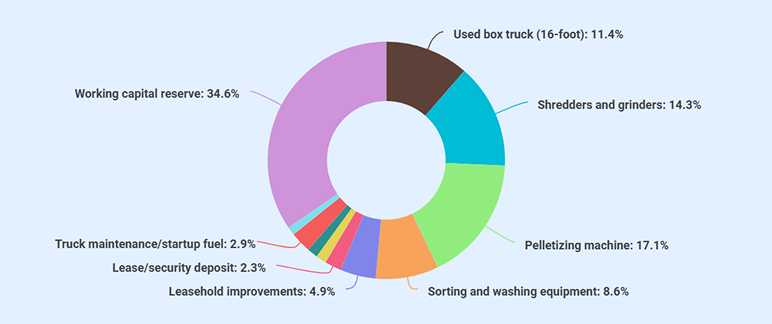
Startup Costs & Funding
| Category | Cost | Accounting Treatment |
| CAPITALIZED ASSETS | ||
| Used box truck (16-foot) | $40,000 | Fixed Asset – 7-year depreciation |
| Shredders and grinders | $50,000 | Fixed Asset – 7-year depreciation |
| Pelletizing machine | $60,000 | Fixed Asset – 7-year depreciation |
| Sorting and washing equipment | $30,000 | Fixed Asset – 7-year depreciation |
| Leasehold improvements | $17,000 | Fixed Asset – 10-year depreciation |
| Subtotal Capitalized Assets | $197,000 | |
| REFUNDABLE DEPOSIT | ||
| Lease/security deposit | $8,000 | Non-current Asset (refundable) |
| Subtotal Deposit | $8,000 | |
| PREPAID EXPENSES | ||
| Insurance premiums | $5,000 | Prepaid → expensed Year 1 |
| Licensing, permits, legal fees | $5,000 | Prepaid → expensed Year 1 |
| Truck maintenance/startup fuel | $10,000 | Prepaid → expensed Year 1 |
| Initial marketing and branding | $4,000 | Prepaid → expensed Year 1 |
| Subtotal Prepaids | $24,000 | |
| CASH RESERVE | ||
| Working capital reserve | $121,000 | Opening Cash (not an expense) |
| Subtotal Cash | $121,000 | |
| TOTAL STARTUP COSTS | $350,000 |
| Sources of Funds | Amount |
| Wells Fargo Equipment Loan | $250,000 |
| Owner Equity – Daniel Collins (60%) | $60,000 |
| Owner Equity – Sarah Davis (40%) | $40,000 |
| Total Sources | $350,000 |
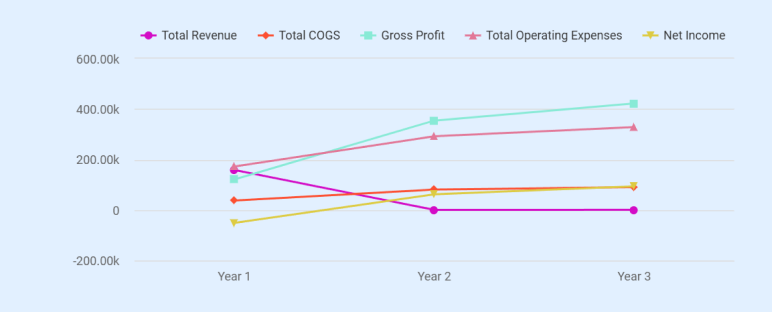
Profit & Loss Statement (3 Years)
| Line Item | Year 1 | Year 2 | Year 3 |
| REVENUE | |||
| Recycled pellet sales | $135,200 | $374,010 | $443,040 |
| Collection service fees | $19,200 | $50,400 | $57,600 |
| Tipping / gate fees | $4,000 | $10,500 | $12,000 |
| Total Revenue | $158,400 | $434,910 | $512,640 |
| COST OF GOODS SOLD | |||
| Fuel (collection routes) | $18,000 | $36,000 | $39,600 |
| Waste disposal (residue) | $5,600 | $14,700 | $16,800 |
| Processing utilities | $9,600 | $19,200 | $21,600 |
| Pellet packaging/shipping | $4,160 | $10,920 | $12,480 |
| Total COGS | $37,360 | $80,820 | $90,480 |
| GROSS PROFIT | $121,040 | $354,090 | $422,160 |
| Gross Margin % | 76.4% | 81.4% | 82.3% |
| OPERATING EXPENSES | |||
| Owner draws – Daniel Collins | $18,000 | $36,000 | $48,000 |
| Owner draws – Sarah Davis | $18,000 | $36,000 | $48,000 |
| Wages – CDL truck driver | $37,500 | $50,000 | $51,500 |
| Wages – Sorting/processing staff | $27,300 | $72,800 | $74,984 |
| Payroll taxes & benefits (12%) | $12,096 | $23,376 | $26,698 |
| Rent + CAM | $27,750 | $28,583 | $29,440 |
| Insurance | $9,600 | $10,080 | $10,584 |
| Equipment maintenance & repairs | $7,000 | $14,000 | $16,000 |
| Marketing & advertising | $3,000 | $8,000 | $10,000 |
| Office supplies, software, and scheduling | $3,600 | $3,600 | $3,600 |
| Phone, internet, miscellaneous | $2,400 | $3,600 | $3,600 |
| Professional services (accounting, legal) | $4,000 | $4,000 | $4,000 |
| Regulatory compliance (TCEQ, DOT) | $2,000 | $2,000 | $2,000 |
| Total Operating Expenses | $172,246 | $292,039 | $328,406 |
| EBITDA | ($51,206) | $62,051 | $93,754 |
| Depreciation | $22,845 | $27,414 | $29,557 |
| EBIT (Operating Income) | ($74,051) | $34,637 | $64,197 |
| Interest Expense | $19,057 | $15,446 | $11,527 |
| Net Income (Pre-Tax) | ($93,108) | $19,191 | $52,670 |
Cash Flow Statement (3 Years)
| Line Item | Year 1 | Year 2 | Year 3 |
| CASH FROM OPERATIONS | |||
| Net Income | ($93,108) | $19,191 | $52,670 |
| Add back: Depreciation | $22,845 | $27,414 | $29,557 |
| Working Capital Changes: | |||
| (Increase) / Decrease in Accounts Receivable | ($12,672) | ($22,121) | ($6,218) |
| Increase / (Decrease) in Accounts Payable | $1,494 | $1,739 | $386 |
| (Increase) / Decrease in Prepaid Expenses | $24,000 | $0 | $0 |
| Total Working Capital Changes | $12,822 | ($20,382) | ($5,832) |
| Cash from Operations | ($57,441) | $26,223 | $76,395 |
| CASH FROM INVESTING | |||
| Capitalized assets (equipment, truck, leasehold) | ($197,000) | $0 | ($15,000) |
| Refundable lease deposit | ($8,000) | $0 | $0 |
| Initial prepaid expenses (startup) | ($24,000) | $0 | $0 |
| Cash from Investing | ($229,000) | $0 | ($15,000) |
| CASH FROM FINANCING | |||
| Loan proceeds | $250,000 | $0 | $0 |
| Owner equity contributions | $100,000 | $0 | $0 |
| Loan principal repayments | ($42,119) | ($45,730) | ($49,649) |
| Cash from Financing | $307,881 | ($45,730) | ($49,649) |
| NET CHANGE IN CASH | $21,440 | ($19,507) | $11,746 |
| Beginning Cash | $0 | $21,440 | $1,933 |
| Ending Cash | $21,440 | $1,933 | $13,679 |
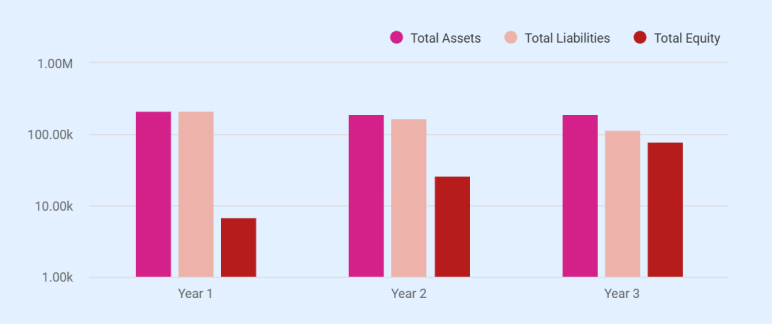
Balance Sheet (3 Years)
| Line Item | Year 1 | Year 2 | Year 3 |
| ASSETS | |||
| Cash | $21,440 | $1,933 | $13,679 |
| Accounts Receivable | $12,672 | $34,793 | $41,011 |
| Prepaid Expenses | $0 | $0 | $0 |
| Total Current Assets | $34,112 | $36,726 | $54,690 |
| Lease Deposit (refundable) | $8,000 | $8,000 | $8,000 |
| Gross Fixed Assets | $197,000 | $197,000 | $212,000 |
| Less: Accumulated Depreciation | ($22,845) | ($50,259) | ($79,816) |
| Net Fixed Assets | $174,155 | $146,741 | $132,184 |
| TOTAL ASSETS | $216,267 | $191,467 | $194,874 |
| LIABILITIES | |||
| Accounts Payable | $1,494 | $3,233 | $3,619 |
| Current Portion of Loan | $45,730 | $49,649 | $53,902 |
| Total Current Liabilities | $47,224 | $52,882 | $57,521 |
| Long-Term Loan | $162,151 | $112,502 | $58,600 |
| Total Liabilities | $209,375 | $165,384 | $116,121 |
| EQUITY | |||
| Contributed Capital | $100,000 | $100,000 | $100,000 |
| Retained Earnings | ($93,108) | ($73,917) | ($21,247) |
| Total Equity | $6,892 | $26,083 | $78,753 |
| TOTAL LIABILITIES + EQUITY | $216,267 | $191,467 | $194,874 |
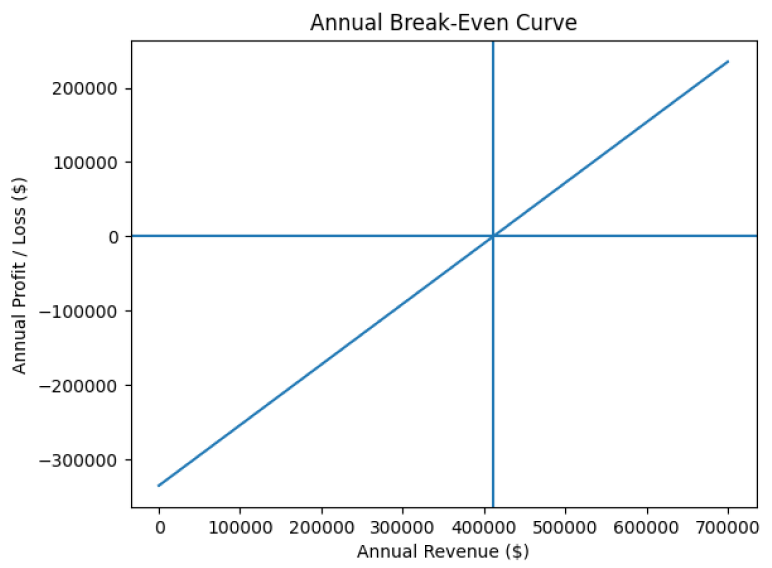
Break-Even Summary
| Metric | Value |
| Annual fixed costs (Year 2 basis) | $334,899 |
| Variable cost ratio (COGS / Revenue) | 18.6% |
| Contribution margin % | 81.4% |
| Monthly break-even revenue | $34,283 |
| Annual break-even revenue | $411,398 |
| Monthly break-even tons (raw collected) | 66.2 tons |
| Annual break-even tons | 795 tons |
| Year 2 actual revenue | $434,910 |
| Year 2 actual tons collected | 840 |
| Margin of safety | 5.7% above break-even |
| Break-even achievement | Year 2 – Net Income positive ($19,191) |
Loan Amortization Summary
| Details | Value |
| Loan amount | $250,000 |
| Term | 5 years (60 months) |
| Interest rate | 8.25% fixed |
| Monthly payment | $5,098 |
| Annual payment | $61,176 |
| Total interest over life | $55,880 |
| Period | Opening Balance | Principal Paid | Interest Paid | Total Payment | Closing Balance |
| Year 1 (Mo 1–12) | $250,000 | $42,119 | $19,057 | $61,176 | $207,881 |
| Year 2 (Mo 13–24) | $207,881 | $45,730 | $15,446 | $61,176 | $162,151 |
| Year 3 (Mo 25–36) | $162,151 | $49,649 | $11,527 | $61,176 | $112,502 |
| Year 4 (Mo 37–48) | $112,502 | $53,902 | $7,274 | $61,176 | $58,600 |
| Year 5 (Mo 49–60) | $58,600 | $58,600 | $2,576 | $61,176 | $0 |
| Total | $250,000 | $55,880 | $305,880 |
The Quickest Way to turn a Business Idea into a Business Plan
Fill-in-the-blanks and automatic financials make it easy.
