




Executive Summary
Business Overview
Calm Haven Day Spa, owned by Natalie Brooks, operates from an 800-square-foot suite at 412 North 7th Avenue, Suite 203, in Phoenix. The space is a professional office building location with dedicated parking. The spa offers massage therapy and basic facials by appointment only. No medical spa services, injectables, or laser treatments are offered.
We target working professionals and residents aged 25-55. These clients book massage and facials as routine wellness care, not occasional luxury. They visit monthly or quarterly.
Market Position and Services
Phoenix has a well-established wellness services market. There are more than 271 health and wellness spa locations operating within the city. This reflects broad consumer acceptance of massage and spa services as regular self-care rather than discretionary indulgence.
Our service menu includes:
- Swedish massage
- Deep tissue massage
- Prenatal massage
- Foot massage
- Basic facials
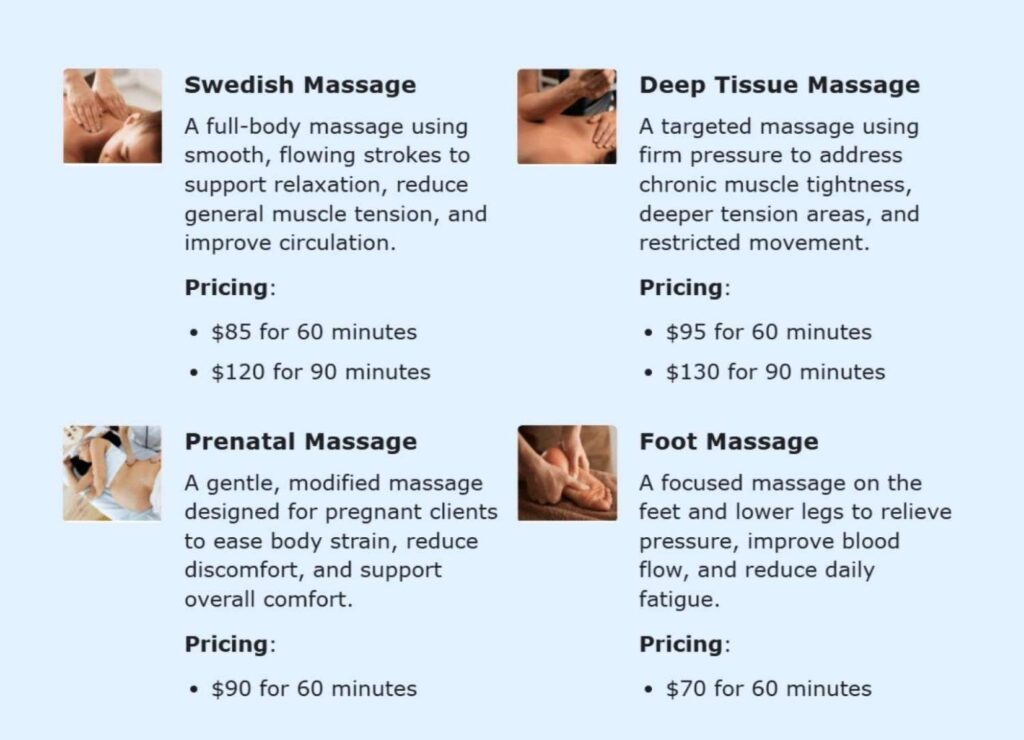
Clients can choose 60- or 90-minute sessions. Prices range from $80 to $130, depending on the service and duration. Optional add-ons, such as aromatherapy and hot stones, increase the average ticket price. Retail skincare sales are offered but aren’t a major revenue focus.
Financial Outlook
We’re seeking $90,000 in term-loan financing. With a $25,000 owner equity contribution, total startup funding is $115,000. We’ll use the loan proceeds for lease deposits, tenant improvements, equipment, initial operating setup, and working capital.
Fixed operating expenses total approximately $7,100/month, covering rent, utilities, insurance, software, marketing, linen service, and other baseline costs.
The business includes a $60,000 working capital reserve, intended to cover fixed operating obligations during the ramp-up period. This reserve provides flexibility while booking volume stabilizes and repeat clients are established.
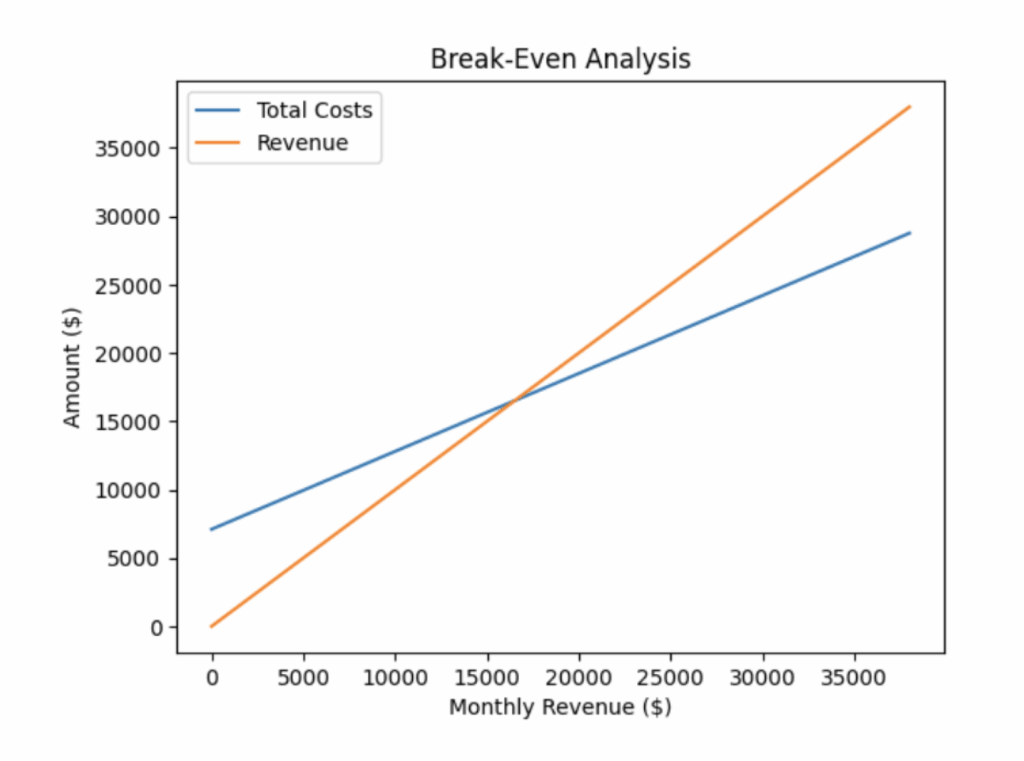
Monthly break-even revenue is estimated at approximately $16,200–$17,500, based on existing staffing levels and current operating costs. Break-even is expected to occur as booking consistency improves during the first year of operations.
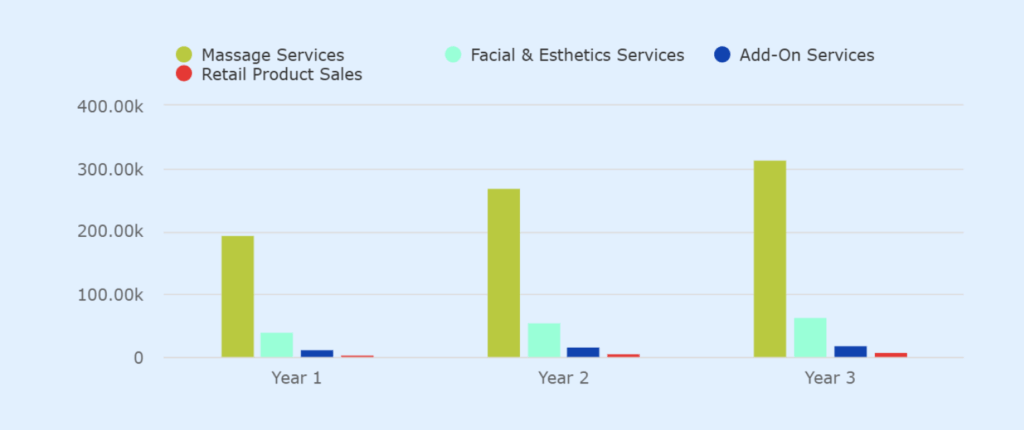
Revenue is expected to build gradually rather than through rapid expansion.
| Line Item | Year 1 ($) | Year 2 ($) | Year 3 ($) |
|---|---|---|---|
| Revenue | |||
| Massage Services | 195,000 | 270,000 | 315,000 |
| Facial & Esthetics Services | 40,000 | 55,000 | 65,000 |
| Add-On Services | 12,000 | 17,000 | 20,000 |
| Retail Product Sales | 5,000 | 7,000 | 8,000 |
| Total Revenue | 252,000 | 349,000 | 408,000 |

Company Description
Calm Haven Day Spa is a small-format, owner-operated wellness business designed to deliver massage and basic esthetic services in a controlled, appointment-only setting. The business is structured for predictable daily operations, limited service scope, and direct owner oversight.
The spa is 100% owned by Natalie Brooks. It operates from a leased professional suite located at 412 North 7th Avenue, Suite 203, Phoenix, Arizona 85007.
Our lease is a 3-year agreement, where in year 1, the monthly rent is $2,600.
The location provides dedicated parking and convenient access for clients. Proximity to office buildings and residential neighborhoods supports the appointment-based service model. The landlord approved tenant improvements for treatment room construction, plumbing adjustments, and reception area modifications.
The leased professional suite occupies approximately 800 square feet in a multi-tenant professional building. The facility has two treatment rooms, a reception area, and a small retail display. The display shows skincare products used during facials. Clients can purchase them after appointments.
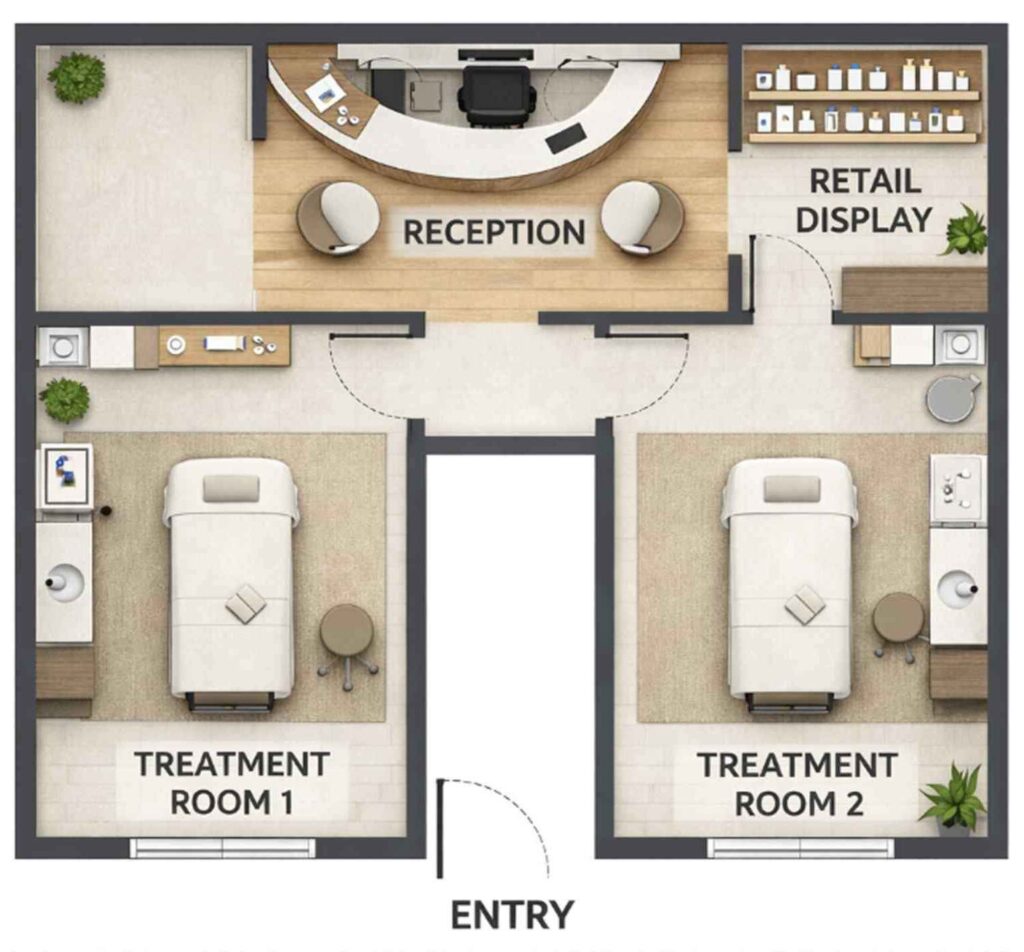
Each treatment room has a massage table, storage cabinets for linens and supplies, and adjustable lighting. We keep rooms simple and functional. No elaborate decor or luxury finishes.
Reception handles check-in, payment processing, and appointment scheduling. Natalie, or the opening therapist, manages this area during business hours.
The suite also meets ADA (Americans with Disabilities Act) accessibility requirements.
Calm Haven provides massage therapy and basic esthetic services by appointment only. The business doesn’t offer:
- Medical spa services
- Injectables
- Laser treatments
- Advanced esthetic procedures
This service scope limits regulatory complexity and liability exposure. It also aligns with the owner’s expertise and staffing capabilities.
Natalie Brooks serves as owner and general manager. She handles:
- Front desk operations
- Appointment scheduling
- Vendor coordination
- Quality control
- Financial management
Her prior work experience includes managing treatment schedules at a wellness clinic and supporting licensed practitioners with client coordination. She’s familiar with state sanitation requirements, client record-keeping standards, and infection-control protocols.
Natalie won’t draw a salary during the initial operating period. She begins taking compensation in year 2.
A business plan shouldn’t take weeks
Services Offered
Calm Haven Day Spa offers massage therapy and facial services by appointment only. The service menu is limited to treatments that fit within standard session blocks and can be delivered by licensed massage therapists and estheticians.
Core Massage Services
The spa provides 4 core massages:
Facial Services
Basic facials include cleansing, exfoliation, extractions, mask application, and moisturizing. The esthetician customizes product selection based on skin type and client concerns.
- Session limit: 60 minutes
- Pricing: $80
Facials are scheduled on select days when the part-time esthetician is available. Massage services are available throughout all operating hours.
Add-On Services
Add-ons increase the session price and are delivered within scheduled appointment blocks.
| Add-On Service | Description | Additional Price |
|---|---|---|
| Aromatherapy | Essential oil selection applied during the session based on the client’s preference | $15 |
| Hot Stone Treatment | Use of heated stones incorporated into the massage session | $20 |
| Scalp Massage | Focused work on the head, neck, and shoulders within the scheduled session | $10 |
Retail Products
The spa sells a limited selection of skincare products used during facial treatments.
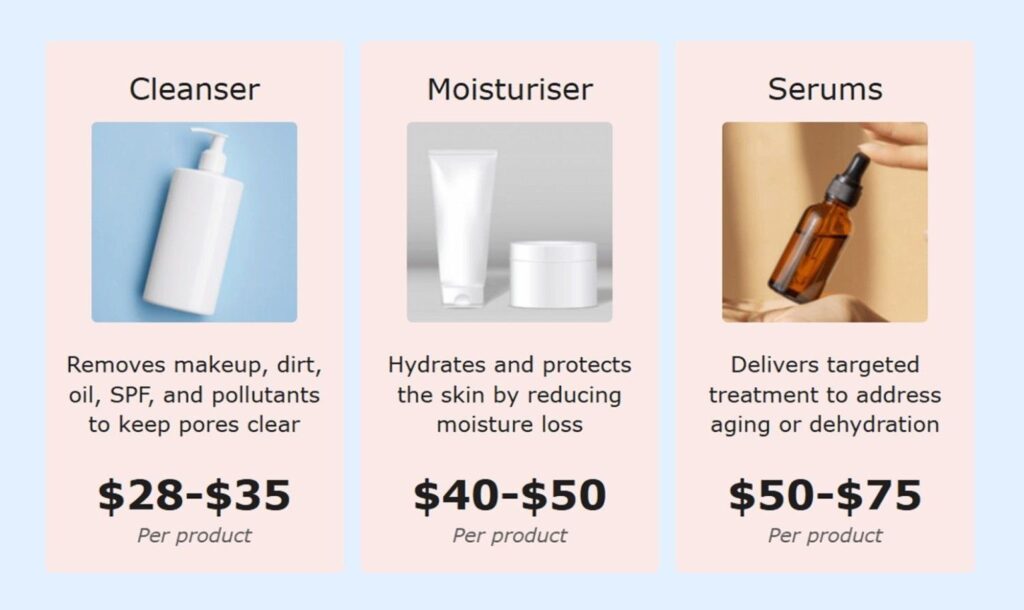
Retail sales are tracked separately but represent a small portion of total revenue. Clients may purchase products after their appointment. Therapists don’t receive commission on retail sales. Product recommendations are made based on treatment results, not sales targets.
Service Delivery Standards
Client intake forms document health history, areas of concern, and pressure preferences. Therapists review intake information before each session. Service notes are recorded after appointments to track client preferences and treatment history.
Does your plan sound generic?
Refine your plan to adapt to investor/lender interests
Market Analysis
Industry Overview
The spa and wellness industry operates on repeat appointments rather than one-time visits. Customers book services like massages and facials on a routine basis, which supports steady revenue.
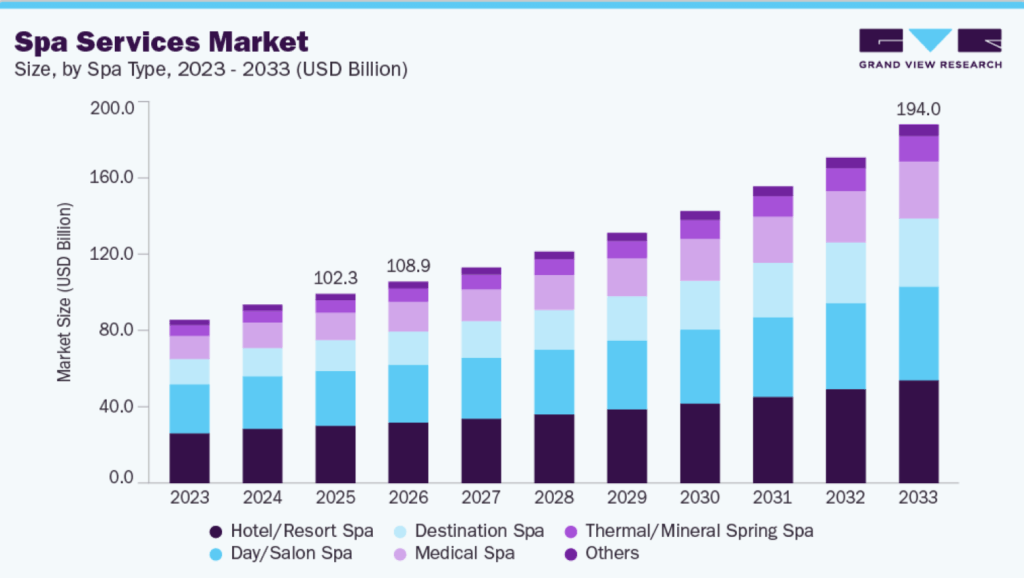
The global spa services market hit $102.32 billion in 2025. It continues growing steadily. This reflects a broader shift toward routine self-care.
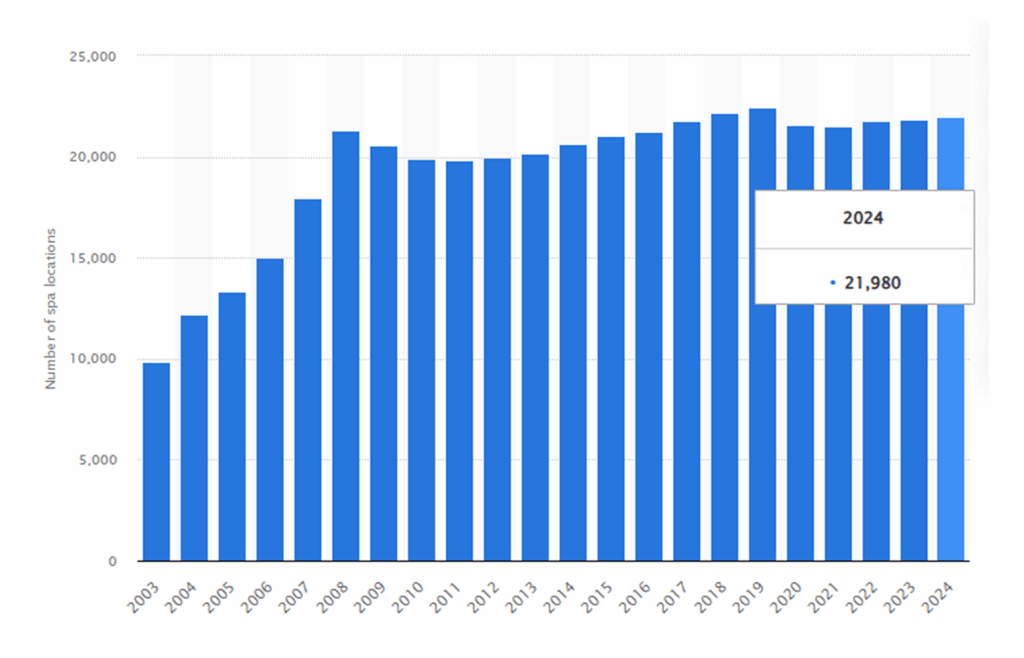
Day spas dominate the U.S. market. Industry listings show more than 21,980 spa locations nationwide. Most operate by appointment, not as destination resorts.
In Phoenix, the spa and wellness industry shows a business success rate of 46%, supported by strong local demand, year-round operation, and a large population that regularly uses personal care services.
Target Customer
Calm Haven Day Spa’s primary target demographic profile includes:
| Segment Attribute | Description |
|---|---|
| Primary Age Range | Adults aged 25-55 |
| Employment Status | Employed professionals and working adults |
| Income Profile | Middle-income households with discretionary spending capacity |
| Primary Service Use | Routine wellness care, including massage and basic facials |
| Visit Frequency | Recurring use (monthly or quarterly) rather than occasional visits |
| Booking Preferences | Evening and weekend appointments outside standard work hours |
| Service Motivation | Stress relief, relaxation, and general wellness maintenance |
| Price Sensitivity | Moderate; values consistency and convenience over luxury or discounts |
| Service Expectations | Reliable service quality, professional environment, predictable scheduling |
| Secondary Segments | Prenatal clients and wellness-focused adults seeking relaxation services |
Competitor Analysis
The local day spa market includes a mix of small independent spas and higher-volume wellness centers. Most offer similar massage and facial services, with differences mainly in pricing, service consistency, and operating style.
| Competitor | Strengths | Weaknesses |
|---|---|---|
| Serenity Touch Spa |
|
|
| Urban Calm Wellness |
|
|
| Pure Balance Day Spa |
|
|
| Tranquil Path Spa |
|
|
Indirect Competitors
Calm Haven also competes with independent massage therapists, salon-based massage rooms, and wellness studios that offer basic relaxation services. These providers may be lower priced but often lack consistent scheduling, standardized service quality, and a dedicated spa environment.
Competitive Advantage
Calm Haven Day Spa operates with a limited service menu, appointment-only scheduling, and direct owner oversight. This allows consistent service quality, predictable operations, controlled costs, and stronger repeat client relationships compared to both high-volume spas and informal wellness providers.
Stop Googling competitors for hours
Marketing Strategies
Calm Haven Day Spa uses simple, low-cost marketing methods suited to a small local business. The goal in Year 1 is to build steady appointments, local trust, and repeat visits. The monthly marketing budget is limited to $416. So the strategy avoids paid ads and large campaigns. Marketing relies on local search visibility, nearby partnerships, physical visibility, and referrals.
Marketing Channels
Google Business Profile
Google Business Profile drives most new bookings. People searching for massage or facial services find the spa through local results. The profile lists the:
- Address
- Hours
- Services
- Pricing
- Photos
- Booking link
After each visit, staff ask customers to leave reviews. The business posts short updates and limited-time offers on a regular basis.
Social Media
The spa uses Instagram and Facebook to stay visible in the local area. Posts include photos of the space, brief service descriptions, open appointment reminders, simple offers, and customer reviews with permission. The owner manages posting in-house a few times per week.
Local Partnerships
The spa builds relationships with nearby salons, gyms, wellness offices, and apartment communities. These partnerships focus on basic referrals and flyer sharing. The goal is to reach people who already use related services.
Signage and Local Visibility
Clear signage supports local awareness. The spa maintains a listing on the building directory and displays clear door signage that shows available services. This setup helps attract nearby foot traffic and visitors from neighboring businesses.
Pamphlet Distribution
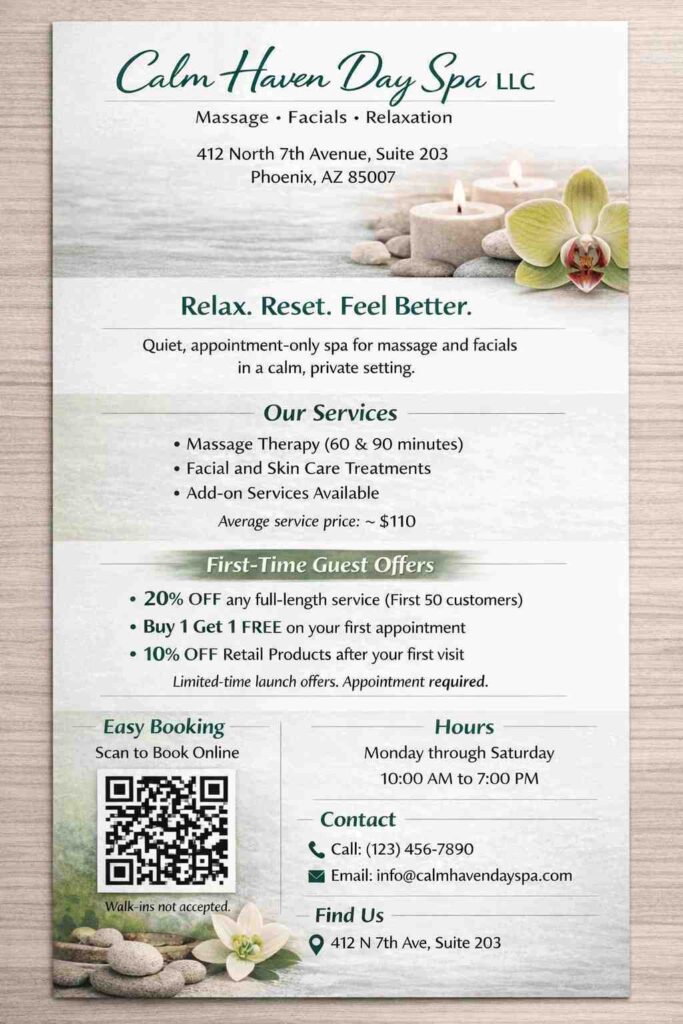
The spa places pamphlets in nearby offices, apartments, gyms, and partner locations. Each pamphlet lists services, includes a first-visit offer, and shows a QR code for booking. Printing and distribution stay within the monthly budget.
Launch Promotion Strategy
Calm Haven Day Spa runs a short launch promotion to fill early appointment slots and attract first-time visitors.
- The first 50 customers receive 20% off any full-length service
- First-time visitors receive a buy-one-get-one offer for the initial appointment only
- Customers receive 10% off retail products after their first visit
The spa shares these offers through Google Business Profile posts, social media, pamphlets, and partner locations.
Sales and Booking Process
Customers book appointments by phone or online. Natalie handles phone inquiries during business hours. She answers questions about services, pricing, availability, and therapists. She enters appointments directly into the system.
The online booking tool shows real-time availability. Confirmation emails go out after each booking. The system sends reminder texts 24 hours before appointments.
Cancellations require 24 hours’ notice. Late cancellations or no-shows cost 50% of the service price.
Customer Acquisition and Retention Plan
New customers find us through local search, social media, pamphlets, and partner referrals. First-time offers encourage trial visits. Clear pricing and easy booking reduce drop-off.
After each visit, staff encourage customers to rebook. We ask them to refer friends and family. Repeat visits drive profitability more than constant new customer acquisition.
Operations & Service Delivery
Calm Haven Day Spa operates six days a week, Monday through Saturday, from 10:00 a.m. to 7:00 p.m. Services are provided by appointment only, with operating hours set to match typical demand for massage and facial services during daytime and early evening hours.
Daily Workflow
Calm Haven runs on a simple routine. Each day follows a predictable flow.
The day starts with a schedule review. Staff prepare treatment rooms. They confirm bookings. Therapists deliver services based on appointments. Time between sessions allows for a room reset and cleaning.
The focus stays on smooth transitions, not high volume.
Staff check in guests throughout the day. They guide guests to appointments. Therapists deliver services based on intake notes and booking details. Staff reset and sanitize rooms after each session.
Natalie manages scheduling updates, client messages, and payments during the day. These tasks stay secondary to appointments. They never interrupt service flow.
At closing, staff clean treatment rooms. They secure supplies and review the next day’s schedule.
Client Check-In and Intake Process
Guests arrive about 10 minutes before their appointment. Staff greet them at reception and confirm appointment details. New guests complete a short intake form that covers health history, pressure preferences, and consent.
During check-in, staff:
- Ask about pain, recent injuries, or pregnancy
- Explain how the session will work and what to expect
- Collect payment details and apply any first-visit offers
Returning guests update their intake if anything has changed. Therapists review past notes and confirm focus areas before starting the session.
Quality Control and Owner Oversight
Natalie commits to daily operations. She oversees scheduling, service flow, and therapist notes. She reviews feedback and addresses issues as they arise. This allows quick fixes and keeps service quality consistent.
Quality control practices include:
- Ongoing review of service notes and booking patterns
- Informal check-ins with therapists to address feedback and scheduling needs
- Tracking of client complaints and service recovery outcomes
The small team structure allows for close oversight without formal management layers.
Vendor Relationships and Supply Management
The spa relies on a limited number of core vendors to support daily operations. Vendor relationships are structured to ensure reliability without excessive inventory or maintenance burden.
| Vendor Category | Vendor Role | Ordering and Inventory Practices | Maintenance and Controls |
|---|---|---|---|
| Linen Service Provider | Supplies and launders towels, sheets, and table linens | Managed through an ongoing service agreement | Ensures consistent linen availability without on-site storage |
| Massage Supply Distributor | Provides oils, lotions, and other consumable products | Supplies are ordered monthly based on usage; two months of inventory are kept for high-use items; limited shelf-life products aren’t overstocked |
Standard pricing negotiated without volume commitments |
| Equipment Maintenance Vendor | Services include massage tables and hot stone warmers | Annual scheduled maintenance | Tables inspected monthly; issues addressed immediately |
| Internal Equipment Backup | — | One backup massage table is kept in storage | Allows uninterrupted service during repairs or maintenance |
Contingency Planning
Therapists sometimes call in sick at short notice. When this happens, affected clients are contacted right away and offered rescheduling. If preferred, appointments can be moved to another available therapist.
Because the spa operates on a controlled appointment schedule, last-minute changes remain manageable. Most clients book in advance, and updated contact details are kept on file to ensure quick communication.
In the event of a power outage or severe weather, the spa closes, and appointments are rescheduled. Operations do not continue without proper lighting, climate control, and hot water.
Clients are notified as soon as any disruption is identified to minimize inconvenience.
Legal Compliance and Regulatory Standards
The spa operates in compliance with Arizona state and local regulations governing massage therapy and esthetic services. This includes maintaining required establishment licenses and ensuring all practitioners hold current, valid professional licenses.
Compliance areas include:
- Licensing and renewal tracking
- Client recordkeeping standards
- Adherence to sanitation and hygiene requirements
Regulatory compliance is reviewed periodically to ensure continued adherence as the business operates.
Client Safety and Sanitation Standards
Client safety is a core operating priority. The spa follows established sanitation and infection-control practices consistent with state guidelines. Treatment rooms and shared surfaces are cleaned between appointments, and clean linens are used for every client.
Safety practices focus on:
- Proper hygiene and sanitation
- Clear communication of health considerations during intake
- Maintaining a safe, calm treatment environment
Insurance Coverage
The business maintains insurance coverage appropriate for a small-format wellness spa, including:
- General liability insurance
- Professional liability insurance
- Workers’ compensation insurance
These policies protect clients, staff, and the business against common operational risks.
Management & Staffing
Natalie Brooks owns Calm Haven Day Spa outright. She serves as general manager.
Her responsibilities include:
- Managing the front desk
- Scheduling appointments
- Coordinating with vendors
- Monitoring service quality
- Handling cash
Natalie won’t draw a salary during the initial operating period. This preserves cash flow during ramp-up.
Staffing Structure
Here’s a simple structure we follow to ensure a seamless workflow:
| Role | Employment Type | Scheduling Basis | Responsibilities |
|---|---|---|---|
| Licensed Massage Therapist | Full-time | Fixed weekly guarantee | Provide massage services to clients, prepare treatment rooms, and maintain basic cleanliness and safety standards. |
| Licensed Massage Therapist | Part-time | Scheduled based on confirmed appointments | Provide massage services during scheduled appointments and assist with room cleanup between sessions. |
| Licensed Esthetician | Part-time | Scheduled based on confirmed facial bookings | Provide facial and skincare treatments, prepare treatment areas, and clean equipment after use. |
The therapist’s compensation is ~$45/service hour blended. All therapists hold active Arizona Massage Therapist licenses issued by the Arizona State Board of Massage Therapy. All estheticians hold active Arizona Esthetician licenses issued by the Arizona Board of Cosmetology.
Financial Plan
The financial plan covers a small, appointment-based spa. The service menu stays limited. Daily capacity stays controlled.
Scheduled massage and facial services drive revenue. Fixed operating expenses, therapist hours, and supply costs create the expense side.
Financial performance depends on consistent bookings and repeat clients.
Startup Costs
| Category | Cost ($) | Justification |
|---|---|---|
| Lease & Facility Setup | ||
| Lease security deposit (2 months) | 5,200 | Standard deposit for commercial lease |
| First month’s rent | 2,600 | Consistent with the $2,600/month rent assumption |
| Minor buildout & paint | 8,000 | Basic setup and cosmetic work for treatment rooms |
| Electrical & plumbing adjustments | 4,500 | Necessary to accommodate treatment room needs |
| Subtotal — Lease & Setup | 20,300 | |
| Treatment Room Equipment (Capitalized) | ||
| Massage tables (2) | 6,000 | Industry standard for two treatment rooms |
| Facial bed & esthetics chair | 4,500 | Essential for facial treatments |
| Steamers, warmers, stools | 3,500 | Required for esthetic services |
| Storage cabinets & shelving | 3,000 | For equipment and product storage |
| Subtotal — Equipment | 17,000 | |
| Pre-Launch & Compliance | ||
| Business registration & permits | 1,200 | Typical fees for health/wellness businesses |
| Professional & liability insurance | 3,000 | Standard coverage for small spa operations |
| Legal & accounting setup | 2,000 | Includes initial legal fees and accounting services |
| Subtotal — Pre-Launch | 6,200 | |
| Marketing & Launch | ||
| Website, branding, online booking setup | 5,000 | Initial digital presence, setup for bookings |
| Opening promotions & local advertising | 4,500 | Local marketing and launch promotions |
| Subtotal — Marketing | 9,500 | |
| Opening Supplies | ||
| Initial service supplies & retail stock | 4,500 | Massage oils, creams, and basic facial products |
| Towels, robes, disposables | 3,000 | Inventory to cover initial customer flow |
| Subtotal — Supplies | 7,500 | |
| Working Capital (Opening Cash) | 54,500 | Covers the first few months of operations |
| Total Startup Costs | 115,000 | Total funding needed for launch |
The working capital reserve covers approximately 2 months of fixed expenses and guaranteed payroll. This provides buffer capacity during our ramp period when revenue builds gradually.
Sources of Funds
| Source | Type | Amount ($) | Treatment in Financials | Notes |
|---|---|---|---|---|
| Owner Capital Contribution | Equity | 25,000 | Equity (Balance Sheet) | Permanent capital at formation |
| Bank Term Loan | Debt | 90,000 | Long-term liability | Used for startup costs and equipment |
| Owner Working-Capital Loan | Debt | 60,000 | Long-term liability | Covers early operating losses and working capital needs |
| Total Funding Available | 175,000 |
Income Statement
| Line Item | Year 1 ($) | Year 2 ($) | Year 3 ($) |
|---|---|---|---|
| Revenue | |||
| Massage Services | 195,000 | 270,000 | 315,000 |
| Facial & Esthetics Services | 40,000 | 55,000 | 65,000 |
| Add-On Services | 12,000 | 17,000 | 20,000 |
| Retail Product Sales | 5,000 | 7,000 | 8,000 |
| Total Revenue | 252,000 | 349,000 | 408,000 |
| Cost of Goods Sold (COGS) | |||
| Therapist Service Labor | (120,000) | (162,000) | (190,000) |
| Service Supplies | (15,000) | (20,000) | (23,000) |
| Linen Service | (7,500) | (9,000) | (10,500) |
| Card Processing Fees | (6,000) | (8,000) | (9,000) |
| Total COGS | (148,500) | (199,000) | (232,500) |
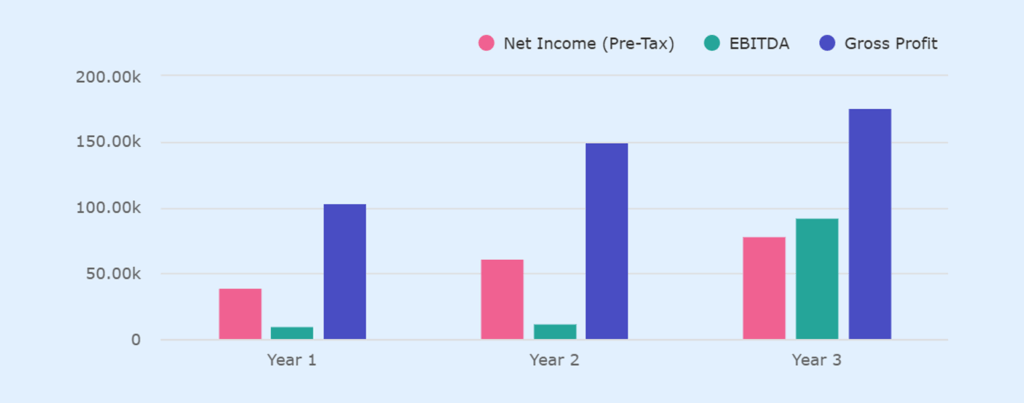
| Gross Profit | 103,500 | 150,000 | 175,500 |
| Gross Margin | 41.1% | 43.0% | 43.0% |
| Operating Expenses (OPEX) | |||
| Rent | (31,200) | (32,000) | (33,000) |
| Utilities | (4,500) | (4,700) | (4,900) |
| Insurance | (3,600) | (3,800) | (4,000) |
| Marketing & Advertising | (5,000) | (5,500) | (6,000) |
| Software & Booking Tools | (2,160) | (2,200) | (2,300) |
| Maintenance & Misc. | (2,400) | (2,500) | (2,600) |
| Operational Friction / Leakage | 0 | (4,500) | (6,000) |
| Owner Compensation | 0 | (18,000) | (24,000) |
| Total Operating Expenses | (48,860) | (73,200) | (82,800) |
| EBITDA | 54,640 | 76,800 | 92,700 |
| EBITDA Margin | 21.7% | 22.0% | 22.7% |
| Depreciation | (8,500) | (8,500) | (8,500) |
| EBIT | 46,140 | 68,300 | 84,200 |
| Interest Expense | (7,200) | (6,600) | (5,900) |
| Net Income (Pre-Tax) | 38,940 | 61,700 | 78,300 |
Cash Flow Statement
| Line Item | Year 1 ($) | Year 2 ($) | Year 3 ($) |
|---|---|---|---|
| Operating Activities | |||
| Net Income (Pre-Tax) | 38,940 | 61,700 | 78,300 |
| Add: Depreciation | 8,500 | 8,500 | 8,500 |
| Change in Accounts Receivable | (1,500) | (1,500) | (2,000) |
| Change in Payables & Accruals | 2,500 | 2,800 | 3,000 |
| Net Cash from Operations | 48,440 | 71,500 | 87,800 |
| Investing Activities | |||
| Buildout & Equipment (Capex) | (60,800) | 0 | 0 |
| Net Cash from Investing | (60,800) | 0 | 0 |
| Financing Activities | |||
| Bank Loan Proceeds | 90,000 | 0 | 0 |
| Owner Cash Contribution | 25,000 | 0 | 0 |
| Loan Principal Repayment | 0 | (12,000) | (12,000) |
| Owner Distributions | 0 | (18,000) | (24,000) |
| Net Cash from Financing | 115,000 | (30,000) | (36,000) |
| Net Change in Cash | 102,640 | 41,500 | 51,800 |
| Beginning Cash | 54,500 | 157,140 | 198,640 |
| Ending Cash | 157,140 | 198,640 | 250,440 |
Balance Sheet
| Line Item | Year 1 ($) | Year 2 ($) | Year 3 ($) |
|---|---|---|---|
| Assets | |||
| Cash | 157,140 | 198,640 | 250,440 |
| Accounts Receivable | 1,500 | 2,500 | 3,500 |
| Prepaid Expenses | 3,000 | 3,200 | 3,400 |
| Total Current Assets | 161,640 | 204,340 | 257,340 |
| Buildout & Equipment (Gross) | 60,800 | 60,800 | 60,800 |
| Accumulated Depreciation | (8,500) | (17,000) | (25,500) |
| Net Fixed Assets | 52,300 | 43,800 | 35,300 |
| Total Assets | 213,940 | 248,140 | 292,640 |
| Liabilities | |||
| Accounts Payable & Accruals | 3,000 | 5,500 | 8,000 |
| Current Portion of Term Loan | 12,000 | 12,000 | 12,000 |
| Long-Term Term Loan | 78,000 | 66,000 | 54,000 |
| Total Liabilities | 93,000 | 83,500 | 74,000 |
| Equity | |||
| Owner Capital Contribution | 25,000 | 25,000 | 25,000 |
| Retained Earnings | 95,940 | 139,640 | 193,640 |
| Total Equity | 120,940 | 164,640 | 218,640 |
| Total Liabilities + Equity | 213,940 | 248,140 | 292,640 |
Break-Even Analysis
| Break-Even Component | Value/Range |
|---|---|
| Monthly Fixed Operating Costs (OPEX) | ~$7,100 |
| Rent | ~$2,600 |
| Utilities | ~$350 |
| Insurance | ~$300 |
| Software & booking tools | ~$180 |
| Maintenance & Misc. | ~$200 |
| Marketing | ~$650 |
| Owner Compensation (Year 2+) | ~$2,000 |
| Base Fixed Cost Used | ~$7,100/month |
| Variable Cost Ratio (COGS % of Revenue) | ~56–58% |
| Contribution Margin | ~42–44% |
| Monthly Break-Even Revenue | $16,200 – $17,500 |
| Implied Capacity Utilization at Break-Even | ~45–50% |
| Max Monthly Capacity (2 rooms) | ~$36k–$38k |
| Break-even Utilization | ~50% |
The Quickest Way to turn a Business Idea into a Business Plan
Fill-in-the-blanks and automatic financials make it easy.
