




Starting a tire shop—whether a retail storefront, a mobile service, or a tire repair garage—requires more than just a passion for cars and a good location. It requires a solid business plan that outlines how the shop will operate, generate revenue, and grow over time.
Not sure how to draft your plan?
Don’t worry! This tire shop business plan template walks you through each step, with practical examples and visuals to guide you.
How to draft a successful tire shop business plan?
Writing a business plan for your tire shop is a step-by-step process. It may seem daunting, but you can break it down into manageable sections.
Here’s a guide on how to outline each component of a tire shop business plan and what to include in it.
1. Executive Summary
The executive summary is the first section of your tire shop business plan, but it’s often written last, after you’ve detailed everything else.
This summary provides an overview of your entire plan in a few paragraphs. The goal is to grab the reader’s attention and give a clear snapshot of what your tire shop is about and why it will succeed.
Here’s how to approach your executive summary:
- Highlight the type of tire shop you’re running, where you stand currently, and a quick highlight of your plan’s key points.
- Mention your target market and why they need your services.
- Summarize your competitive advantage—maybe you’re located off a busy highway, or offer 24/7 mobile tire changes.
- Add a short overview of your marketing strategy as well as introduce your management team.
- Give a clear snapshot of your financial projections and funding needs (if any).
Some readers may only read the executive summary, so it should clearly show that your tire shop is a solid opportunity. Keep the tone confident and forward-looking, without going into too much detail.
Say goodbye to boring templates
Build your business plan faster and easier with AI
Plans starting from $14/month

2. Business Overview
The business overview (also called the company description) sets the stage for your entire tire shop business plan. It explains what your shop is, what it offers, and what your goals are, both short- and long-term.
In this section, you’ll need to describe the type of tire shop you’re opening, your background, business location, legal structure, and your mission and vision statements. It gives readers a full understanding of who you are and what your business aims to achieve.
Here are the key elements to include in your business overview:
Business Type and Model
Describe the kind of tire shop you’re running. Is it a retail store that sells multiple brands? A tire repair center that offers alignments and minor auto repairs? A mobile service that changes tires at the customer’s location? Or a mix of these? Be specific so your readers understand your business scope.
Business Background
Share when and why you started (or plan to start) your shop. For example, maybe you saw a gap in the local market for affordable tire service or have years of industry experience.
If you’re already operating, include key milestones like customer volume, online ratings, or business partnerships.
Legal structure and Location
State whether you’re a sole proprietor, LLC, or corporation—this affects taxes and liability.
Mention where your shop is located or the area you plan to serve. If you have a physical shop, describe the facility. If mobile, explain how your vehicle setup supports operations.
Mission and Vision
Your mission is a short statement about your purpose. Your vision outlines where you’re headed long term.
Overall, the business overview should give a clear, full picture of your shop’s identity, structure, and goals. Readers should come away knowing exactly what your business does and where it’s headed.
3. Industry and Market Research
No tire shop operates in a vacuum—you need to understand the tire repair industry and your local market. In this section, you’ll present your research on the industry trends, target customers, and competition.
Showing that you’ve done your homework on market conditions will reinforce that your business plan (and business idea) is built on facts, not just hopes.
Here are the key elements to include in your market analysis:
- Industry overview
- Target market
- Customer personas
- Competitive analysis
- Market gaps
- Market outlook and challenges
Finally, summarize the market outlook. Is your area growing? Are there seasonal peaks (that you can prepare for? Acknowledge any challenges, too.
By the end of the industry and market research section, the reader should be convinced that you understand the playing field and position yourself effectively.
4. SWOT Analysis
Every business has internal strengths and weaknesses, as well as external opportunities and threats. Performing a SWOT analysis helps you summarize these factors for your tire shop.
Below is a clear breakdown of the SWOT analysis matrix that highlights what these factors might look like for a typical tire shop:
- Strengths: These are internal advantages. For example, extensive industry experience, a prime location with lots of drive-by traffic.
- Weaknesses: These are internal challenges or limitations. Perhaps you’re a brand-new entrant, or you have limited capital or inventory.
- Opportunities: These are external chances to grow or improve. Look at market trends and gaps for this.
- Threats: External factors that could harm your business. Common threats include increasing competition, price pressures, and economic downturns. Identifying threats allows you to prepare contingency plans.
Here’s a simple SWOT analysis chart for your reference and to help bring valuable insights together.
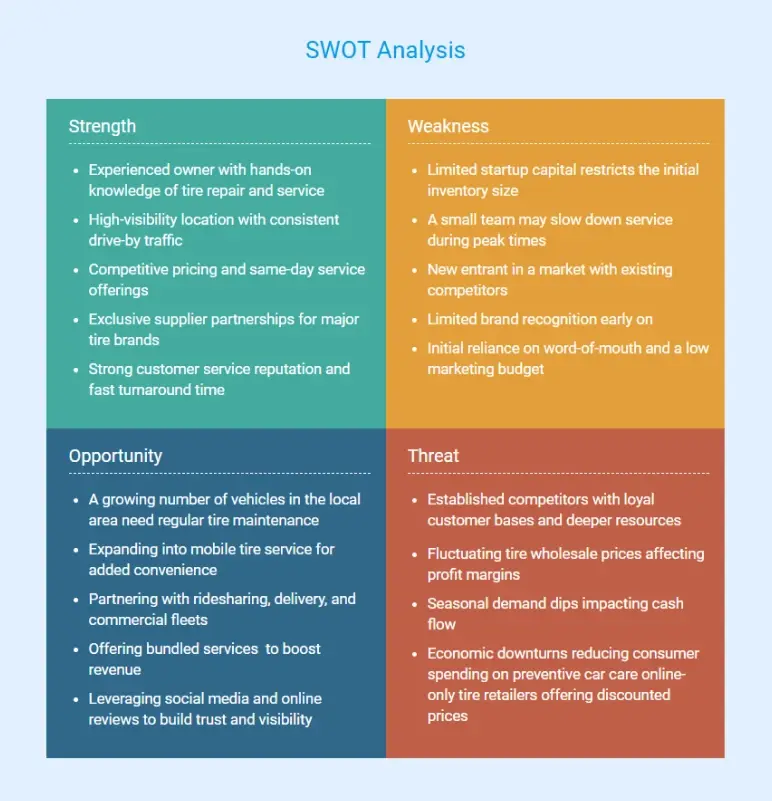
Conducting a SWOT analysis not only helps in internal planning but also shows readers (or lenders) that you’ve thoughtfully analyzed your business environment.
5. Products and Services
Now, let’s get into the nuts and bolts of what you’re selling and how you’ll earn revenue. This section should detail the core offerings of your tire shop.
For a tire shop business, this typically includes:
- Tire sales: List the types of tires you’ll sell—new tires by brand, size, and vehicle type, and possibly used tires if you plan to stock specialty tires like performance tires, winter/snow tires, or off-road tires if relevant.
- Services: Most tire shops offer related services. These can include tire installation and mounting, wheel balancing, tire rotation, wheel alignment, and tire pressure monitoring system services.
- Additional offerings: Think about what else makes sense. Some tire shops also offer brake service, oil changes, or minor auto repairs to create additional revenue streams.
It’s also helpful to convey not just what you’ll offer, but any notable features or policies. These details can set you apart and should be included in your business plan to show the value you’re delivering to customers.
By clearly outlining your products and services, the reader of your plan will understand exactly how your tire shop will earn money.
6. Sales and Marketing Strategy
“Build it and they’ll come” doesn’t always work, especially not in the tire business, where competition can be stiff and customers have many options. Your sales and marketing strategy section explains how you’ll attract customers to your tire shop, make sales, and grow your revenue.
Start with your marketing plan, which often involves the “4 Ps”—Product, Price, Place, Promotion—tailored to your tire shop.
You already detailed your products and services. In marketing terms, reaffirm how your offering meets customer needs.
Next, explain your pricing strategy relative to the market. Are you pricing competitively to win customers? Or are you at a premium because you offer superior service or convenience?
Describe how your location will help you reach customers. If you have a physical store, emphasize visibility, accessibility, and the area.
After that, list the marketing channels and tactics you’ll use:
- Online marketing
- Social media
- Promotional partnerships
- Grand opening or periodic promotions
Your marketing section should convey that you know who your customers are and how to reach them effectively.
On the sales strategy side, discuss how a customer’s journey looks and how you maximize sales.
Also, mention the sales process—do customers schedule appointments, or is it mostly walk-in? Describe how you’ll keep customers coming back to your shop.
By laying out a robust sales and marketing strategy, your plan demonstrates that you have a concrete plan to generate revenue and grow your customer base, not just hoping that customers find you. It shows you’re proactive and savvy about how to compete in the marketplace.
7. Operations Plan
The operations plan details how your tire shop will run on a day-to-day basis, as well as how to reach your longer-term operational goals.
Essentially, this section turns the strategies from earlier sections into action. What do you need to do regularly to deliver your products and services, and what milestones do you aim to achieve over time?
Break your operations plan into two parts: short-term processes and long-term plans.
Everyday operations (short-term processes)
Describe the typical workflow of your tire shop. This can include:
Opening and closing routines
Outline daily tasks such as setting up equipment, checking inventory, shop hours, and closing out the register at the end of the day.
Team responsibilities
Detail who does what. Tire technicians handle the manual work, a front-desk person handles billing and customer intake, and you oversee operations and jump in as needed.
Inventory management
Tires are bulky and come in many sizes, so managing inventory is key. Explain how you’ll manage stock.
Customer service & admin
How will appointments be scheduled (phone, online booking)? How will you handle record-keeping?
Also, note any software or systems you use for operations, like accounting software, inventory management tools, or a CRM for customer follow-up.
Long-term operational goals (milestones)
This is where you outline key goals and expansion plans. Think in terms of 6 months, 1 year, 5 years down the line:
- Growth milestones
- Financial milestones
- Operational improvements
- Future services or offerings
In summary, the operations plan should reassure the reader that you know how to execute your business on a practical level. You’ve thought through the daily grind as well as the big-picture expansion.
This is where the grand ideas meet reality, demonstrating that your tire shop can run efficiently from day one and can scale up as needed.
8. Management Team
The success of a tire shop—or any small business—is predicated on its management team and operational aspects. This section helps present the individuals who help build up your tire shop and why they will make it work.
Generally, this section includes the owner(s), the store manager, and the lead technicians.
As a tire shop owner, provide a brief bio highlighting your experience, industry knowledge, and individual strengths relating to effectively managing a shop.
If you have key team members, describe the qualifications and responsibilities of the store or operations manager. If the business is in the process of being owner-operated, focus on the team of technicians or support staff.
After that, include a simple organization chart that clearly shows how your team is structured and how decisions are made. For instance:
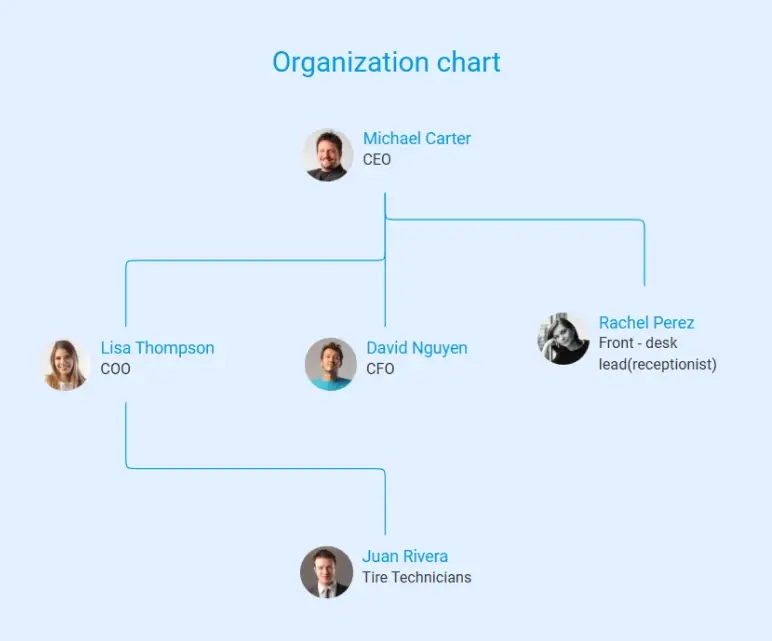
If your team involves any advisors or external support, mention them as well. Explain how those independent professionals or advisors are supporting your tire shop.
9. Financial Plan
The financial plan is where you outline the expected financial performance of your tire shop. This section gives credibility to your business by showing that the numbers add up and make sense.
It usually includes projections for revenue, expenses, and profits for the next 3-5 years, as well as an explanation of how you arrived at those numbers.
If you’re seeking funding, this section also shows how much you need and how it will be used.
The following are the key components to include in the tire shop financial plan:
- Startup costs
- Revenue projections
- Operating expenses
- Profit & loss statement
- Cash flow estimates
- Balance sheet projections
- Break-even analysis
Lastly, address the financial viability of your tire shop, showing that even under conservative estimates, the business can sustain itself.
Also, mention that you’ll be monitoring your finances closely, perhaps using accounting software and reviewing monthly, which shows you plan to stay on top of the numbers.
Why do you need a business plan for a tire shop?
Writing a business plan might feel like a lot of work, but it’s crucial for a tire shop’s success. Here are a few key reasons why having a business plan is important for a tire shop owner:
- Clarity and strategy: A business plan forces you to outline your business strategy in detail. You’ll clarify what services and products you’ll offer, what sets you apart, and how you’ll operate day-to-day.
- Understanding the market: In preparing the plan, you’ll conduct industry and market research, learning about the local demand for tires, seasonal trends, and what competitors are doing.
- Securing financing: If you need to borrow money or attract investors to start or grow your tire shop, a business plan is non-negotiable.
- Operational guidance: A business plan isn’t just for outsiders—it’s a management tool for you. It sets milestones and targets. By referring back to your plan, you can measure progress and make better decisions.
In short, a business plan helps you organize your ideas, anticipate challenges, and chart a course for success. Next, let’s dive into how to draft a successful tire shop business plan, step by step.
Download a free tire shop business plan template
Ready to create your own tire shop business plan, but not sure where to start? We’ve got you covered. Download our free tire shop business plan template (PDF) to help you get started with clarity and confidence.
This template includes a simple outline and sample content for every key section. It’s fully customizable to fit your shop, whether you’re opening a small neighborhood tire service or a full-service auto care center. It saves you time, keeps you organized, and ensures you don’t overlook any critical details.
The Quickest Way to turn a Business Idea into a Business Plan
Fill-in-the-blanks and automatic financials make it easy.

Conclusion
That’s a wrap! We’ve covered all the essential parts of a tire shop business plan and how to approach each one. Plus, you have a ready-to-use sample to guide your next step.
Still, feeling stuck or want to move faster? Tools like Upmetrics can help you streamline the entire planning process.
With built-in AI support, financial forecasting tools, customizable templates, and expert resources, you can build a solid, professional plan quickly and efficiently.
So, why wait? Start planning now!


