




You already know how to build a travel itinerary, manage a client relationship, and close a supplier deal. But what trips most people up is turning all of that into a solid plan that a bank will actually say yes to.
How do you show revenue projections for a business that runs on commissions? What does an SBA lender even want to see? How much do you need to get started?
But there’s a lot to figure out on your own.
That’s exactly what this sample is here for. It shows you how Wanderlux Travel Group, a full-service travel agency launching in Brookhaven, Georgia, structures its financials, positions its services, and makes the case to an SBA lender.
Use it as your reference. And build your own plan from here!
Executive Summary
Wanderlux Travel Group is a full-service travel agency launching in Brookhaven, Georgia, in April 2026.
We are seeking $120,000 in SBA 7(a) financing from Community First Bank, plus $30,000 in owner equity, for $150,000 in total startup capital. Those funds cover office setup, technology, marketing launch, and a working capital reserve of $110,600.
Business Model
Wanderlux runs two revenue streams. Leisure travel generates commissions of 10-15% plus planning fees. Corporate travel management delivers predictable monthly contract revenue from managed travel programs.
Host agency affiliation provides IATA (International Air Transport Association) accreditation and pre-negotiated supplier contracts from day one. That’s what allows a new agency to earn competitive position rates without years of direct supplier relationships.
On the corporate side, we are targeting 10 to 15 accounts by the end of Year 1, at $500 to $1,500 per month in management fees per account.
Market Opportunity
Travelers are coming back to advisors:
- Travel advisors booked $119.3 billion in travel in 2024, with continued growth projected by the U.S. Bureau of Labor Statistics.
- Travel advisor-assisted bookings grew faster than any other channel in 2025, with an estimated 13.3 million Americans actively seeking professional advisory help.
Greater Atlanta’s metro population of 6.4 million includes a concentrated base of high-income households in Brookhaven, Buckhead, and Dunwoody.
Brookhaven’s Dresden Drive corridor is lined with financial advisory firms, boutique law practices, and architecture studios. These are exactly the dual-income professionals who travel two to three times per year and want someone to handle the complexity. That’s the client Wanderlux is built for.
Our Team
Wanderlux is led by Nicole Pratt and Marcus Pratt. Nicole Pratt holds a Certified Travel Associate designation with 10 years of advisory experience.
She most recently managed a team of eight agents at a full-service agency before launching Wanderlux to build her own client base under her own brand. She leads all leisure and specialty bookings.
Marcus Pratt brings seven years of corporate sales experience and a BBA in Marketing from Georgia State University. He handles all corporate prospecting and account management.
In practice, each owner runs their segment independently, which keeps operations clean from day one.
Financial Snapshot
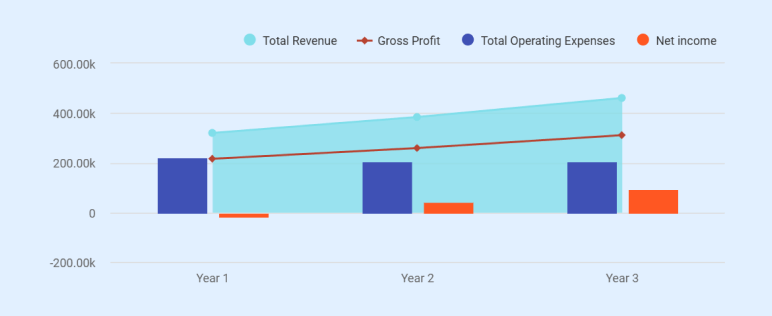
The financial projections reflect a conservative ramp. Year 1 projects a pre-tax loss of $16,630, driven almost entirely by $16,000 in one-time startup expenses that do not repeat in Year 2 or beyond.
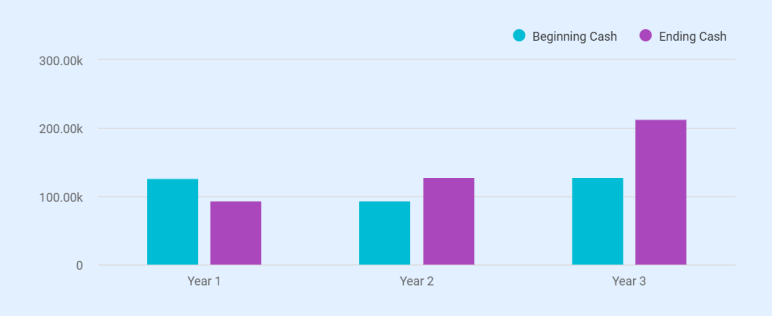
Even after absorbing that loss, ending cash closes Year 1 at $93,556, a healthy reserve that supports continued operations and loan repayment without interruption.
Year 2 returns $43,220 in net income. Annual debt service is $17,093. That produces a debt service coverage ratio of 2.53x, well above the SBA’s standard 1.25x threshold. The business breaks even at 608 bookings per year (51 per month). Year 1 projects 640.
| Line Item | Year 1 ($) | Year 2 ($) | Year 3 ($) |
| Total Bookings | 640 | 768 | 922 |
| Total Revenue | $320,000 | $384,000 | $460,800 |
| Gross Profit | $216,000 | $259,200 | $311,040 |
| Net Income (Pre-Tax) | ($16,630) | $43,220 | $95,761 |
| Ending Cash | $93,556 | $127,833 | $213,424 |
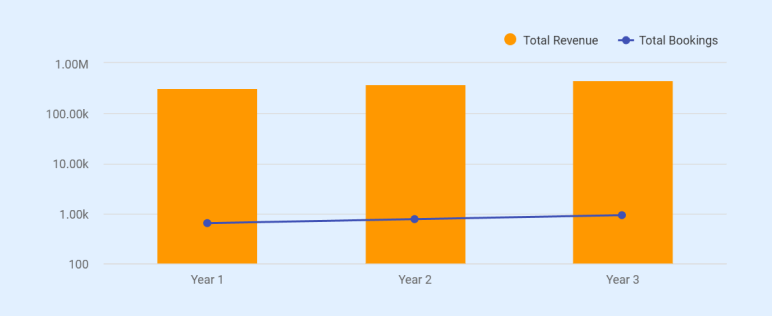
The SBA 7(a) loan carries a monthly payment of $1,424 at 7.50% fixed over 10 years. Wanderlux’s Year 2 net income of $43,220 covers annual debt service of $17,093 with room to spare.
The business does not require a second loan to reach profitability. It requires time, consistent bookings, and the referral network that both owners have already started building before launch.
Company Overview
Wanderlux Travel Group is a Georgia-registered limited liability company, headquartered in Brookhaven, Georgia, 30319.
It’s filed with the Georgia Secretary of State with an active EIN (Employer Identification Number) and full ASTA (American Society of Travel Advisors) membership.
The company operates from 600 square feet of leased office space in Brookhaven at $2,000 per month. Brookhaven sits between Buckhead, Dunwoody, and Sandy Springs. These are three of Greater Atlanta’s most affluent neighborhoods.
Being accessible to all three without the overhead of a higher-rent district keeps fixed costs manageable from day one.
At Wanderlux, we provide full-service travel planning for Greater Atlanta’s leisure and corporate clients, held to advisor-led service standards.
Through its host agency affiliation, the company secures IATA accreditation, global distribution system (GDS) access, and pre-negotiated supplier contracts from launch. This is what allows a new agency to earn competitive commission rates immediately, without years of direct supplier relationship building.
Wanderlux carries errors & omissions (E&O) insurance and general liability coverage from launch, with seller-of-travel registration filed for clients in regulated states.
Quick facts:
| Entity Type | Limited Liability Company (LLC) |
| State of Registration | Georgia |
| Headquarters | Brookhaven, GA 30319 |
| Office Size | ~600 sq ft leased commercial space |
| Monthly Rent | $2,000 |
| Launch Date | April 2026 |
| Industry Association | ASTA Member |
As said earlier, advisor-assisted bookings are growing faster than any other booking channel in the U.S. right now. Greater Atlanta’s post-pandemic travel demand has recovered strongly.
The suburban markets Wanderlux targets have seen rising disposable incomes with limited boutique advisory options.
As the market data shows, both leisure and corporate travel have fully recovered post-pandemic and are growing. April 2026 is a deliberate launch window, not a default start date.
Ownership
Nicole Pratt: CEO & Lead Travel Advisor
Nicole holds a Certified Travel Associate designation and a Bachelor’s in Hospitality Management from the University of Central Florida.
She spent 10 years at a full-service Atlanta agency, managing a team of eight advisors for the final four years. She left that role in late 2025 to launch Wanderlux on her own terms.
Marcus Pratt: COO & Corporate Sales
Marcus holds a BBA in Marketing from Georgia State University and spent seven years selling managed services contracts to mid-size companies across Atlanta.
He completes his transition from that role in July 2026, meaning corporate outreach runs at reduced capacity through Q2. That timeline is already factored into Year 1 projections.
Keys to Success
Wanderlux’s path to profitability depends on 5 operational factors. Each one is measurable and tracked monthly from launch.
- Securing host agency commission rates of 10-15% across leisure bookings from day one
- Marcus closing at least 10 corporate accounts at $500-$1,500/month before December 2026
- Nicole maintaining a 40%+ client repeat rate by the end of Year 2
- Keeping each advisor’s active client load at 20 projects maximum to protect service quality
- Generating 30+ referral introductions annually through the partner network by Year 2
Growth Milestones
We have defined clear milestones for the first three years of operation:
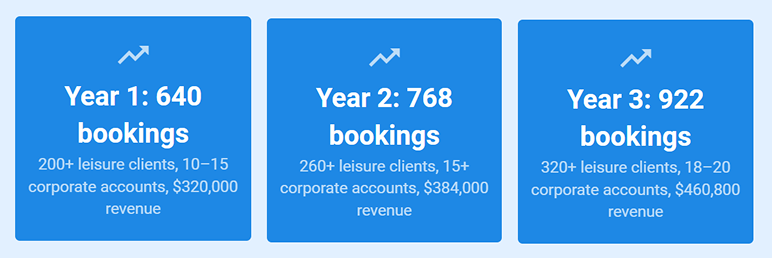
These milestones reflect a steady growth approach supported by our operational capacity and financial projections.
Travel Industry & Market Analysis
Industry Overview
As outlined earlier, travel advisors booked $119.3 billion in 2024, and advisor-assisted bookings are growing faster than any other booking channel. But the headline number alone doesn’t tell the full story.
The common assumption is that online platforms have replaced advisors. The data says otherwise.
- According to the survey of 25,000 North American travelers, 74% want a travel expert with them on vacation, despite the wide availability of booking apps and platforms.
- International travel now accounts for 80% of total advisor bookings, the highest share ever recorded, with demand continuing to grow.
- Around 85% of luxury travelers view travel advisors as essential for handling disruptions and securing seamless experiences
That’s the clear reasoning. OTAs (Online Travel Agencies) handle simple point-to-point bookings reasonably well. They fall apart on multi-destination itineraries, group travel, and anything requiring real-time problem-solving.
The demand for human expertise is growing. 58% of Millennial and Gen Z travelers want a travel advisor for major, complex trips. The BLS (U.S. Bureau of Labor Statistics) projects approximately 7,100 travel agent job openings annually through 2034.
And most importantly, total U.S. travel spending is projected at $1.35 trillion in 2025, growing to $1.49 trillion by 2029. That growth is not evenly distributed.
Markets with high household incomes and strong corporate travel demand tend to outperform national averages. Greater Atlanta is one of them. And that’s where Wanderlux is launching.
The Atlanta Market
Atlanta is Delta Air Lines’ primary hub. That single fact shapes the city’s travel culture more than any demographic statistic.
Atlanta residents fly more frequently than the national average. Corporate travel is embedded in how business operates here. The companies Wanderlux targets already have employees on planes every week.
| Market Indicator | Data |
| Metro Atlanta population | ~6.4 million |
| Brookhaven city median household income | $117,663 |
| ZIP 30319 median household income | $130,648 |
| Dunwoody city median household income | $121,903 |
| Fortune 500 headquarters in metro | 13 |
| Fortune 1000 headquarters in metro | 23 |
| Total metro businesses | 150,000+ |
Brookhaven, Buckhead, and Dunwoody have a strong base of high-income households. These are frequent travelers who prefer curated experiences over self-booking.
At the same time, Atlanta has a large number of mid-size companies that require regular travel for meetings, events, and operations.
Travel demand is also balanced:
- Leisure travel peaks during holidays and summer
- Corporate travel remains steady throughout the year
This balance supports Wanderlux’s dual revenue model and reduces dependency on one segment.
Wanderlux’s target area holds 15,000+ affluent households and 2,000+ mid-size companies. Reaching 200 leisure clients and 15 corporate accounts by the end of Year 1 is less than 1.5% of either segment.
The plan does not need a large market share. It needs the right clients within a well-defined slice of it.
Target Customer Profile
Wanderlux focuses on two clear customer segments.
1. Leisure Travelers
Who they are
- Age 35 to 60, dual-income couples or empty nesters
- Household income $150,000+
- Brookhaven, Buckhead, Dunwoody
- At least one international trip per year
What they want
- One contact who owns the entire trip from booking to return
- One single expert recommendation, not 12 options to scroll through
- Someone accountable when things go wrong
Pain points
- Self-booked trips that cost more to fix than an advisor would have charged
- No support when a flight cancels or a hotel loses the reservation
- Review sites that leave them more confused than when they started
Behavior
- Two to three trips per year, $4,000 average booking value
- Lifetime annual value: $8,000 to $12,000 per retained client
- Referral-driven. Each satisfied client averages two to three introductions.
- Repeat client target: 40% by Year 2
2. Corporate Clients
Who they are
- 50 to 500 employees, Greater Atlanta metro
- No central booking oversight
- Travel spend largely untracked
What they need
- Centralized booking with a travel policy that employees follow
- Monthly spend reports and quarterly reviews
- One number to call at 6 AM when something goes wrong
Pain points
- Employees booking outside policy using personal loyalty programs
- No system to audit whether the lowest fare was selected
- National TMCs with minimum account sizes that exclude mid-size companies
Behavior
- 20 to 50 bookings per month, $1,500 average booking value
- One retained corporate account outperforms 36 individual leisure bookings annually
- Office managers flag the problem, CFOs sign the contract
- Door opener: Marcus’s free travel audit
- Contract: annual managed travel agreement with quarterly reviews
Competitive Analysis
Wanderlux sits in a space most competitors do not occupy: boutique personal service combined with modern technology and a dual leisure-corporate model. Understanding why requires looking at who is already in the market and what each one cannot do.
Greater Atlanta’s travel market has four competitor categories:
- OTAs (Online Travel Agencies) like Expedia and Booking.com
- National TMCs (Travel Management Companies) like BCD Travel and American Express Global Business Travel
- Independent local agencies like KK Travels Worldwide and Condor Tours
- Home-based and franchise advisors affiliated with networks like Dream Vacations and Travel Leaders
The table below breaks down each competitor category across service type, capability, and key limitations.
Competitor Comparison
| Category | Expedia / Booking.com | Amex GBT / BCD Travel | KK Travels / Condor | Home-Based Advisors |
| Type | OTA | National TMC | Local boutique leisure | Franchise / hosted |
| Serves | Self-service leisure | Large enterprise (500+ employees) | Leisure only | Leisure only |
| Pricing model | Free to book, fees on changes | High transaction fees + management contracts | Commission + planning fees | Commission-based |
| Personal service | None | Dedicated managers for large clients only | High | Medium |
| Corporate capability | None | High | None | None |
| Where they fall short | No human support. No accountability when trips go wrong. | Priced out of reach for mid-size companies. | Leisure-only. No corporate programs. | No physical office. No corporate capability. Harder to verify credentials. |
The Gap We Fill
One honest note for the Wanderlux: The real competitive gap is the startup disadvantage. No client base, no track record, and no brand recognition at launch. That is a genuine vulnerability.
What offsets it is Nicole’s existing client relationships, Marcus’s seven-year corporate network in Atlanta, and host agency supplier access that takes most independent agencies three to five years to build on their own.
The position itself is straightforward. No agency in the Brookhaven and Buckhead corridor currently combines high personal service, modern booking technology, and a dual leisure-corporate model.
KK Travels and Condor serve leisure clients well, but stop there. National TMCs handle corporate travel but are priced out of reach for a 100-person Atlanta company. Home-based advisors keep costs low but have no office and no corporate programs.
Wanderlux does not compete on commodity bookings. It competes on complexity, relationships, and accountability. That is a deliberate choice.
Our Competitive Moat
Three factors make Wanderlux’s position difficult to replicate quickly.
- Host agency relationships provide supplier access and commission rates that take new entrants years to build independently.
- Corporate travel contracts carry natural switching costs. Once a company’s travel policy, reporting, and booking workflow are set up through Wanderlux, changing providers means rebuilding all of it.
- The referral network in Brookhaven and Buckhead compounds over time. Each satisfied leisure client becomes a potential source of two to three future introductions. That dynamic is slow to build and hard to displace.
Travel Services & Pricing
Wanderlux offers four distinct service categories, each generating revenue through a combination of supplier commissions and client-facing fees.
Leisure bookings deliver higher per-transaction margins. Corporate management fees deliver month-to-month predictability. Group and specialty travel add volume without requiring additional headcount in Year 1.
All commission rates are secured through host agency affiliation and consortium membership from day one, which is what makes competitive supplier rates available to a new agency from launch. Revenue breaks down as approximately 54% leisure, 28% corporate, and 18% group across Year 1 bookings.
All service fees are disclosed upfront and non-negotiable. That policy is deliberate. Waiving fees to win clients trains them to expect free work. Wanderlux does not compete that way.
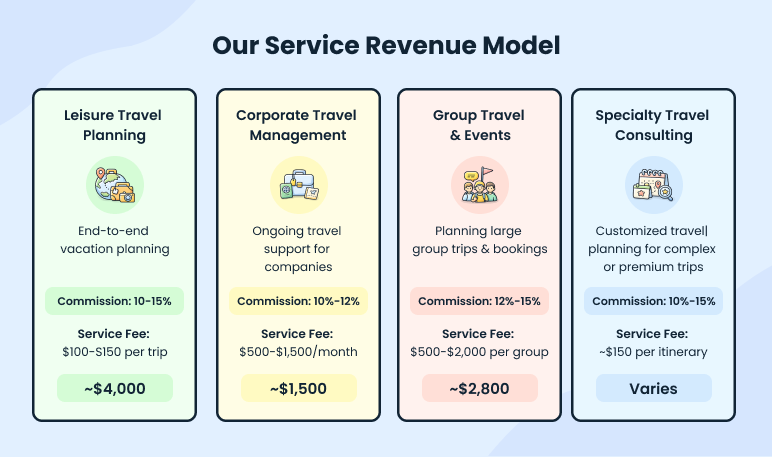
The sections below explain what each service includes, how it is delivered, and how it contributes to overall revenue.
Leisure Travel Planning
Full-service vacation planning for individuals and couples booking luxury resorts, river cruises, all-inclusives, and safaris. This is not a flight-and-hotel assembly. It is end-to-end planning for trips that typically run $4,000 or more.
Cruises and all-inclusive packages booked through consortium relationships pay up to 15 to 16 percent commission.
Airlines pay almost nothing, which is why the leisure mix is weighted toward full itinerary planning rather than standalone flight bookings.
Pricing
- 10%–15% commission from suppliers
- $100–$150 planning fee per trip
Capacity
- Each advisor handles 15–20 active clients at a time
Corporate Travel Management
Managed travel programs for mid-size companies with regular travel needs but no formal travel policy. Marcus handles all corporate accounts from initial outreach through onboarding and ongoing management.
Clients receive a single point of contact, monthly spend reports, and 24/7 after-hours support through the host agency emergency line for in-travel disruptions.
Marcus and Nicole are not personally staffing overnight support. That coverage comes through the host agency infrastructure.
Pricing
- 10%–12% commission
- $500–$1,500 monthly management fee
- Average booking value of ~$1,500
Capacity
- Target of 10–15 corporate accounts in Year 1
Group Travel & Events
Corporate retreats, incentive trips, destination weddings, and family reunions for groups of 10 or more travelers. The planning complexity is beyond what OTAs can handle and more than most local independent agencies take on.
It covers coordinating flights, accommodation blocks, ground transfers, and event programming across multiple parties.
Corporate retreat bookings come through Marcus’s corporate accounts. Destination weddings come through referrals from wedding planners. Family reunion bookings come through leisure client relationships.
Pricing
- 12%–15% commission
- $500–$2,000 planning fee per group
- Average revenue of ~$2,800 per group
Capacity
- Around 20 group events planned in Year 1
Specialty Travel Consulting
Honeymoons, adventure travel, accessibility travel, and multi-generational trips. These require deeper customization and more advisor time than standard leisure bookings.
Nicole built her specialty credentials across 10 years of luxury advisory work, including multi-leg international itineraries, accessibility travel, and luxury safari coordination.
Pricing
- 10%–15% commission
- $150 consulting fee per itinerary
Capacity
- Limited volume to maintain service quality
Supplier & Partner Network
A travel agency’s profitability depends on its relationships with suppliers. At Wanderlux, we’re not starting from scratch. We’ve built our setup around a host agency and partner network that gives us access to suppliers, systems, and commission structures from day one.
Host Agency Relationship
Wanderlux affiliates with Nexion, a full-service host agency and ASTA member. Through Nexion, Wanderlux gains access to:
- IATA (International Air Transport Association) and CLIA (Cruise Lines International Association) accreditation
- GDS (Global Distribution System) access via Sabre or Amadeus
- Pre-negotiated supplier contracts from day one
Nexion retains 20-30% of gross commissions as a fee for that infrastructure. This is standard industry practice and is already reflected in revenue projections. Supplier contracts become accessible upon finalizing the affiliation agreement before the April 2026 launch.
Consortium Membership
Through Nexion, Wanderlux gains access to Signature Travel Network, a consortium that negotiates collectively with suppliers for preferred rates and overrides.
Key benefits include:
- Commission overrides above standard rates based on booking volume
- Preferred supplier status with major hotel, cruise, and tour operator partners
- Marketing co-op funds for client-facing promotions
- FAM (Familiarization) trip access for advisors
FAM trips are not a travel perk. They are how Nicole and the team stay current on luxury destinations, verify supplier quality firsthand, and maintain the recommendation credibility that clients pay planning fees for.
Key Suppliers
Key partners by category:
| Category | Key Partners | Commission Range |
| Cruise Lines | Royal Caribbean, Viking, Celebrity Cruises | 10-16% |
| Hotels | Marriott, Hilton, IHG | 8-12% |
| Tour Operators | Tauck, G Adventures, Abercrombie & Kent | 10-15% |
| Airlines | Delta Air Lines (Atlanta hub) | 1-5% |
For corporate accounts, Marcus will use Delta’s corporate travel program alongside Marriott and Hilton corporate rate agreements. The supplier network spans enough categories that no single relationship represents a critical dependency.
Technology Partners
GDS access runs through Sabre or Amadeus via Nexion. TravelJoy serves as the primary CRM for client and booking management, with ClientBase under evaluation as an alternative for larger account needs.
Travefy handles client-facing itinerary creation, which is the deliverable that differentiates a professional advisory experience from a self-booked trip.
QuickBooks Online manages accounting and commission tracking. Combined monthly technology spend is approximately $600, or $7,200 annually.
Marketing & Client Acquisition Strategy
Wanderlux’s marketing prioritizes relationship-driven acquisition: referrals, local partnerships, and community presence, supported by targeted digital campaigns.
The total annual marketing budget is $18,000, or 5.6% of Year 1 revenue. That is a conservative allocation for a referral-heavy service business where each satisfied client generates future introductions without additional spend.
Client Acquisition Channels
The $18,000 budget breaks down across four channels:
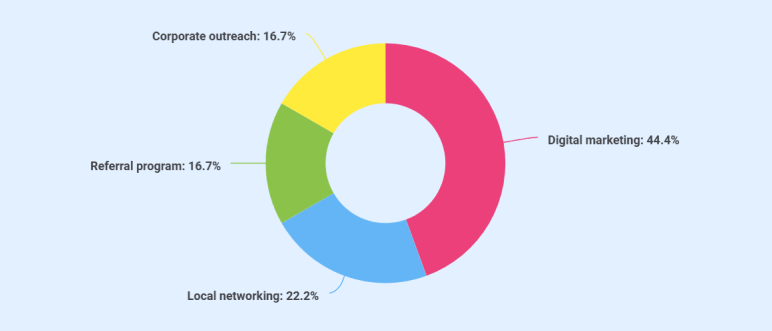
Wanderlux does not run discount promotions or compete on price. That channel was considered and rejected. Clients who find an advisor through a discount offer are not the clients who return for a $4,000 safari booking.
(1) Digital marketing ($8,000/year)
The agency website serves as the primary conversion point for both leisure and corporate inquiries. A blog covering Atlanta travel tips and destination guides supports organic search visibility. In addition:
- Instagram targets the leisure segment with destination content and client trip highlights.
- LinkedIn targets corporate decision makers with managed travel content and Marcus’s direct outreach.
- Google Business Profile captures local search intent from Brookhaven and Buckhead residents.
- A monthly email newsletter keeps past clients and warm leads engaged between bookings.
Combined, these channels are expected to generate 30 to 40 percent of Year 1 new client inquiries.
(2) Referral program ($3,000/year)
Each successful client referral earns a $100 travel credit, budgeted for 30 referrals in Year 1.
Partner referrals come from wedding planners, event coordinators, and luxury realtors operating in Brookhaven, Buckhead, and Dunwoody. These partners encounter clients who are planning significant life events and need travel coordination.
A referred client costs less to acquire and converts faster than a cold lead. Referrals are expected to generate 40-50% of Year 1 leisure bookings based on Nicole’s experience at her prior agency.
(3) Local networking ($4,000/year)
Wanderlux keeps an active membership in the Brookhaven Chamber of Commerce and hosts a Travel Night at the office once a quarter. These are casual events, open to existing clients and their guests. No formal pitch, no ask. Just good conversation that naturally leads to referrals.
The team also shows up at local bridal shows and corporate expos a few times a year. It is a slower channel than digital, but the introductions tend to be warmer and convert better over time.
(4) Corporate outreach ($3,000/year)
Marcus runs all corporate prospecting directly. Target companies are identified through the Atlanta Business Chronicle and LinkedIn.
Through Q2 2026, outreach runs in the evenings while Marcus completes his transition. He uses that period for research and LinkedIn introductions to warm prospects before the first live meeting.
The opening offer is a free corporate travel audit, which gives Marcus a specific reason to reach out and gives prospects a low-commitment entry point.
The audit typically surfaces overspending and policy gaps that Wanderlux can address immediately. This channel targets 10 to 15 signed corporate accounts by the end of Year 1.
Client Retention & Upsell
Acquiring a client is the beginning, not the goal. Wanderlux targets a 40% repeat booking rate by Year 2 through four retention practices:
- Annual review calls to plan the following year’s travel calendar
- Birthday and anniversary reminders with personalized trip suggestions
- Exclusive FAM trip-based destination offers for top leisure clients
- Quarterly business reviews for corporate accounts covering spend, policy compliance, and upcoming travel needs
Booking & Sales Flow
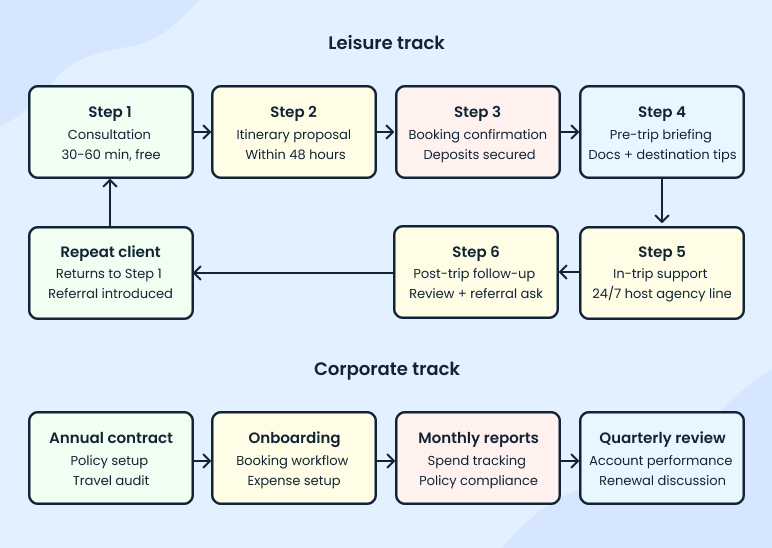
Every leisure client follows the same six-step journey from first contact to post-trip follow-up. The process is designed to set clear expectations, deliver at every stage, and end with a referral request built naturally into the closing conversation.
Corporate clients follow a parallel track: annual contract, onboarding, monthly reports, and quarterly business reviews.
Operations Plan & Management
Wanderlux operates from a dedicated office in Brookhaven with structured hours, defined daily workflows, and technology systems designed for a team of four.
Operating Hours & Scheduling
- Monday to Friday: 9:00 AM to 6:00 PM EST
- Saturday: 10:00 AM to 2:00 PM (by appointment)
- Sunday: Closed
- Emergency support: 24/7 via host agency after-hours line
Appointments are booked through Calendly, integrated directly with the CRM. Walk-ins are welcome during business hours.
Staffing & Team Structure
Two travel advisors are hired and onboarded before the April 2026 launch date. Onboarding includes CRM training, GDS access setup through Nexion, and a two-week shadowing period with Nicole before taking independent client bookings.
- Marcus operates in a part-time capacity through Q2 2026 and transitions to full-time in July 2026.
- Nicole and the two advisors carry a full operational load through the first two quarters. That constraint is factored into Year 1 corporate account projections.
The current four-person team supports a maximum of 60 concurrent active client relationships across three advisors at 20 clients each. When booking volume approaches that ceiling, the Year 3 advisor hire is triggered.
If one advisor leaves during Year 1, Nicole absorbs the active client load temporarily while a replacement is recruited. Based on current hiring timelines in the Atlanta market, a qualified replacement can typically be onboarded within 4 to 6 weeks.
At 922 projected bookings in Year 3, that threshold is expected to be reached by mid-year.
We also plan to add an admin and marketing coordinator at an estimated base of $45,000 to $50,000 when revenue supports additional costs. If required, we’ll add a third travel advisor at a comparable compensation structure to the existing advisors.
Compensation Overview
| Role | Year 1 Compensation | Notes |
| Nicole Pratt (CEO) | $65,000 | Below market rate, preserves Year 1 cash flow |
| Marcus Pratt (COO) | $55,000 | Part-time through Q2, full-time from July 2026 |
| Travel Advisor 1 | ~$40,000 | Base plus commission, classified as COGS |
| Travel Advisor 2 | ~$40,000 | Base plus commission, classified as COGS |
| Admin Coordinator | $45,000-$50,000 | Year 2 hire when revenue supports it |
| Travel Advisor 3 | ~$40,000 | Year 3 hire at 922 bookings/year |
Neither owner draws above Year 1 figures until Year 2 profitability is confirmed. Salaries remain flat at $120,000 combined through Year 3.
Profits are retained to build cash reserves, fund the Year 3 advisor hire, and accelerate loan repayment. Owner compensation will be reviewed once the business is fully scaled.
Daily Operational Workflow
The schedule accommodates 12 to 15 client touchpoints per day across the team. Each advisor carries a maximum of 20 active client projects at any time.
A complex international itinerary takes four to six hours of research and proposal time. At 20 active clients with staggered booking timelines, an advisor delivers all proposals within 48 hours without quality slipping.
When Nicole’s slots are full, new referrals route to Advisor #2. If both are at capacity, incoming clients go on a waitlist with a callback within 24 hours. Nicole reviews every proposal before client delivery, a practice from managing eight advisors at her prior agency.
During Q1 and Q2, Marcus runs corporate prospecting during evening hours. Full-time corporate sales begin in July 2026. January through March is the highest-pressure period.
Consultations run at maximum capacity as holiday travelers begin booking summer trips. During peak season, existing client proposals are prioritized, and Saturday hours are extended by appointment.
Licensing, Insurance & Compliance
Wanderlux launches with all required registrations and coverage in place:
- Georgia LLC filed with the Secretary of State, active EIN (Employer Identification Number)
- Seller-of-travel registration filed for clients in regulated states: California, Florida, Washington, and Hawaii
- ASTA (American Society of Travel Advisors) membership from launch
- E&O (Errors and Omissions) insurance: $1M coverage, renewed annually
- General liability insurance
- IATA (International Air Transport Association) and CLIA (Cruise Lines International Association) accreditation via Nexion host agency affiliation
Technology & Systems
Wanderlux runs entirely on cloud-based tools, requiring no on-site server infrastructure.
| Tool | Purpose |
| Sabre / Amadeus (via Nexion) | GDS access for flights, hotels, and packages |
| TravelJoy | Primary CRM for client and booking management |
| Travefy | Client-facing itinerary creation |
| QuickBooks Online | Accounting and commission tracking |
| Google Workspace | Email, calendar, and document collaboration |
| Zoom / Slack | Internal communication and client video calls |
| Mailchimp | Email newsletter and client campaigns |
| Canva / WordPress | Marketing content and website management |
| Calendly | Appointment scheduling integrated with CRM |
Risk Analysis
Every new business carries risk. These are the ones most relevant to Wanderlux, and what the plan does to address each one.
1. Corporate accounts take longer to close than expected
Marcus is targeting 10 to 15 accounts by Year 1. If the close rate is slower, corporate revenue falls short.
The leisure segment and the $110,600 working capital reserve provide enough buffer to absorb a slower corporate ramp without impacting loan repayment.
2. Marcus’s transition delays corporate outreach
Marcus is part-time through Q2 2026. If that extends, corporate prospecting gets pushed further.
Nicole and the two advisors cover full operations through Q1 and Q2, and corporate targets are already back-loaded to Q3 and Q4 to account for this.
3. Host agency changes commission terms
Nexion’s commission split is standard but not guaranteed forever. If terms change, net revenue per booking drops.
Wanderlux would review alternative host agency arrangements and lean on Signature Travel Network’s preferred supplier relationships to protect margins.
4. Repeat client rate falls below 40%
Year 2 projections assume 40% of Year 1 leisure clients rebook. If retention runs lower, Year 2 revenue takes a hit.
The retention program, annual review calls, birthday reminders, and quarterly newsletters are built specifically to keep clients engaged between trips.
5. Key person dependency
Nicole is the primary revenue driver on the leisure side. If she were unavailable for an extended period, the business would feel it.
Both advisors are fully trained before launch, and all client details are logged in TravelJoy from day one, so no relationship lives only in Nicole’s head.
Financial Plan
Wanderlux’s financial model shows how Wanderlux makes money, what it spends, and how the business grows over three years. The numbers are based on the actual service mix, booking volume, and pricing strategy.
Travel advisory is a commission-based business with low fixed costs. There is no inventory, no equipment to depreciate beyond workstations, and no receivables sitting unpaid for months. That keeps the financial model straightforward.
Year 1 is close to break-even once you strip out the one-time startup costs. Year 2 turns profitable. Year 3 builds from there.
Startup Costs & Funding
Wanderlux’s startup model is asset-light. The majority of the $150,000 goes toward working capital, not equipment or buildout.
| Expense | Amount |
| Office furniture and fixtures | $5,000 |
| Computers and equipment (3 workstations) | $8,000 |
| Leasehold improvements (office buildout) | $4,000 |
| Marketing launch (website, branding, collateral) | $10,000 |
| Licenses and permits (LLC filing, seller-of-travel) | $2,500 |
| Professional services (legal setup, accounting) | $3,500 |
| Insurance deposit (6 months E&O + general liability) | $2,400 |
| Security deposit (office lease — 2 months) | $4,000 |
| Working capital reserve (cash) | $110,600 |
| Total Startup Costs | $150,000 |
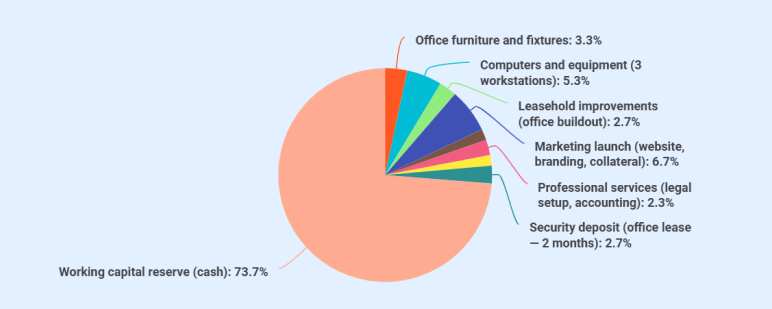
Wanderlux requires $150,000 in total startup capital. $120,000 in SBA 7(a) financing from Community First Bank and $30,000 in owner equity from Nicole and Marcus Pratt.
| Funding source | Amount |
| SBA 7(a) Loan (Community First Bank) | $120,000 |
| Owner equity (Nicole & Marcus Pratt) | $30,000 |
| Total Startup Capital | $150,000 |
The 80/20 debt-to-equity ratio is standard for SBA 7(a) financing. The $110,600 working capital reserve covers approximately six months of operating expenses, providing a sufficient runway through the slower Q1 and Q2 ramp period while Marcus completes his transition to full-time.
Financial Assumptions
| Item | Assumption |
| Average revenue per booking (blended) | $500 |
| Bookings per month | Year 1: 53; Year 2: 64; Year 3: 77 |
| Annual bookings | Year 1: 640; Year 2: 768; Year 3: 922 |
| Year-over-year revenue growth | 20% |
| Revenue mix | Leisure ~54%, Corporate ~28%, Group ~18% |
| Platform & GDS fees | 5% of revenue |
| Direct labor (2 travel advisors) | 25% of revenue (base + commission) |
| Payroll tax rate | 10% (on both direct labor and owner salaries) |
| Owner/admin salaries (annual) | $120,000 ($65,000 Nicole + $55,000 Marcus) |
| Accounts receivable (DSO) | 15 days |
| Accounts payable (DPO) | 0 days (commission model) |
| Inventory days | 0 (service business) |
Income Statement (Profit & Loss)
| Category | Year 1 ($) | Year 2 ($) | Year 3 ($) |
| Bookings (annual) | 640 | 768 | 922 |
| Total Revenue | 320,000 | 384,000 | 460,800 |
| COGS | |||
| Platform & GDS fees (5%) | 16,000 | 19,200 | 23,040 |
| Travel advisor labor (25%) | 80,000 | 96,000 | 115,200 |
| Payroll taxes on advisor labor (10%) | 8,000 | 9,600 | 11,520 |
| Total COGS | 104,000 | 124,800 | 149,760 |
| Gross Profit | 216,000 | 259,200 | 311,040 |
| Gross Margin | 67.5% | 67.5% | 67.5% |
| Operating Expenses | |||
| Owner/admin salaries | 120,000 | 120,000 | 120,000 |
| Payroll taxes on owner salaries (10%) | 12,000 | 12,000 | 12,000 |
| Office rent/lease | 24,000 | 24,000 | 24,000 |
| Insurance (E&O + general liability) | 4,800 | 4,800 | 4,800 |
| Accounting and legal | 6,000 | 6,000 | 6,000 |
| Phone, internet, utilities | 3,600 | 3,600 | 3,600 |
| Ongoing marketing | 18,000 | 18,000 | 18,000 |
| Technology subscriptions (CRM, GDS, website) | 7,200 | 7,200 | 7,200 |
| Office supplies | 2,400 | 2,400 | 2,400 |
| Travel & trade shows (FAM trips) | 6,000 | 6,000 | 6,000 |
| Repairs and maintenance | 1,200 | 1,200 | 1,200 |
| Marketing launch (one-time) | 10,000 | – | – |
| Licenses & permits (one-time) | 2,500 | – | – |
| Professional services setup (one-time) | 3,500 | – | – |
| Total Operating Expenses | 221,200 | 205,200 | 205,200 |
| EBITDA | (5,200) | 54,000 | 105,840 |
| Depreciation | 2,714 | 2,714 | 2,714 |
| EBIT | (7,914) | 51,286 | 103,126 |
| Interest expense | 8,716 | 8,066 | 7,365 |
| Net Income (Pre-Tax) | (16,630) | 43,220 | 95,761 |
Cash Flow Statement
| Category | Year 1 ($) | Year 2 ($) | Year 3 ($) |
| Beginning Cash | 126,600 | 93,556 | 127,833 |
| Operating Activities | |||
| Net income (pre-tax) | (16,630) | 43,220 | 95,761 |
| Depreciation (add back) | 2,714 | 2,714 | 2,714 |
| Change in accounts receivable | (13,151) | (2,630) | (3,156) |
| Change in prepaid expenses | 2,400 | 0 | 0 |
| Net Cash from Operations | (24,667) | 43,304 | 95,319 |
| Investing Activities | |||
| Capital expenditures | 0 | 0 | 0 |
| Net Cash from Investing | 0 | 0 | 0 |
| Financing Activities | |||
| Loan principal repayment | (8,377) | (9,027) | (9,728) |
| Net Cash from Financing | (8,377) | (9,027) | (9,728) |
| Net Change in Cash | (33,044) | 34,277 | 85,591 |
| Ending Cash | 93,556 | 127,833 | 213,424 |
Opening Balance Sheet (at Launch)
| Line Item | Amount ($) |
| ASSETS | |
| Cash (working capital + one-time expense float) | 126,600 |
| Inventory | 0 |
| Prepaid expenses (insurance + security deposit) | 6,400 |
| Gross PP&E (furniture, computers, leasehold) | 17,000 |
| Total Assets | 150,000 |
| LIABILITIES & EQUITY | |
| SBA 7(a) loan (Community First Bank) | 120,000 |
| Owner’s capital — paid-in (Pratt family) | 30,000 |
| Total Liabilities + Equity | 150,000 |
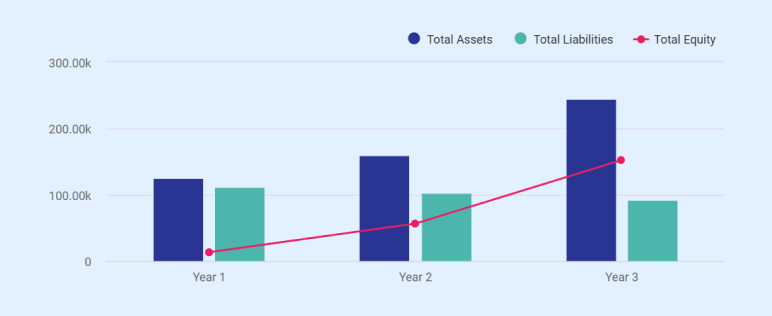
Balance Sheet (Years 1-3)
| Line Item | Year 1 ($) | Year 2 ($) | Year 3 ($) |
| ASSETS | |||
| Cash | 93,556 | 127,833 | 213,424 |
| Accounts receivable | 13,151 | 15,781 | 18,937 |
| Inventory | 0 | 0 | 0 |
| Prepaid expenses & deposits | 4,000 | 4,000 | 4,000 |
| Net PP&E | 14,286 | 11,571 | 8,857 |
| Total Assets | 124,993 | 159,185 | 245,218 |
| LIABILITIES | |||
| Accounts payable | 0 | 0 | 0 |
| SBA 7(a) loan balance | 111,623 | 102,595 | 92,867 |
| Total Liabilities | 111,623 | 102,595 | 92,867 |
| EQUITY | |||
| Paid-in capital | 30,000 | 30,000 | 30,000 |
| Retained earnings | (16,630) | 26,590 | 122,351 |
| Total Equity | 13,370 | 56,590 | 152,351 |
| Total Liabilities + Equity | 124,993 | 159,185 | 245,218 |
Break-Even Analysis
| Item | Value |
| Average revenue per booking (blended) | $500 |
| Platform & GDS fees per booking (5%) | $25 |
| Advisor labor per booking (25%) | $125 |
| Payroll taxes on labor per booking (2.5%) | $12.50 |
| Total variable cost per booking | $162.50 |
| Contribution margin per booking | $337.50 |
| Contribution margin (%) | 67.5% |
| Annual fixed operating costs (Year 2 steady-state) | $205,200 |
| Break-even bookings per year | 608 bookings |
| Break-even bookings per month | 51 bookings |
| Break-even revenue (annual) | $304,000 |
Loan Terms & Repayment Confidence
| Item | Assumption |
| Lender | Community First Bank |
| Loan amount | $120,000 |
| Loan term | 10 years |
| Interest rate | 7.50% fixed (SBA 7(a)) |
| Monthly payment | $1,424 |
| Annual loan payment | $17,093 |
| Interest expense (Yr 1–3) | Yr 1: $8,716; Yr 2: $8,066; Yr 3: $7,365 |
| Principal repayment (Yr 1–3) | Yr 1: $8,377; Yr 2: $9,027; Yr 3: $9,728 |
| Ending loan balance (Yr 1–3) | Yr 1: $111,623; Yr 2: $102,595; Yr 3: $92,867 |
The SBA loan carries a monthly payment of $1,424 at 7.50% fixed over 10 years. Annual debt service totals $17,093.
There are no prepayment penalties on SBA 7(a) loans with terms over 15 years, though at 10 years, a 5% prepayment fee applies in Year 1, declining to 3% in Year 2 and 1% in Year 3.
Year 2 net income of $43,220 covers that payment with a debt service coverage ratio (DSCR) of 2.53x, well above the SBA’s standard 1.25x threshold.
Even if Year 2 net income fell 50% to $21,610, the DSCR would still hold at 1.26x, just above the threshold. The business would need to lose more than half its projected Year 2 profit before loan repayment became a concern.
Year 3 net income of $95,761 produces a DSCR of 5.60x. Wanderlux does not require additional financing at any point in the projection period to meet its debt obligations.
The Quickest Way to turn a Business Idea into a Business Plan
Fill-in-the-blanks and automatic financials make it easy.
